


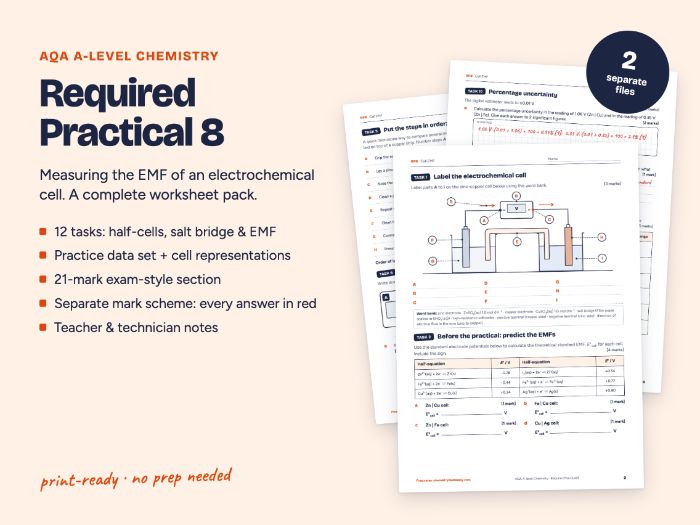
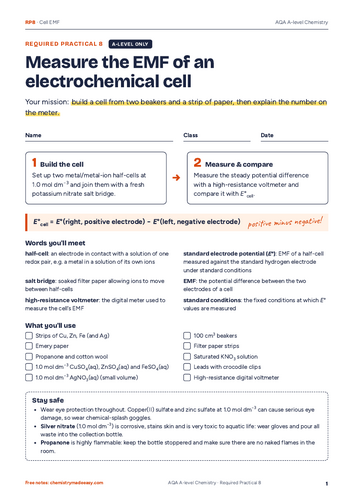
A complete AQA A-level Chemistry Required Practical 8 worksheet: measuring the EMF of an electrochemical cell, with full mark scheme.
Two separate files
- Worksheet (9 pages): the student copy, print-ready in black and white
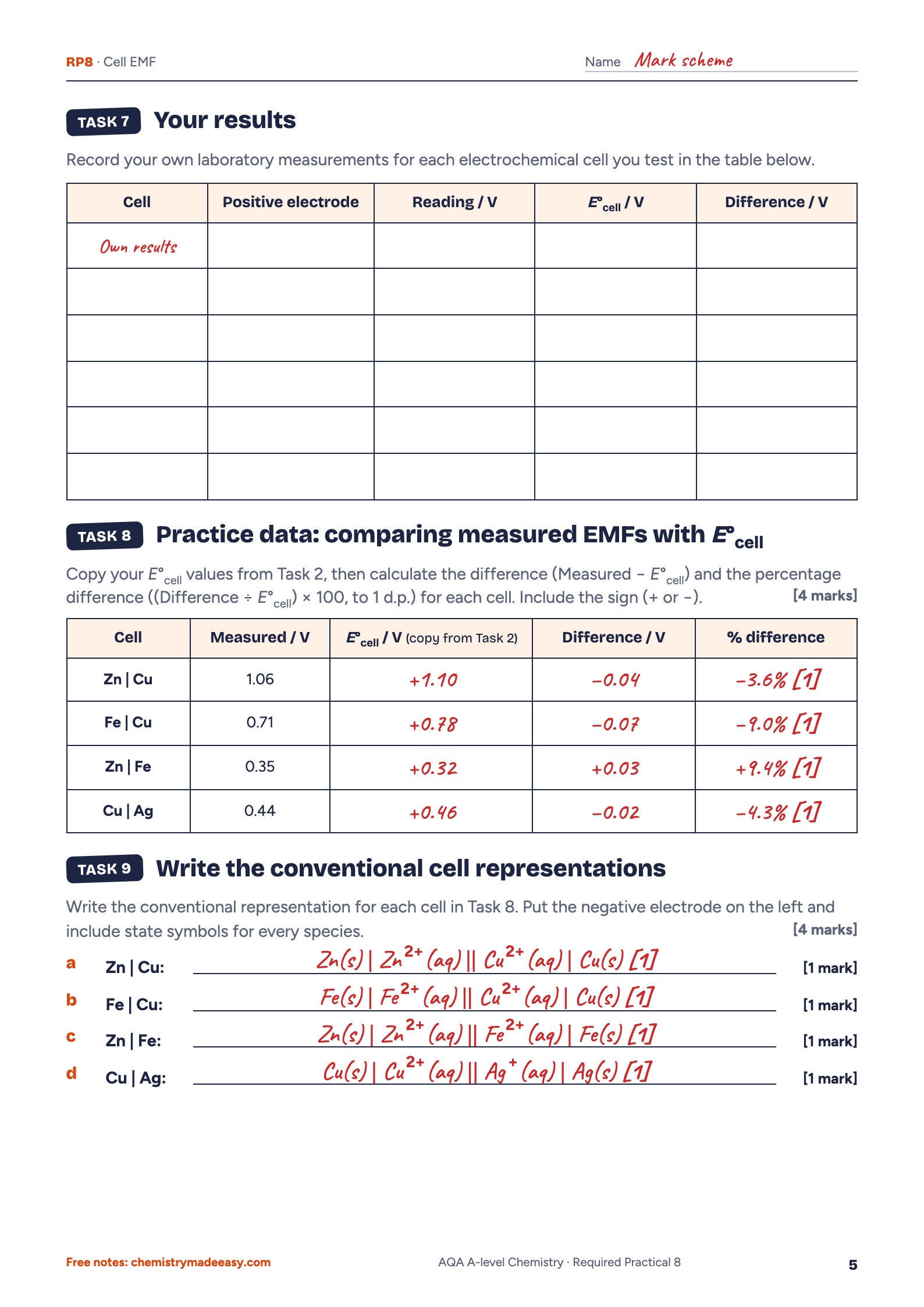
- Mark scheme (11 pages): the same worksheet completed with every answer written in red, with marks shown, plus teacher and technician notes and marking guidance
Use it during the practical, as a follow-up lesson or as homework. Students who miss the lab can still work through a full set of practice results.
What students do
- Label a zinc-copper cell: electrodes, solutions, salt bridge, voltmeter terminals and the direction of electron flow
- Predict the standard EMF of four cells from a table of standard electrode potentials
- Follow the method, with a “why?” prompt for each key step
- Pick the correct set-up and explain the faults in the other two (a copper wire in place of the salt bridge, and a sodium chloride bridge with a silver half-cell)
- Put the steps of a quick filter-paper comparison of metals in order
- Read three digital voltmeters, including a negative reading, and explain what the minus sign means
- Record their own results, or use a practice data set to find the difference and percentage difference from the standard EMF
- Write conventional cell representations with state symbols
- Calculate percentage uncertainty and decide whether a difference is bigger than the meter’s uncertainty
- Decide how six changes or slips affect the measured EMF (bigger, smaller or no change)
- Explain how the potassium nitrate salt bridge works and which way the ions move
- Answer 8 exam-style questions (21 marks), including a Fe3+/Fe2+ half-cell with a platinum electrode, whether Fe3+ oxidises iodide ions, the standard hydrogen electrode, the alkaline hydrogen-oxygen fuel cell, finding an unknown electrode potential and a 6-mark question on ranking three unknown metals by reducing power
- Finish with an “I can” self-check
For teachers
- Quantities per group, options for the silver half-cell, timings, CPAC opportunities and a safety note for every reagent at the concentration used
- Note on the AQA quick-comparison method used in the ordering task
- Common slips to watch for
All questions are original. This is an independent resource, not endorsed by AQA.
Something went wrong, please try again later.
This resource hasn't been reviewed yet
To ensure quality for our reviews, only customers who have purchased this resource can review it
Report this resourceto let us know if it violates our terms and conditions.
Our customer service team will review your report and will be in touch.
£2.00