


AQA A-level Economics lesson on market equilibrium, shortages, surpluses and how price changes move competitive markets towards equilibrium.
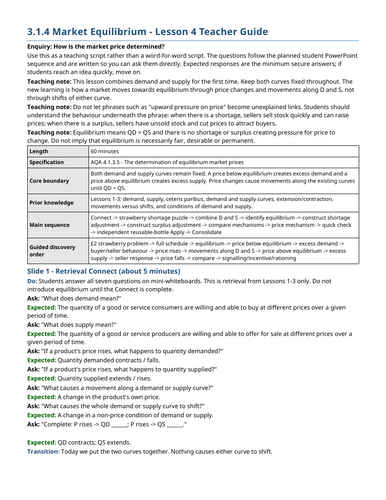
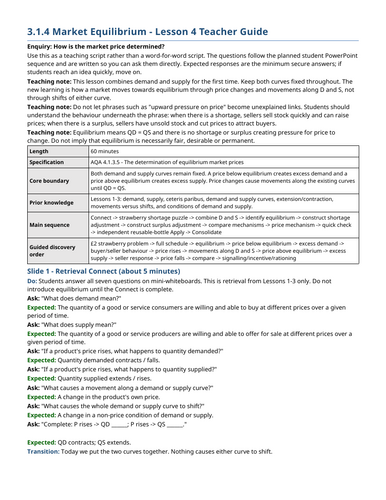
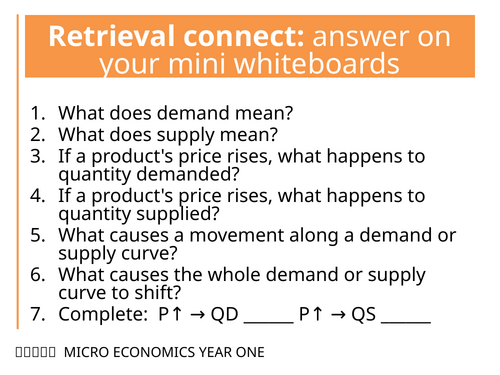
This complete lesson explores the enquiry question: How is the market price determined? It begins with a retrieval Connect on demand and supply before guided questioning uses a strawberry market to help students discover equilibrium price and quantity. Students then work through what happens when price is above or below equilibrium, explain how shortages and surpluses create pressure for prices to change, apply the model independently to the market for reusable water bottles, and finish with a causal-sequencing plenary.
Students learn how to:
identify equilibrium price and quantity from a schedule or diagram;
distinguish excess demand/shortage from excess supply/surplus;
explain why a shortage creates upward pressure on price;
explain why a surplus creates downward pressure on price;
use movements along demand and supply curves to explain market adjustment;
construct a complete causal chain showing how a competitive market moves towards equilibrium.
The lesson uses guided discovery throughout. Students combine demand and supply data for strawberries on one graph, identify the point where QD = QS, and then investigate prices above and below equilibrium. Guided questioning builds the full adjustment mechanism: sellers respond to shortages or unsold stock, price changes, quantity demanded and supplied move along their curves, and the gap narrows until equilibrium is restored.
Students then apply the model independently to reusable water bottles, using a demand and supply schedule to calculate disequilibrium, explain the direction of price change, draw the market and challenge the misconception that unsold goods necessarily mean the demand curve has shifted.
The accompanying teacher guide supports delivery with guided questioning, expected responses and misconception prompts.
This lesson follows Demand, Demand Shifts and Supply and leads directly into Shifts in Market Equilibrium.
Something went wrong, please try again later.
This resource hasn't been reviewed yet
To ensure quality for our reviews, only customers who have purchased this resource can review it
Report this resourceto let us know if it violates our terms and conditions.
Our customer service team will review your report and will be in touch.
£1.00