AQA A-Level PE | Paper 2 COMPLETE MEGA BUNDLE | Factors Affecting Optimal Performance | All 4 Sections
Resource Bundle






This mega bundle brings together every complete lesson pack and student resource for AQA A-Level PE Paper 2: Factors Affecting Optimal Performance in Physical Activity and Sport. All four sections of Paper 2 are covered — 350+ slides across 18+ PowerPoint lesson packs, plus a complete NEA resource pack — built by a specialist PE teacher with 9 years’ AQA sixth-form experience and used across multiple real sixth-form cohorts.
Every resource is structured around AO1 (knowledge), AO2 (application to sport) and AO3 (analysis and evaluation), with embedded tasks, sport-specific examples, exam-style questions and model answers throughout.
WHAT’S INCLUDED — ALL 4 SECTIONS:
SECTION A | Exercise Physiology and Biomechanical Movement (3.2.1–3.2.2)
Nine complete lesson packs covering the full Paper 2 Section A specification:
Exercise Physiology — 3 lesson packs:
• 4.1 — Diet and Nutrition (37 slides): macronutrients, vitamins, minerals, hydration, ergogenic aids (creatine, caffeine, bicarbonate loading, nitrates), athlete-specific application tasks with model answers
• 4.2 — Preparation and Training for Performance (49 slides): training principles (SPORR, FITT), all training methods (aerobic, anaerobic, strength), fitness testing, periodisation, loading strategies, tapering, overtraining, altitude and heat preparation
• 4.3 — Injury Prevention and Rehabilitation (34 slides): injury classification, prevention principles, stretching, three-phase rehabilitation (acute, sub-acute, return-to-play), cryotherapy, sports massage, electrotherapy, 15-mark extended writing scaffold
Biomechanical Movement — 6 lesson packs:
• 5.1 — Biomechanical Principles (20 slides): Newton’s three laws (inertia, acceleration F=ma, action/reaction), scalars, centre of mass, four factors affecting stability
• 5.2 — Levers in Sport (18 slides): three classes of lever, body examples, mechanical advantage and disadvantage, why Class 3 dominates sport
• 5.3 — Linear Motion (21 slides): forces (gravity, friction, air resistance, muscular), vectors and scalars, momentum (p=mv), impulse (F×t=Δmv), force-time graphs, sprinting application
• 5.4 — Angular Motion (18 slides): Newton’s laws applied to rotation, angular displacement/velocity/acceleration, moment of inertia, conservation of angular momentum (L=Iω), gymnastics and diving application
• 5.5 — Projectile Motion (19 slides): horizontal displacement factors, shot put vs shuttlecock flight paths, vector components of parabolic flight, worked calculations
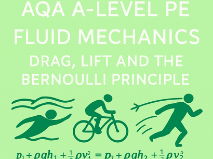
• 5.6 — Fluid Mechanics: Drag and Lift (19 slides): drag factors, streamlining, Bernoulli principle, upward lift (discus) and downforce (cycling, racing cars, speed skiing)
SECTION B | Sport Psychology (3.2.3)
Seven complete lesson packs covering the full Paper 2 Section B specification:
• 6.1–6.5 — Personality, Attitudes and Aggression (21 slides): trait theory, social learning, interactionist perspective (Hollander, Lewin), triadic model of attitudes, cognitive dissonance, sportsmanship, gamesmanship, four theories of aggression, control strategies
• 6.3–6.4 — Arousal, Anxiety and Peak Flow (17 slides): drive theory, inverted U, catastrophe theory, zone of optimal functioning, peak flow, somatic and cognitive anxiety, CSAI-2 measurement
• 6.6–6.7 — Motivation and Achievement Motivation (17 slides): intrinsic/extrinsic motivation, over-justification effect, Atkinson’s Nach/Naf model, achievement goal theory (task vs outcome orientation), mastery climate strategies
• 6.8–6.9 — Social Facilitation and Group Dynamics (17 slides): Zajonc’s model, evaluation apprehension, Tuckman’s group formation stages, task and social cohesion, Steiner’s model, Ringelmann effect, social loafing
• 6.10–6.11 — Goal Setting and Attribution Theory (18 slides): outcome/performance/process goals, SMARTER principles, Weiner’s attribution model, self-serving bias, learned helplessness, attribution retraining
• 6.12–6.13 — Self-Efficacy, Confidence and Leadership (18 slides): Bandura’s four sources of efficacy, Vealey’s confidence model, autocratic/democratic/laissez-faire leadership, Fiedler’s contingency theory, Chelladurai’s multi-dimensional model
• 6.14 — Stress Management in Sport (20 slides): all cognitive techniques (mental rehearsal, visualisation, imagery, thought stopping, positive self-talk, attentional control), all somatic techniques (biofeedback, centering, breathing control, PMR), direct comparison and programme design
SECTION C | Sport and Society and the Role of Technology (3.2.4)
Four complete lesson packs covering the full Paper 2 Section C specification:
• 7.1–7.2 — Concepts of Physical Activity and Elite Performer Pathways (27 slides): physical recreation, PE, school sport and sport defined; sporting development continuum; talent identification and development; UK Sport WCPP, Gold Event Series, ‘From Home 2 The Games’; GPS, VAR, Hawk-Eye, analytics platforms; technology in sport AO3 evaluation
• 7.3–7.4 — Ethics and Violence in Sport (26 slides): amateurism, Olympic Oath, sportsmanship, gamesmanship, win ethic, positive and negative deviance; performer and spectator violence causes; all prevention strategies evaluated (all-seater stadia, banning orders, CCTV, TMO)
• 7.5 — Drugs in Sport (20 slides): anabolic steroids, EPO and beta blockers — mechanism, performance effects, health risks and sport examples for each; UKAD and WADA roles; biological passport; anti-doping strategies evaluated
• 7.6–7.7 — Sport and the Law and Commercialisation and Media (24 slides): duty of care, negligence, contracts; Hillsborough, Heysel, Bosman and Allport v Wilbraham case studies; the golden triangle; full stakeholder analysis (sponsors, sport, performers, spectators, officials) with AO3 judgement
PERFECT FOR:
• Year 12 and Year 13 AQA A-Level PE lessons and revision across the full Paper 2 specification
• Departments buying a complete, ready-to-teach Paper 2 unit — no further preparation required
• Individual teachers wanting every Paper 2 lesson pack and NEA resource in one purchase
WHY BUY FROM PEAK PE RESOURCES?
Every resource is aligned precisely to the AQA specification and mark scheme descriptors, with sport examples drawn from real exam questions across all topic areas. The complete Paper 2 series — every section, every lesson pack, every student resource — delivered in one bundle.
Keywords: AQA A-Level PE, Paper 2, mega bundle, exercise physiology, biomechanics, sport psychology, sport and society, NEA, non-exam assessment, factors affecting optimal performance, complete lesson pack, A Level PE resources, Year 12 PE, Year 13 PE, AQA PE revision, AQA 7582, Section A, Section B, Section C, Section D
Something went wrong, please try again later.
The lesson resources are good and detailed. However, Section D, the NEA resources are missing, which were listed as part of the bundle. Please advise.
Report this resourceto let us know if it violates our terms and conditions.
Our customer service team will review your report and will be in touch.