


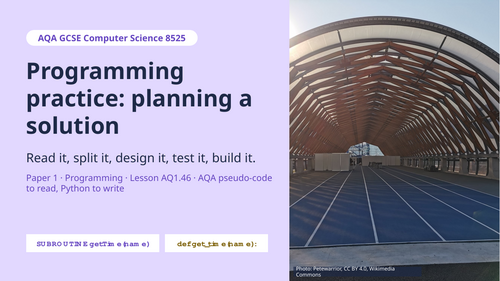
Programming practice: planning a solution lesson for AQA GCSE Computer Science (8525), with editable PowerPoint slides, a student worksheet and full answers. Students practise planning a program before coding it, using decomposition, pseudo-code and test data to design a solution.
Written for Paper 1 Computational thinking and programming skills, section 3.1 Fundamentals of algorithms (spec 3.1.1.2, 3.1.1.4, 3.2.10.7). Everything is editable, so you can adapt it to your class.
What’s included- PowerPoint lesson (37 slides) with teacher notes on every slide and about 10 activities with click-to-reveal answers
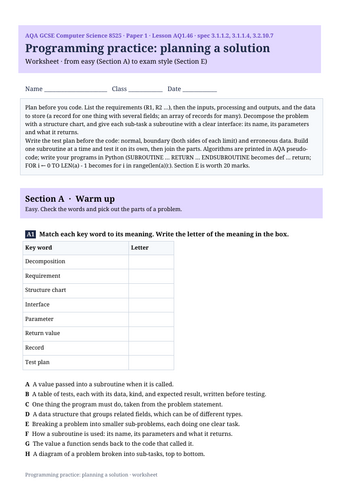
- Student worksheet (Word), from easy warm-ups to a 20-mark exam-style section
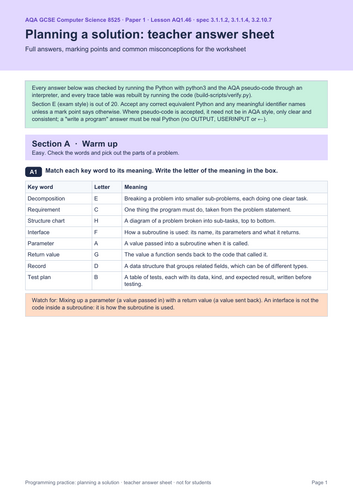
- Teacher answer sheet (PDF) with full answers, AQA-style marking points and common mistakes
By the end of the lesson students can:
- Follow a systematic approach from a problem statement to tested code
- Decompose a problem into subroutines with clear interfaces
- Write parts of the design as a flowchart, AQA pseudo-code and Python
Worksheet sections: A (warm up) to E (exam style, 20 marks)
Every lesson includes- Learning goals and a starter question
- Clear explanations, diagrams and worked examples (Python 3 throughout, with AQA pseudo-code alongside so students can read exam algorithms)
- A quick check and a “your turn” task linked to the worksheet
- Exam-style questions with marks, and an exit ticket
- PowerPoint (.pptx) and Word (.docx), fully editable; answers as PDF
- Works in PowerPoint and Google Slides
- Bright, clear GCSE design, consistent across the whole course
These are independent resources written for the AQA GCSE Computer Science specification (8525, version 1.3), for exams from 2027. They are not produced or endorsed by AQA. Spec point numbers are our own numbering of the specification statements.
More lessons in this series- Previous lesson: Programming practice: search and sort – AQA GCSE Computer Science
- Next lesson: Programming practice: a quiz game – AQA GCSE Computer Science
- Save with the bundle: Fundamentals of algorithms – AQA GCSE CS (14 lessons)
Last updated: November 2026.
Something went wrong, please try again later.
This resource hasn't been reviewed yet
To ensure quality for our reviews, only customers who have purchased this resource can review it
Report this resourceto let us know if it violates our terms and conditions.
Our customer service team will review your report and will be in touch.
£3.00