


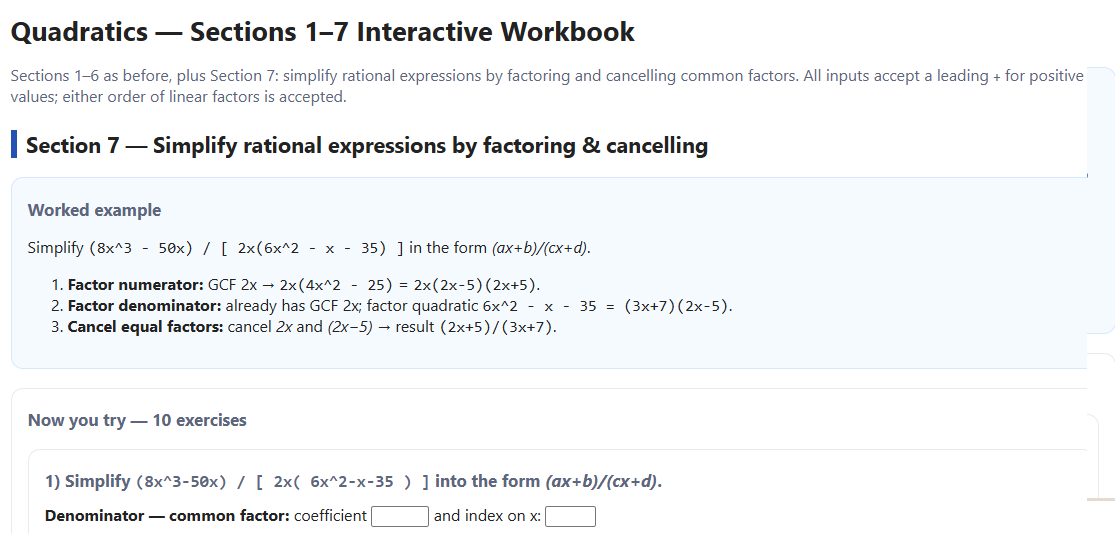
What’s inside
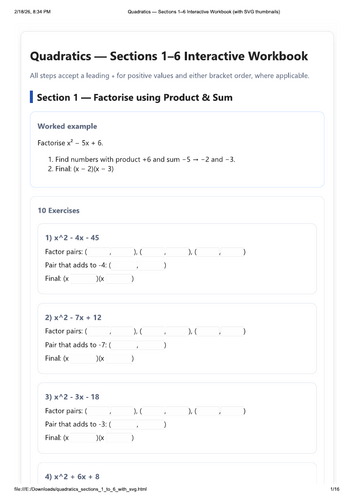
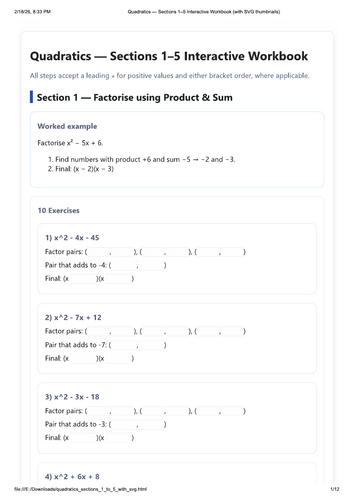
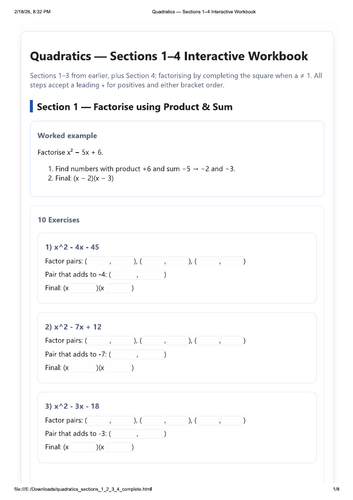
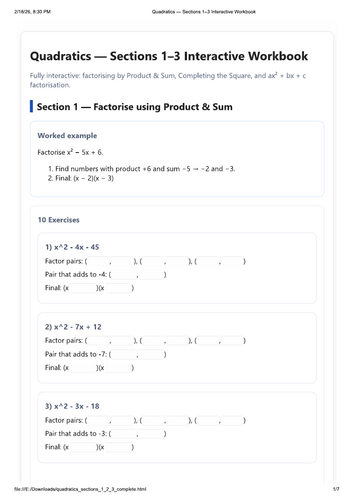
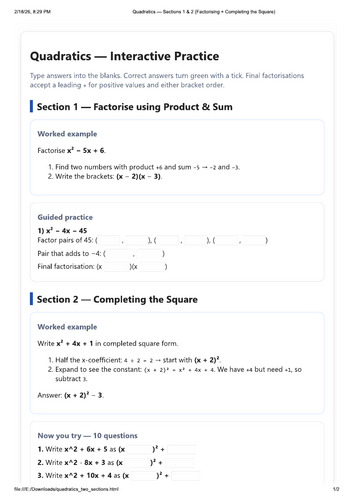
Section 1 — Product & Sum (10 Qs)
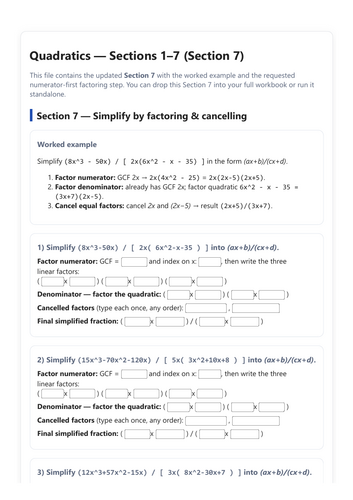
Factor pairs → sum pair → final brackets. ✔ / ✖ feedback.
Section 2 — Completing the Square (10 Qs)
Fill (x+h)2+k(x+h)^2+k(x+h)2+k and, when possible, factor the difference of squares.
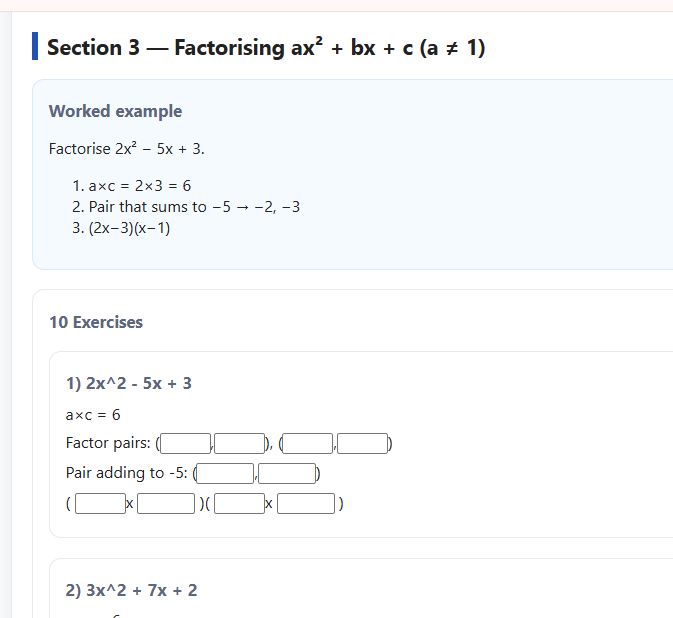
Section 3 — Factorising with a≠1a\neq1a=1 (10 Qs)
AC‑method scaffold: factor pairs of acacac, sum to bbb, final (ax+p)(cx+q)(ax+p)(cx+q)(ax+p)(cx+q).
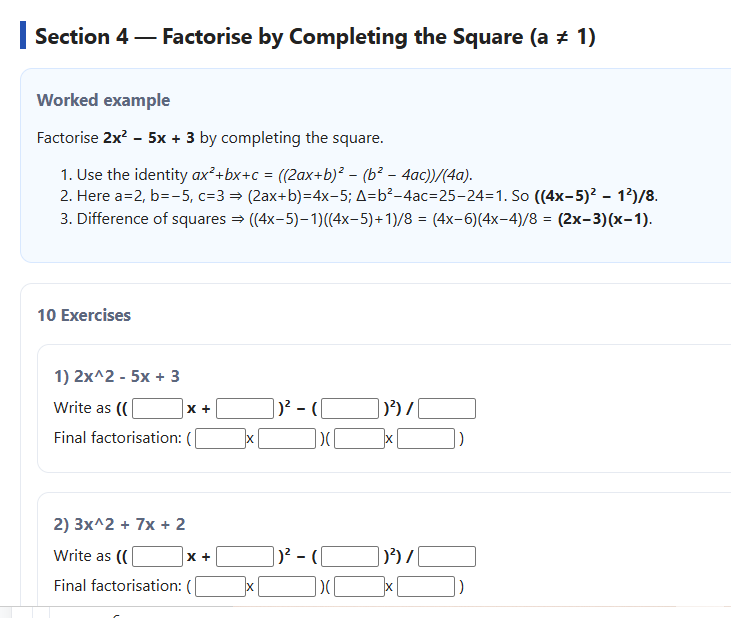
Section 4 — Factorise by Completing the Square (a ≠ 1) (10 Qs)
Fill ((2ax+b)2−D2)/(4a)\big((2ax+b)^2 - D^2\big)/(4a)((2ax+b)2−D2)/(4a) then final factorisation.
Unified styling, instant marking, accepts + for positives and either bracket order.What Section 5 includes
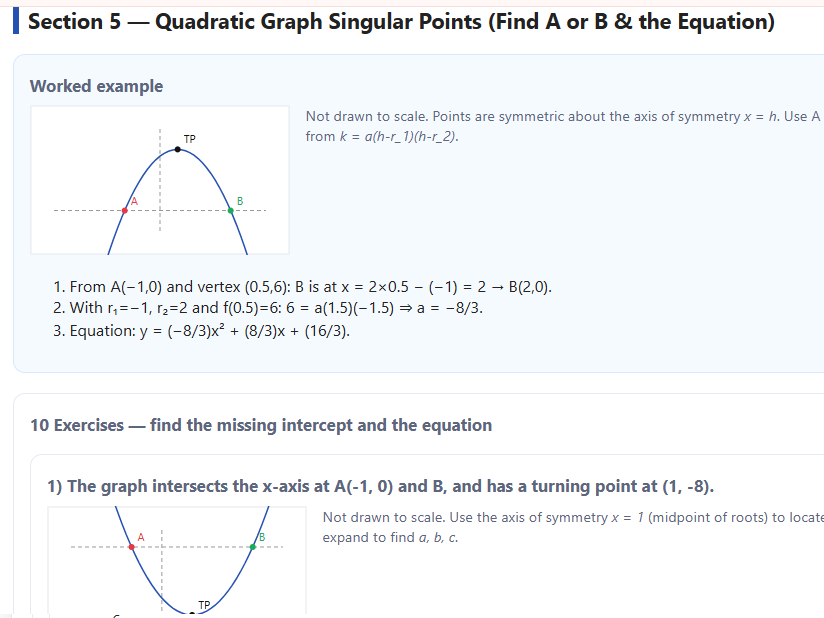
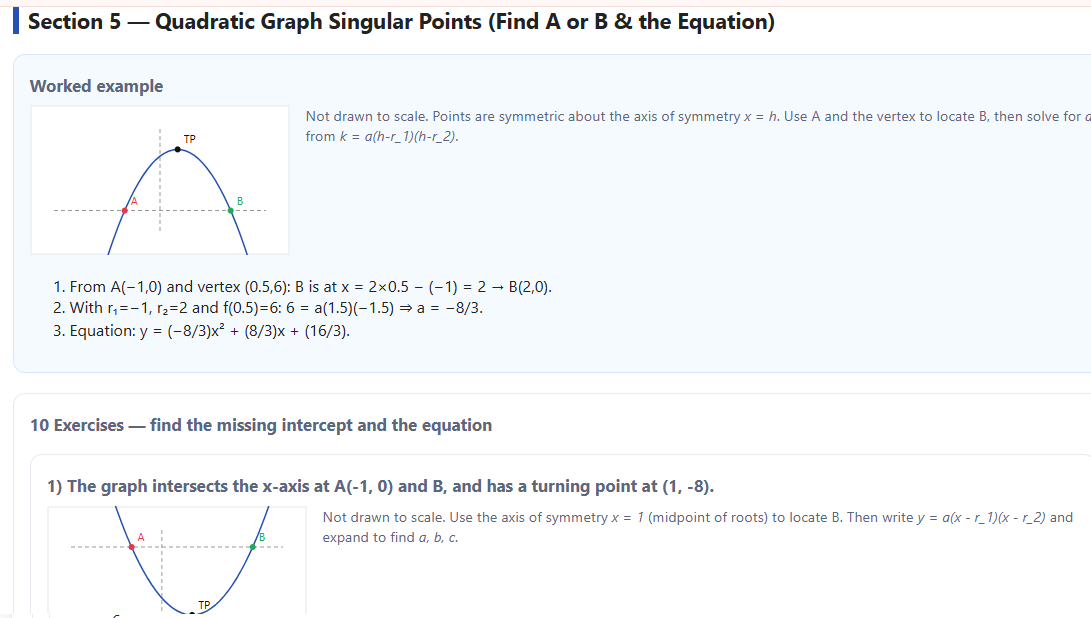
Worked example (matches your screenshot’s style):
Given A(−1,0)A(-1,0)A(−1,0) and turning point (0.5,6)(0.5, 6)(0.5,6), it finds B(2,0)B(2,0)B(2,0).
Then it determines aaa from k=a(h−r1)(h−r2)k=a(h-r_1)(h-r_2)k=a(h−r1)(h−r2) and expands to the standard form.
10 exercises with integer-friendly coefficients:
Each card displays the known intercept (either AAA or BBB) and the turning point.
Students fill:
The missing point ( , __ )(,__,,__,)(,__) — the y‑coordinate must be 0.
The equation y=_ x2+_ x+_y = _,x^2 + _,x + _y=_x2+x+.
Answers accept + for positive entries; ticks turn on when correct; same green/red marking as your other sections.What Section 6 teaches
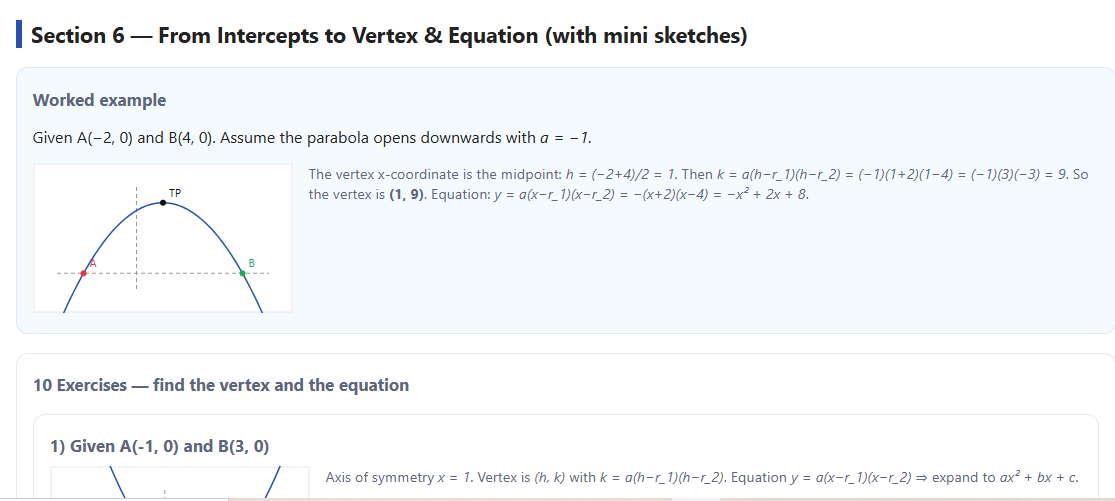
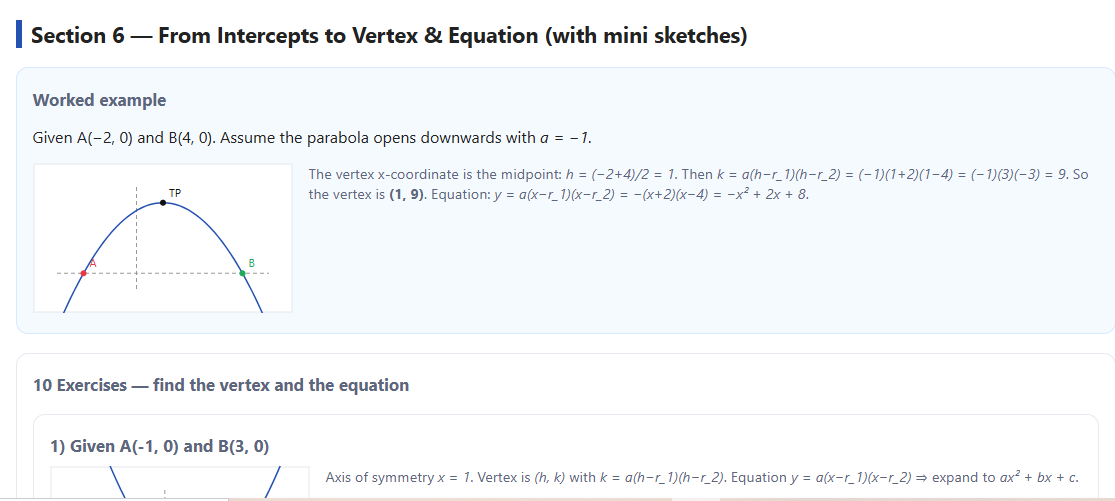
Vertex from intercepts: h=r1+r22h = \dfrac{r_1 + r_2}{2}h=2r1+r2 (axis of symmetry), and k=a(h−r1)(h−r2)k = a(h-r_1)(h-r_2)k=a(h−r1)(h−r2).
Equation from intercepts: y=a(x−r1)(x−r2)y = a(x-r_1)(x-r_2)y=a(x−r1)(x−r2) → expand to ax2+bx+cax^2 + bx + cax2+bx+c, with
b=−a(r1+r2)b = -a(r_1+r_2)b=−a(r1+r2), c=a(r1r2)c = a(r_1r_2)c=a(r1r2).
Inputs are auto‑checked with ✔/✖; numbers can be integers or decimals (e.g. 1.5, 9, −4.5).
The SVG thumbnails are not to scale but do show opening direction and the relative placement of A, B, and the turning point.
Something went wrong, please try again later.
This resource hasn't been reviewed yet
To ensure quality for our reviews, only customers who have purchased this resource can review it
Report this resourceto let us know if it violates our terms and conditions.
Our customer service team will review your report and will be in touch.
£2.00