


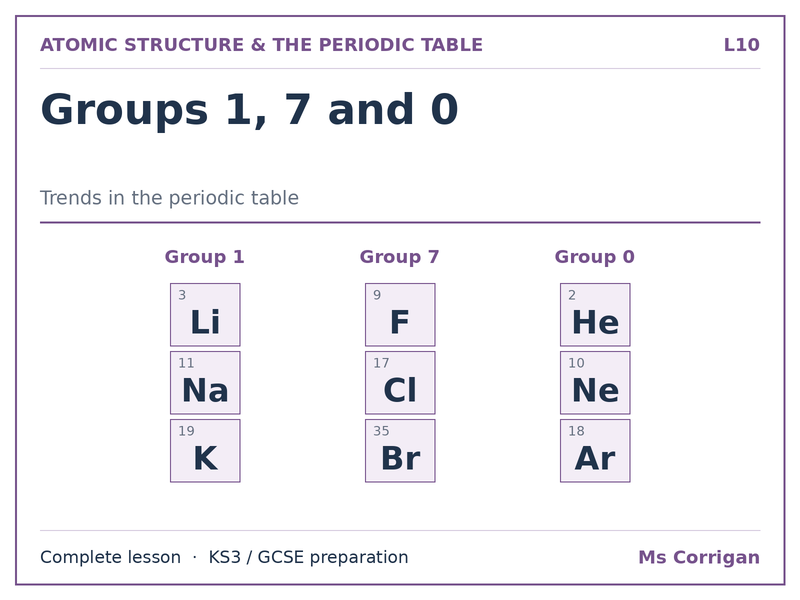

Created by an experienced Head of Science, this fully resourced, editable 55-minute chemistry lesson explores the properties and trends of Group 1 (alkali metals), Group 7 (halogens) and Group 0 (noble gases), linking electronic structure to chemical behaviour and reactivity.
Designed for KS3 and GCSE preparation, the lesson incorporates evidence-informed teaching strategies, scaffolded learning and stretch opportunities for mixed-ability classes. It has been developed with both specialist and non-specialist science teachers in mind.
Learning objectives:
- Describe the characteristic physical and chemical properties of Groups 1, 7 and 0.
- Explain how electronic structure determines the chemical properties of elements within a group.
- Describe and explain the trend in reactivity down Group 1.
- Describe and explain the trend in reactivity down Group 7.
- Predict the properties and reactions of unfamiliar elements using periodic trends.
- Explain the low reactivity of noble gases in terms of their electronic structure.
- Interpret experimental observations and construct scientific explanations.
What’s included:
- Editable PowerPoint with detailed teacher guidance in the notes section of every slide.
- First, Next, Then (FNT) retrieval starter.
- Clear scientific definitions and illustrated explanations.
- Electronic structure diagrams supporting explanations of periodic trends.
- Mini-whiteboard activities and diagnostic assessment.
- Thinking Hard activities with green feedback slides.
- Collaborative activities developing prediction, pattern recognition and scientific reasoning.
- Student recording sheet and corresponding answers.
- Independent consolidation and stretch activities.
- Practical demonstration and video alternatives.
- Women in Science feature exploring Marguerite Perey’s discovery of francium.
- Cross-curricular connections with physics and mathematics.
- Real-world applications and interesting scientific facts.
- A little humour from Science Doggo!
- Formative assessment opportunities.
- Teacher delivery and resource preparation guidance.
Carefully designed to address common misconceptions, particularly the opposing reactivity trends of Groups 1 and 7, whilst encouraging students to move beyond factual recall and develop detailed scientific explanations.
As the final lesson in the unit, it draws together students’ understanding of atomic structure, electronic configuration and the organisation of the periodic table, providing a strong foundation for subsequent GCSE Chemistry learning.
Part of a complete 10-lesson teaching unit
This lesson is also available as part of my complete Atomic Structure and the Periodic Table teaching unit, which includes ten fully resourced lessons, a comprehensive scheme of work, animations, assessments, teacher guidance and technician preparation resources.
View the complete unit here:
https://www.tes.com/teaching-resource/-13699763
Something went wrong, please try again later.
This resource hasn't been reviewed yet
To ensure quality for our reviews, only customers who have purchased this resource can review it
Report this resourceto let us know if it violates our terms and conditions.
Our customer service team will review your report and will be in touch.
£3.49