


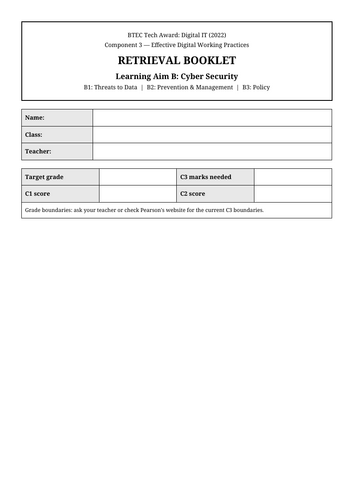
A retrieval practice starter booklet for Learning Aim B: Cyber Security in the BTEC Tech Award Digital Information Technology (2022) Component 3 external exam.
Designed as a 5–10 minute classroom starter for Y11 students in the run-up to the Component 3 exam. Built around retrieval practice — students test themselves before seeing the answers. The knowledge organiser is a checking tool, not a starting point.
Want to try before you buy? The Learning Aim A retrieval booklet is available free here: https://www.tes.com/teaching-resource/-13506135
What’s included:
20-question retrieval quiz — students write from memory with no notes available
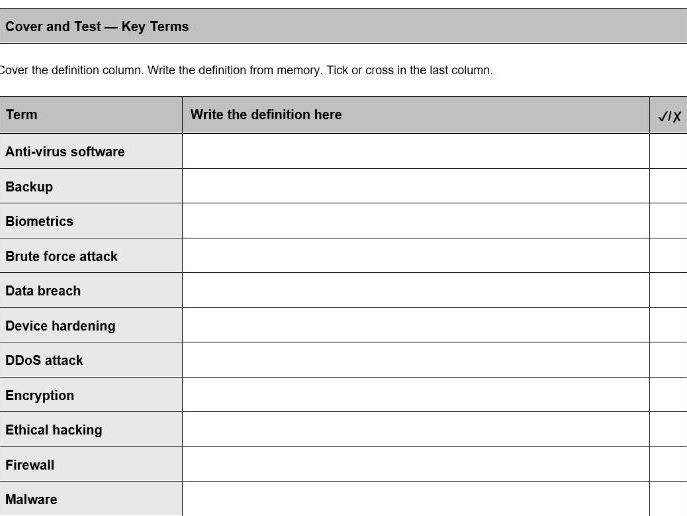
Cover and test key terms activity — blank write column, tick/cross self-marking
Knowledge organiser covering B1, B2 and B3 topics in plain, student-friendly language
12 real exam practice questions from the May 2024 and January 2025 papers, clearly labelled by series
Model answers with examiner commentary for every question
All answers at the back — quiz answers and key term definitions grouped together so students work first
Topics covered:
Why systems are attacked (financial gain, espionage, disruption, personal attacks, fun/challenge)
External threats: hacking, malware (virus, worm, ransomware, spyware, Trojan), phishing, pharming, social engineering, shoulder surfing, man-in-the-middle, DoS/DDoS
Internal threats: unintentional disclosure, intentional theft/leaking, portable storage devices, visiting untrustworthy websites, overriding security controls
Impacts of a security breach: data loss, reputational damage, financial loss, legal action, downtime
User access restriction: physical locks, passwords, biometrics, access levels, two-factor authentication
Data level protection: firewall, anti-virus software, encryption, device hardening, backup and recovery
Finding weaknesses: ethical hacking, penetration testing
Actions after an attack: investigate, manage
Security policy, acceptable use policy, disaster recovery policy
Exam questions included (real papers):
May 2024: Q1a (two other impacts of a data breach), Q1b (one other way to ensure a strong password), Q1c (how two-factor authentication checks identity), Q3a (one way software can protect data), Q3b (two ways to monitor staff computer use)
Jan 2025: Q1b (benefit of biometrics for restricting access), Q1c (one level of permitted access), Q1d (one way a firewall protects systems), Q1e (two ways anti-virus software protects data), Q3a (action when receiving a suspicious email), Q3b (two acceptable behaviours under an AUP), Q3c (two reasons for penetration testing)
Suitable for: BTEC Tech Award in Digital Information Technology (2022) — Component 3 only. Not suitable for the legacy specification.
Format: Microsoft Word (.docx) — fully editable so you can adapt for your students.
Something went wrong, please try again later.
This resource hasn't been reviewed yet
To ensure quality for our reviews, only customers who have purchased this resource can review it
Report this resourceto let us know if it violates our terms and conditions.
Our customer service team will review your report and will be in touch.
£2.00