


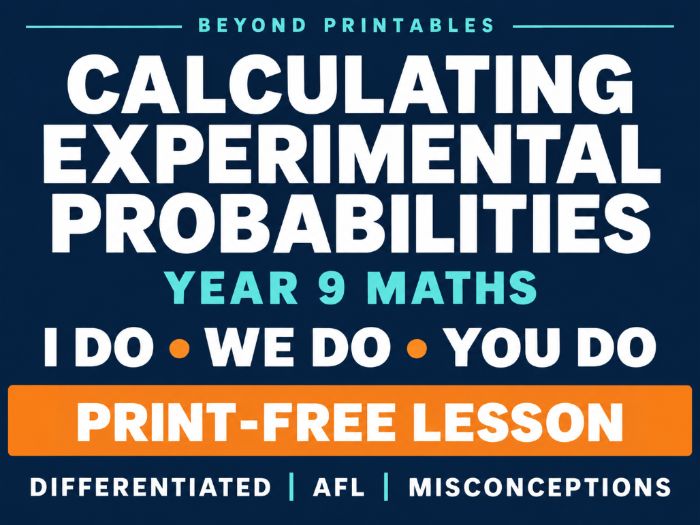
Teach calculating experimental probabilities with a complete, print-free Year 9 maths lesson built around I Do, We Do, You Do. Pupils use observed results to estimate probabilities, find complementary probabilities, combine batches correctly and explain how sample size and bias affect reliability. Display the editable PowerPoint and teach directly from the screen, with no printed worksheets required.
WHAT IS INCLUDED?
A 77-slide editable PowerPoint with a six-question retrieval starter, prerequisite checks, key vocabulary, method explanations, matched modelling, guided practice, individual AFL, differentiated independent work, worked answers, exam-style questions and exit checks. Numerical fractions use clear stacked notation.
I DO, WE DO, YOU DO
Three matched modelling pairs build from estimating one probability to finding an event and its complement, then pooling results from two batches. I Do 1 matches We Do 4, 2 matches 5, and 3 matches 6. Corresponding answer slides keep each pair together. Space beneath the modelling questions supports live teacher working and guided discussion before pupils practise independently.
PRINT-FREE CLASSROOM TEACHING
Pupils record calculations and explanations in exercise books or on mini-whiteboards. The displayed tasks provide the information needed for each activity. Use the questions for whole-class teaching, targeted support or revision.
DIFFERENTIATION WITH PURPOSE
Eight Developing questions ask for both success and failure probabilities. Eight Secure questions explore pooled estimates, missing success counts, missing trial totals, reliability and experimental design. Five Greater Depth questions extend to reverse reasoning, trial ratios, possible sample sizes and the effect of extra failures. The single-slide whole-class task also includes a Super Challenge comparing two spinners, asking pupils to distinguish evidence of possible bias from proof.
AFL AND MISCONCEPTIONS
Twenty-two individual AFL questions are each followed immediately by a solution slide. Check whether pupils divide by the total number of trials, pool raw counts instead of averaging unequal batches, and understand that an experimental estimate can vary. Questions also challenge the belief that an event is impossible because it did not occur, or that a larger sample automatically removes bias.
PRACTICE AND FEEDBACK
Twenty minimally different questions build fluency in success and failure probabilities and combined estimates. Worked answers support feedback, while exam-style questions and three exit checks help assess what pupils can calculate and explain independently. Pupils meet numerical data, a frequency table and comparisons with theoretical probability.
Beyond Printables: print-free teaching, purposeful differentiation, regular AFL and explicit attention to misconceptions. Suitable for KS3 teaching and GCSE revision.
Something went wrong, please try again later.
This resource hasn't been reviewed yet
To ensure quality for our reviews, only customers who have purchased this resource can review it
Report this resourceto let us know if it violates our terms and conditions.
Our customer service team will review your report and will be in touch.
£3.00