


Reverse Polish notation lesson for Cambridge International AS & A Level Computer Science (9618), with editable PowerPoint slides, a student worksheet and full answers. Reverse Polish notation writes operators after their operands so no brackets are needed; students convert expressions and evaluate them with a stack.
Written for Paper 3 Advanced Theory, section 16 System software (syllabus 16.2.4). Everything is editable, so you can adapt it to your class.
What’s included- PowerPoint lesson (15 slides) with teacher notes on every slide
- Student worksheet (Word), ready to print or edit
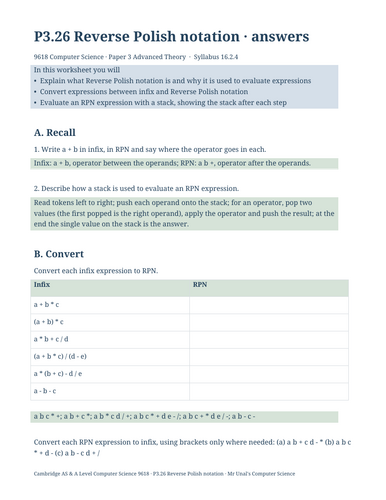
- Answer sheet (Word) with mark-scheme style answers for every question
By the end of the lesson students can:
- Explain what Reverse Polish notation is and why it is used to evaluate expressions
- Convert expressions between infix and Reverse Polish notation
- Evaluate an RPN expression with a stack, showing the stack after each step
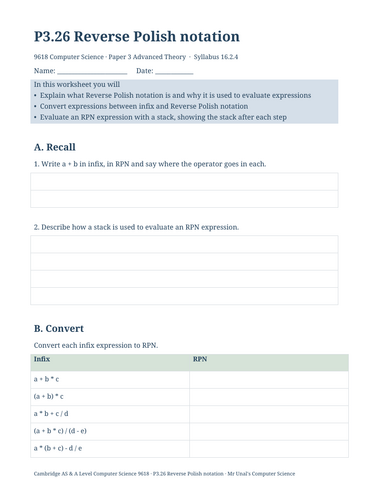
Worksheet sections: A. Recall; B. Convert; C. Evaluate with a stack; D. Exam-style questions; E. Challenge
Every lesson includes- Learning goals and a starter question
- Clear explanations, diagrams and worked examples (Cambridge pseudocode, as in the 2027–2029 pseudocode guide, with Python alongside)
- A quick check and a “your turn” task linked to the worksheet
- Exam-style questions with marks, and an exit ticket
- PowerPoint (.pptx) and Word (.docx), fully editable
- Works in PowerPoint and Google Slides
- Calm, muted sixth-form design, consistent across the whole course
These are independent resources written for the Cambridge International AS & A Level Computer Science syllabus (9618) for examination in 2027, 2028 and 2029. They are not produced or endorsed by Cambridge University Press & Assessment. Syllabus point numbers are our own numbering of the syllabus statements.
More lessons in this series- Previous lesson: BNF and syntax diagrams – A Level Computer Science 9618 lesson
- Next lesson: Symmetric and asymmetric encryption – A Level CS 9618 lesson
- Save with the bundle: System software – A Level Computer Science 9618 (7 lessons)
Last updated: November 2026.
Get this resource as part of a bundle and save up to 36%
A bundle is a package of resources grouped together to teach a particular topic, or a series of lessons, in one place.
Bundle
Paper 3 Part 2 – A Level Computer Science 9618 (14 lessons)
14 ready-to-teach lessons for Cambridge International AS & A Level Computer Science (9618): Paper 3 Part 2. Every lesson has editable PowerPoint slides, a student worksheet and full answers, and the bundle costs less than buying the lessons one by one. A ready-to-teach bundle for Cambridge International AS & A Level Computer Science (9618): Paper 3 Advanced Theory, part 2, lessons P3.21 to P3.34. Every lesson comes with: - **Editable PowerPoint slides**: goals, starter, explanations, diagrams, worked examples, a quick check, a task and an exit ticket, with teacher notes - **Student worksheet (Word)**: recall, applied practice and exam-style questions with marks - **Answer sheet (Word)**: full mark-scheme style answers Worth £69.86 if bought lesson by lesson. ## What's inside **Section 16 System software** - P3.21 Processes, states and the kernel - P3.22 Scheduling algorithms - P3.23 Virtual memory, paging and segmentation - P3.24 Interpreters and compiler stages - P3.25 BNF and syntax diagrams - P3.26 Reverse Polish notation **Section 17 Security** - P3.27 Symmetric and asymmetric encryption - P3.28 Quantum cryptography and TLS - P3.29 Digital certificates and signatures **Section 18 Artificial intelligence** - P3.30 Graphs and Dijkstra's algorithm - P3.31 A* search - P3.32 Neural networks and machine learning - P3.33 Deep and reinforcement learning - P3.34 Back propagation and regression ## Why teachers use it - Mapped lesson by lesson to the syllabus, so coverage is easy to track - Cambridge pseudocode, as in the 2027–2029 pseudocode guide, with Python alongside - Fully editable: adapt to your class, timings and school template These are independent resources written for the Cambridge International AS & A Level Computer Science syllabus (9618) for examination in 2027, 2028 and 2029. They are not produced or endorsed by Cambridge University Press & Assessment. Syllabus point numbers are our own numbering of the syllabus statements. Last updated: November 2026.
£26.99
Bundle
System software – A Level Computer Science 9618 (7 lessons)
7 ready-to-teach lessons for Cambridge International AS & A Level Computer Science (9618): System software. Every lesson has editable PowerPoint slides, a student worksheet and full answers, and the bundle costs less than buying the lessons one by one. A complete, ready-to-teach bundle for Cambridge International AS & A Level Computer Science (9618): Section 16 System software, in 7 bespoke lessons. Every lesson comes with: - **Editable PowerPoint slides**: goals, starter, explanations, diagrams, worked examples, a quick check, a task and an exit ticket, with teacher notes - **Student worksheet (Word)**: recall, applied practice and exam-style questions with marks - **Answer sheet (Word)**: full mark-scheme style answers Worth £34.93 if bought lesson by lesson. ## What's inside - **P3.20** The OS as resource manager - **P3.21** Processes, states and the kernel - **P3.22** Scheduling algorithms - **P3.23** Virtual memory, paging and segmentation - **P3.24** Interpreters and compiler stages - **P3.25** BNF and syntax diagrams - **P3.26** Reverse Polish notation ## Why teachers use it - Mapped lesson by lesson to the syllabus, so coverage is easy to track - Cambridge pseudocode, as in the 2027–2029 pseudocode guide, with Python alongside - Fully editable: adapt to your class, timings and school template - Works for teaching, revision, cover lessons and homework These are independent resources written for the Cambridge International AS & A Level Computer Science syllabus (9618) for examination in 2027, 2028 and 2029. They are not produced or endorsed by Cambridge University Press & Assessment. Syllabus point numbers are our own numbering of the syllabus statements. Last updated: November 2026.
£14.99
Something went wrong, please try again later.
This resource hasn't been reviewed yet
To ensure quality for our reviews, only customers who have purchased this resource can review it
Report this resourceto let us know if it violates our terms and conditions.
Our customer service team will review your report and will be in touch.
£3.00