


This Year 7 Science lesson brings together pupils’ learning from the full Separation Techniques unit. After studying filtration, crystallisation, simple distillation and chromatography, students now compare all four methods to understand when and why each technique is used. The lesson strengthens scientific reasoning, reinforces key vocabulary and helps pupils apply their knowledge to real‑world scenarios.
Learners review the purpose of each technique, match methods to different types of mixtures, and explain the scientific principles behind them. They compare similarities and differences, such as changes of state, solubility and particle size. Pupils then apply their understanding to problem‑solving tasks, selecting the most appropriate technique for a given mixture and justifying their choice using scientific language.
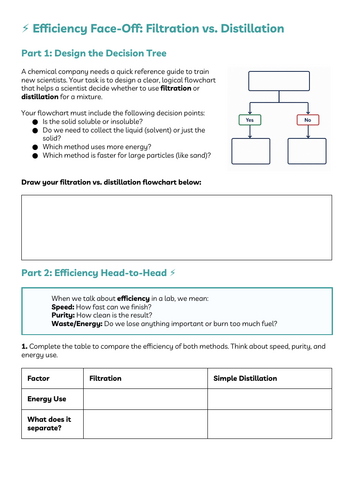
A fully editable PPT and worksheet are included, supporting retrieval, comparison and extended explanation.
Learning Objective:
To compare filtration, crystallisation, distillation and chromatography and apply them to real‑world scenarios.
Success Criteria:
- Match each technique to the type of mixture it separates.
- Explain the key differences between the four methods.
- Select the correct technique for a given scenario and justify the choice.
Something went wrong, please try again later.
This resource hasn't been reviewed yet
To ensure quality for our reviews, only customers who have purchased this resource can review it
Report this resourceto let us know if it violates our terms and conditions.
Our customer service team will review your report and will be in touch.
£2.00