


We hope these guide series help you plan your review/revision work. These are concise and precisely aligned with the updated syllabus. Many teachers have collaborated in making of these guides. If they are useful in your teaching, please consider leaving a review. It would truly be helpful for us to improve on the process of making. You can also explore other guides at the store.
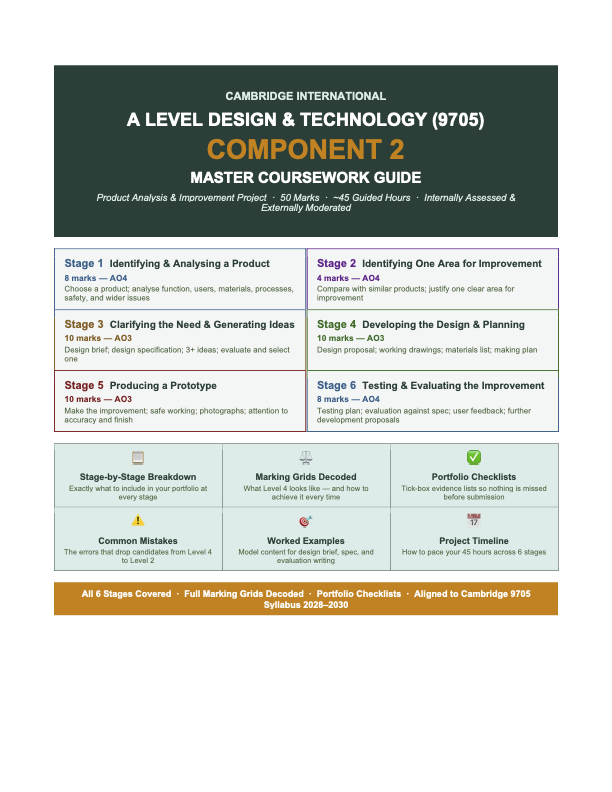
Cambridge A Level Design & Technology Component 2 is the Product Analysis and Improvement Project – 50 marks, 50% of AS Level (25% of A Level), approximately 45 guided learning hours. This guide, last updated May 2026, transforms how students approach the 6-stage portfolio, from product analysis to prototype evaluation.
What’s inside (31 pages):
The Golden Rule: “Have I said WHY, not just WHAT?” – the difference between Level 2 description and Level 4 analysis.
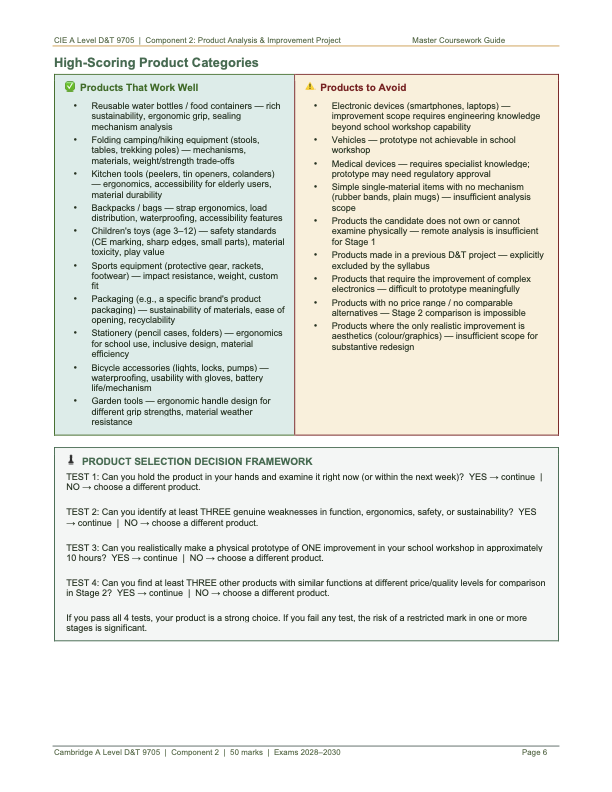
Product selection framework – 4 tests to choose the right product (personal familiarity, scope for analysis, achievable prototype, comparator products exist). High-scoring categories: reusable bottles, folding equipment, kitchen tools, backpacks, children’s toys, garden tools.
Stage 1 – Analysis (8 marks): 9 sub-sections (function, users, materials, production processes, safety, cultural/social, economic, environmental). Worked example: Level 4 materials analysis with specific polymers, properties, and environmental evaluation.
Stage 2 – Product comparison (4 marks): structured comparison table (3+ products) + justification of ONE focused improvement area.
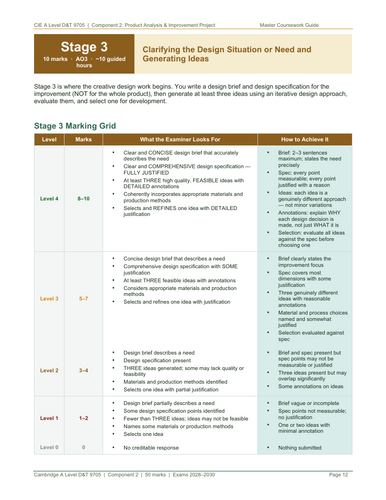
Stage 3 – Idea generation (10 marks): Level 4 design brief (2–4 sentences, specific user group, constraints). Measurable design specification formula: “must [criterion] because [justification]”. Three genuinely different ideas with annotated sketches. Evaluation matrix and selection with refinement.
Stage 4 – Development & planning (10 marks): working drawings (scale, dimensions, multiple views, materials, finishes). Gantt chart making plan (operations, time, tools, materials, safety per stage). Specification check table.
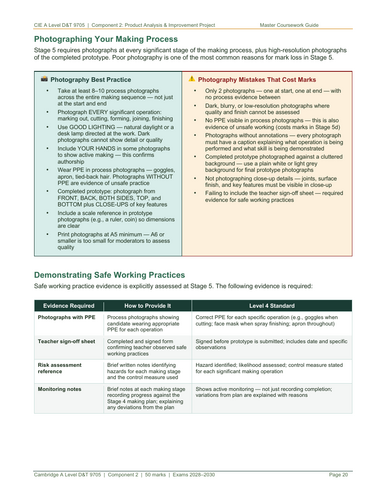
Stage 5 – Prototype (10 marks): photography protocol (8–10 process photos, PPE visible, teacher sign-off). evidence of 3+ practical skills (cutting, forming, joining, finishing). Completed prototype photographed from 6 angles with scale reference.
Stage 6 – Testing & evaluation (8 marks): one test per specification point (method, criterion, equipment). User feedback from 3+ users with direct quotes. Resource evaluation. Further development linked to test findings with production technique and wider issues (economic, environmental, social).
#ALevel #CambridgeALevel #DesignAndTechnology #9705 #Component2 #Coursework #ProductAnalysis #DesignProject #DTTeacher #Portfolio #Prototype #SustainableDesign #ProductImprovement #Ergonomics #Materials #ExamPrep #RevisionGuide #TesResources
Something went wrong, please try again later.
This resource hasn't been reviewed yet
To ensure quality for our reviews, only customers who have purchased this resource can review it
Report this resourceto let us know if it violates our terms and conditions.
Our customer service team will review your report and will be in touch.
£4.85