pptx, 1.54 MB
pptx, 1.54 MB
PNG, 314.63 KB
PNG, 314.63 KB
PNG, 198.53 KB
PNG, 198.53 KB

Edexcel Superpower Relations and the Cold War, 1941-91

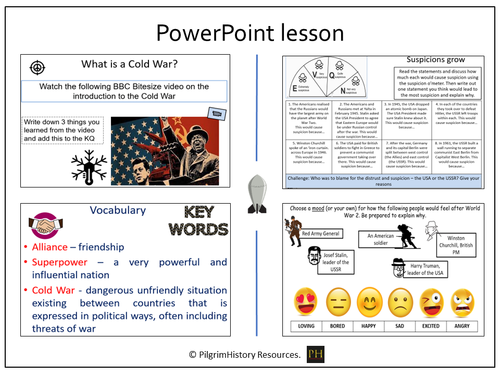
This lesson aims to define what the Cold War was about, the differences between Communism and Capitalism and how after 1945, both the Soviet Union and America went from allies to enemies.

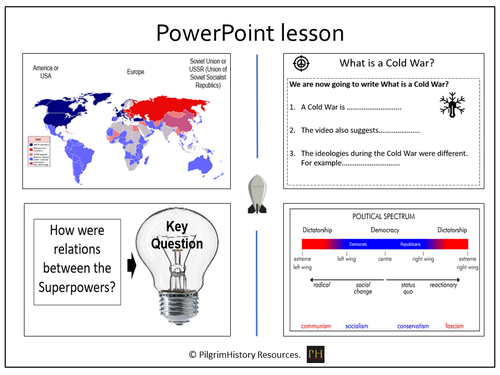
Students use a map and video footage to define the origins of the Cold War, with a writing frame supplied if required.

Students also learn about the different political spectrums in the world of Capitalism and Communism at the time and use this knowledge to categorise them in a colour coding activity.

They also had to analyse evidence of how mutual suspicions and superpower rivalry grew which they plot on a suspicion o’meter and justify their choices.

The plenary uses a mood board to distinguish between the various ‘moods’ of leaders and soldiers from the time.

The lesson is enquiry based with a key question posed at the start of the lesson and revisited throughout this and subsequent lessons to show the progress of learning.

The resource includes suggested teaching strategies and differentiated materials and comes in PowerPoint format if there is a wish to adapt and change.

Get this resource as part of a bundle and save up to 25%

A bundle is a package of resources grouped together to teach a particular topic, or a series of lessons, in one place.

Bundle

Edexcel Superpower Relations and the Cold War Bundle Part 1

This bundle is the first part in a series of lessons I have created for Edexcel GCSE 9-1 Superpower relations and the Cold War, 1941-1991. The lessons are all differentiated, fully resourced, adaptable on Powerpoint and are tailored to enable the students to achieve the highest grades. The lessons will allow students to demonstrate (AO1) knowledge and understanding of the key features and characteristics of the period studied from the formation of the Grand Alliance to the outcomes of Tehran, Yalta and Potsdam as well as the ideologies of East and West, the Arms Race and the Berlin and Hungarian crisis. They will explain and analyse (AO2) second-order concepts such as change and continuity in tensions between East and West, the causes and consequences of the Telegrams, Cominform and Comecon, the formation of NATO and the Warsaw Pact as well as the Truman Doctrine and Marshall Aid. The lessons are as follows: L1 Origins of the Cold War L2 Conferences of Tehran, Yalta and Potsdam L3 The Kennan and Novikov Telegrams L4 Soviet Satellite States L5 Truman Doctrine L6 Marshall Aid L7 Cominform and Comecon (free resource) L8 Berlin Crisis 1948 L9 NATO and Warsaw Pact L10 Significance of Arms Race (free resource) L11 Hungarian Uprising The lessons are enquiry based with a key question posed at the start of the lessons and revisited throughout to show the progress of learning. The lessons in this bundle are therefore linked together to build up a picture of how diplomacy, propaganda and spying led two Superpowers with opposing political ideologies to create tensions, rivalries and distrust as well as subsequently form mutual understanding and cooperation over the time period in question. The resources include retrieval practice, suggested teaching strategies, differentiated materials and GCSE exam practice questions. They come in PowerPoint format if there is a wish to adapt and change. Further assessment materials can be found on the Edexcel Website. A complete set of lessons for this unit can be found here: https://www.tes.com/teaching-resource/resource-13325744

£21.00

Reviews

Something went wrong, please try again later.

This resource hasn't been reviewed yet

To ensure quality for our reviews, only customers who have purchased this resource can review it

Report this resourceto let us know if it violates our terms and conditions.
Our customer service team will review your report and will be in touch.