


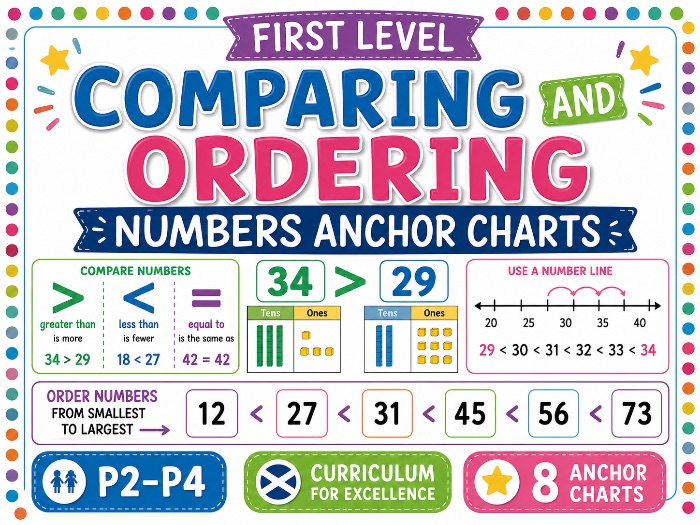
A bright and engaging set of 8 Comparing and Ordering Numbers Anchor Charts designed for pupils working within First Level Curriculum for Excellence.
This colourful, child-friendly resource helps learners develop confidence when comparing numbers, using greater than, less than and equal to symbols, ordering numbers and using place value and number lines to support their thinking.
The posters include clear explanations, visual examples and simple problem-solving contexts, making them ideal for maths working walls, classroom displays, whole-class teaching and independent reference.
WHAT IS INCLUDED?
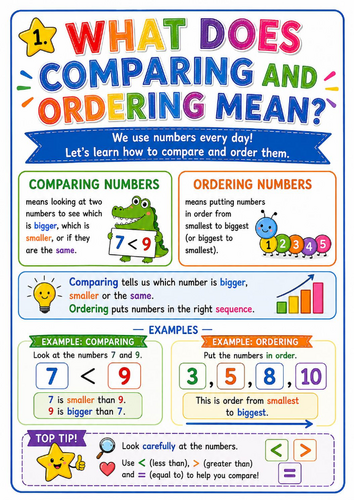
What Does Comparing and Ordering Mean?
Greater Than, Less Than and Equal To
Comparing Numbers Using Place Value
Ordering Numbers from Smallest to Biggest
Ordering Numbers from Biggest to Smallest
Using a Number Line to Compare
Comparing and Ordering in Real Life
Comparing and Ordering Problem Solving
SKILLS COVERED
Comparing numbers
Ordering numbers
Identifying greater and smaller numbers
Using greater than, less than and equal to symbols
Understanding the meaning of >, < and =
Comparing tens and ones
Using place value to compare numbers
Ordering from smallest to largest
Ordering from largest to smallest
Using number lines to compare values
Identifying numbers that come before, after and between
Comparing quantities and sets
Applying comparing and ordering skills to real-life contexts
Solving comparison problems
Explaining mathematical thinking
EACH ANCHOR CHART FEATURES
Bright, primary-friendly design
Clear and simple explanations
Colourful worked examples
Visual representations
Place value support
Number line examples
Helpful reminders and top tips
Child-friendly mathematical vocabulary
Problem-solving opportunities
Visual support for independent learning
PERFECT FOR
P2-P4
First Level Numeracy and Mathematics
Comparing and Ordering topics
Maths working walls
Classroom displays
Whole-class teaching
Guided maths
Independent pupil reference
Revision and consolidation
Supporting visual learners
Problem solving and mathematical reasoning
Curriculum: Curriculum for Excellence
Level: First Level
Subject: Numeracy and Mathematics
Topic: Comparing and Ordering Numbers
Pages: 8
A practical and colourful classroom resource for helping pupils confidently compare and order numbers while developing a secure understanding of place value, number relationships and mathematical symbols.
Get this resource as part of a bundle and save up to 53%
A bundle is a package of resources grouped together to teach a particular topic, or a series of lessons, in one place.
Bundle
Patterns and Relationships KS1/First Level Anchor Chart Bundle
A bright and comprehensive set of 40 Patterns and Relationships Anchor Charts designed for pupils working within First Level Curriculum for Excellence. This colourful, child-friendly bundle brings together 5 complete anchor chart packs, supporting pupils as they explore patterns, sequences, number relationships, missing numbers, equality and number sentences. Each poster uses clear explanations, colourful visual models, worked examples and practical strategies to help pupils develop strong number sense, mathematical reasoning and problem-solving skills. The consistent primary-style design makes the bundle perfect for creating an engaging maths working wall or providing pupils with an accessible visual reference throughout their learning. WHAT IS INCLUDED? NUMBER PATTERNS – 8 ANCHOR CHARTS What Is a Number Pattern? Repeating Patterns Growing Patterns Decreasing Patterns Skip Counting Finding the Rule Missing Numbers in Patterns Number Pattern Problem Solving PATTERNS – 8 ANCHOR CHARTS What Are Patterns? Repeating Patterns Growing Patterns Decreasing Patterns Skip Counting Finding the Rule Missing Numbers in Patterns Pattern Problem Solving NUMBER RELATIONSHIPS – 8 ANCHOR CHARTS What Are Number Relationships? Number Bonds Doubles and Near Doubles Halves and Sharing Equally More Than, Less Than and Equal To Before, After and Between Odd and Even Numbers Fact Families MISSING NUMBERS – 8 ANCHOR CHARTS What Are Missing Numbers? Missing Numbers on a Number Line Counting On to Find Missing Numbers Counting Back to Find Missing Numbers Missing Numbers in Addition Missing Numbers in Subtraction Find the Rule in a Pattern Missing Number Problem Solving EQUALS SIGN & NUMBER SENTENCES – 8 ANCHOR CHARTS What Does the Equals Sign Mean? What Is a Number Sentence? True and False Number Sentences Addition Number Sentences Subtraction Number Sentences Missing Numbers in Number Sentences Making Number Sentences Number Sentence Problem Solving SKILLS COVERED Recognising and continuing patterns Understanding that patterns follow rules Repeating, growing and decreasing patterns Identifying the repeating core of a pattern Skip counting in 2s, 5s and 10s Finding and describing pattern rules Completing missing numbers in sequences Understanding relationships between numbers Number bonds to 10 and 20 Finding missing parts and wholes Doubles and near doubles Halving and sharing equally Comparing numbers Using greater than, less than and equal to Understanding numbers before, after and between Identifying odd and even numbers Understanding fact families Connecting addition and subtraction Using number lines Counting on and counting back Finding missing numbers in calculations Understanding the equals sign as “the same value as” Understanding equality and balance Reading and writing number sentences Identifying true and false number sentences Writing addition and subtraction number sentences Creating number sentences from pictures and stories Solving missing-number problems Solving simple word problems Checking whether answers make sense Developing mathematical vocabulary Building reasoning and problem-solving skills EACH ANCHOR CHART FEATURES Bright, engaging primary-friendly design Clear child-friendly explanations Colourful visual representations Worked examples Step-by-step strategies Number lines and pictorial models Part-part-whole representations Practical mathematical vocabulary Helpful reminders and top tips “Have a Go” practice opportunities Problem-solving examples Consistent design across all 40 posters Visual support for independent learning PERFECT FOR P2–P4 First Level Numeracy and Mathematics Curriculum for Excellence Patterns and Relationships Maths working walls Classroom displays Whole-class teaching Guided maths Independent pupil reference Mental maths Revision and consolidation Supporting visual learners Early finishers Intervention and additional support Developing mathematical reasoning Building pupil confidence and independence Curriculum: Curriculum for Excellence Level: First Level Suggested Stage: P2–P4 Subject: Numeracy and Mathematics Curriculum Area: Patterns and Relationships Individual Packs: 5 Anchor Charts: 40 Pages: 40 A comprehensive, ready-to-use First Level resource for helping pupils recognise patterns, understand relationships between numbers, find missing values, explore equality and confidently use number sentences to explain and solve mathematical problems.
£7.99
Bundle
Number KS1/First Level Anchor Chart Bundle
A bright and comprehensive First Level Number Anchor Chart Bundle designed for pupils working within First Level Curriculum for Excellence. This huge bundle includes 80 colourful, child-friendly maths anchor charts covering key First Level number concepts including place value, comparing and ordering, rounding, addition, subtraction, mental maths, multiplication, division, times tables and fractions. Each set uses clear explanations, visual models, worked examples and practical strategies to help pupils build confidence, develop number sense and become more independent mathematicians. The bundle is ideal for creating a complete First Level maths working wall or providing visual support throughout a full year of Numeracy and Mathematics teaching. WHAT IS INCLUDED? PLACE VALUE - 8 ANCHOR CHARTS What Is Place Value? Hundreds, Tens and Ones Reading and Writing Numbers Making Numbers in Different Ways Partitioning Numbers Finding the Value of a Digit Place Value on a Number Line Place Value Problem Solving COMPARING AND ORDERING NUMBERS - 8 ANCHOR CHARTS What Does Comparing and Ordering Mean? Greater Than, Less Than and Equal To Comparing Numbers Using Place Value Ordering Numbers from Smallest to Biggest Ordering Numbers from Biggest to Smallest Using a Number Line to Compare Comparing and Ordering in Real Life Comparing and Ordering Problem Solving ROUNDING - 8 ANCHOR CHARTS What Is Rounding? Using a Number Line to Round Rounding to the Nearest 10 Rounding to the Nearest 100 Round Up or Round Down Estimating by Rounding Rounding in Real Life Rounding Problem Solving ADDITION - 8 ANCHOR CHARTS What Is Addition? Addition Words and Symbols Counting On to Add Using Objects and Ten Frames Number Bonds and Doubles Bridging Through 10 Adding Tens and Ones Addition Word Problems SUBTRACTION - 8 ANCHOR CHARTS What Is Subtraction? Subtraction Words and Symbols Using Objects and Ten Frames to Subtract Counting Back on a Number Line Finding the Difference Fact Families and Number Bonds Bridging Through 10 Subtraction Word Problems MENTAL ADDITION AND SUBTRACTION - 8 ANCHOR CHARTS What Is Mental Addition and Subtraction? Counting On and Counting Back Number Bonds to 10 and 20 Doubles and Near Doubles Make 10 and Bridge Through 10 Adding and Subtracting Tens Use Known Facts Choosing a Mental Strategy MULTIPLICATION - 8 ANCHOR CHARTS What Is Multiplication? Equal Groups Repeated Addition Making Arrays Skip Counting Using a Number Line Doubling and x2 Multiplication Word Problems DIVISION - 8 ANCHOR CHARTS What Is Division? Sharing Equally Division by Grouping Division on a Number Line Division Arrays Division Fact Families Division and Multiplication Division Word Problems TIMES TABLES - 8 ANCHOR CHARTS What Are Times Tables? Counting in 2s, 5s and 10s Equal Groups and Repeated Addition Arrays for Times Tables The 2 Times Table The 5 Times Table The 10 Times Table Times Tables Word Problems FRACTIONS - 8 ANCHOR CHARTS What Are Fractions? Equal Parts Fractions of Shapes Fractions of a Set Numerator and Denominator Unit Fractions Fractions on a Number Line Fractions in Real Life SKILLS COVERED Place value and number sense Hundreds, tens and ones Reading, writing and partitioning numbers Comparing and ordering numbers Greater than, less than and equal to Number lines Rounding and estimating Addition and subtraction Counting on and counting back Number bonds Doubles and near doubles Bridging through 10 Adding and subtracting tens Mental maths strategies Using known facts Multiplication and division Equal groups Repeated addition Sharing and grouping Arrays Skip counting Multiplication and division fact families 2, 5 and 10 times tables Fractions and equal parts Fractions of shapes and sets Numerator and denominator Unit fractions Fractions on number lines Word problems Mathematical reasoning Explaining mathematical thinking EACH ANCHOR CHART FEATURES Bright, colourful primary-friendly design Clear child-friendly explanations Worked examples Visual representations Number lines Ten frames Base-ten models Equal groups and arrays Fraction models Step-by-step strategies Key mathematical vocabulary Helpful reminders and top tips Real-life connections Problem-solving opportunities Visual support for independent learning PERFECT FOR P2-P4 First Level Numeracy and Mathematics Maths working walls Classroom displays Whole-class teaching Guided maths Independent pupil reference Daily maths lessons Mental maths Revision and consolidation Supporting visual learners Intervention and additional support Building maths confidence Developing mathematical reasoning Creating a consistent classroom maths display This bundle provides a clear progression through many of the key Number skills taught at First Level. Pupils can move from developing early place value and number sense through addition and subtraction before progressing to multiplication, division, times tables and fractions. Curriculum: Curriculum for Excellence Level: First Level Suggested Stage: P2-P4 Subject: Numeracy and Mathematics Area: Number Individual Packs: 10 Anchor Charts: 80 Pages: 80 A huge ready-to-use First Level Number resource for creating a colourful and consistent maths working wall while giving pupils accessible visual support throughout their learning.
£12.99
Something went wrong, please try again later.
This resource hasn't been reviewed yet
To ensure quality for our reviews, only customers who have purchased this resource can review it
Report this resourceto let us know if it violates our terms and conditions.
Our customer service team will review your report and will be in touch.
£3.00