


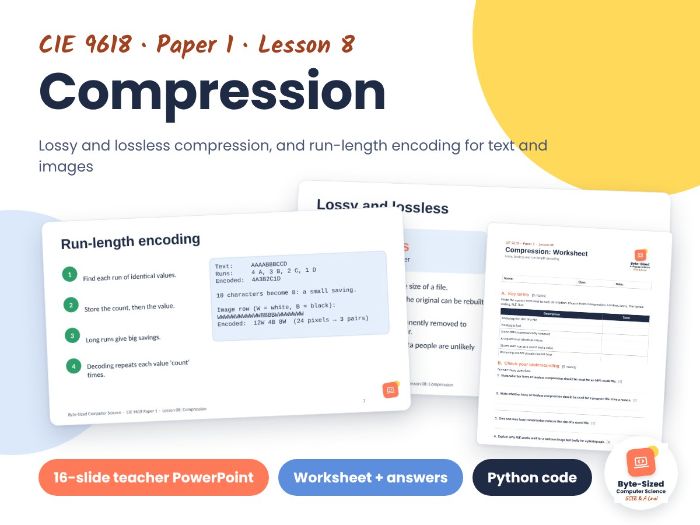
This lesson finishes off the information representation section with compression. Students learn why files are compressed, the real difference between lossy and lossless (including perceptual coding for sound), and how to choose and justify a method for a given file type.
Run-length encoding is taught by hand for text and for a row of pixels, and then built in Python. There’s also a spot-the-mistake slide that shows RLE can actually make a file bigger, which makes a great evaluation point.
What’s included
- 16-slide editable teacher PowerPoint, with speaker notes on every slide
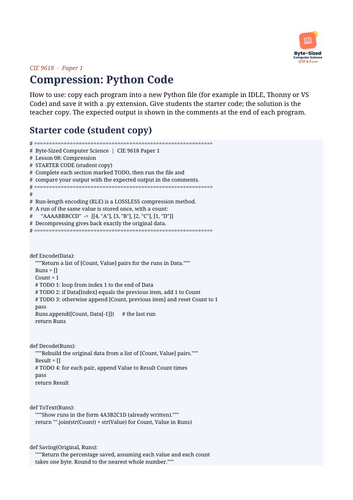
- Python starter code with guided TODOs and the full tested solution, in a Word file ready to copy into your editor (including a row-by-row image encoding extension)
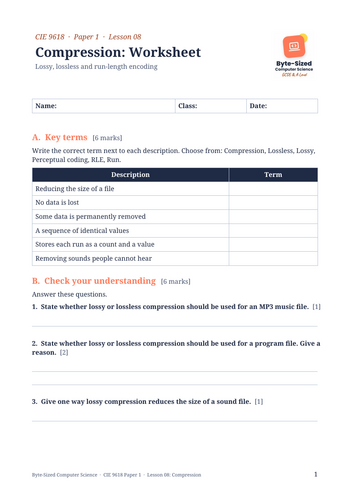
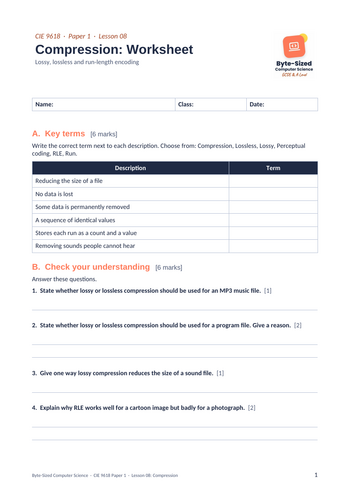
- Student worksheet (32 marks) in Word and PDF: key terms, an RLE table, fill-the-gap statements, correcting statements and exam-style questions
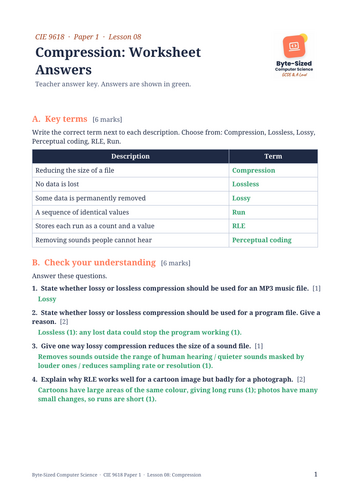
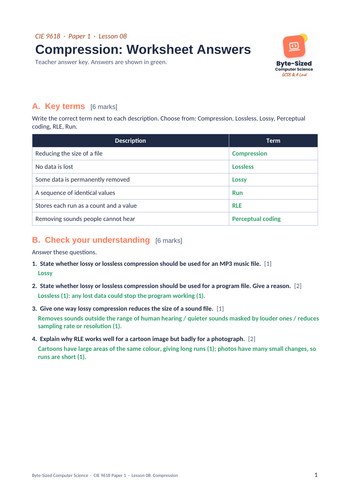
- Full answer key in Word and PDF
How the lesson runs
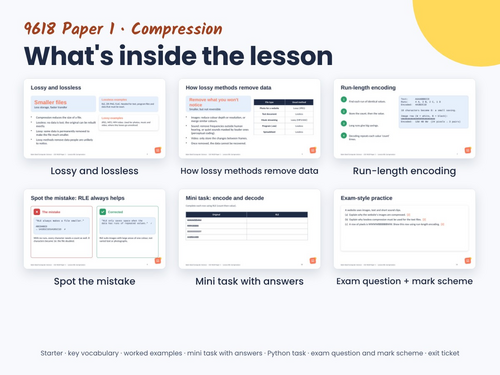
- A starter on why files are compressed
- Lossy versus lossless, then how lossy methods remove data
- Key vocabulary: compression, runs, RLE and perceptual coding
- Worked examples: RLE by hand, then RLE in Python
- A spot-the-mistake slide on when RLE fails
- An encode-and-decode mini task with answers
- Choosing a method
- A Python task, exam-style question with mark scheme, and exit ticket
Written for Cambridge International AS & A Level Computer Science (9618), Paper 1 Theory Fundamentals, and pitched at AS Level (Year 12). Everything is editable, so you can adapt it for your own classes.
Please leave a review if you find it useful. It really helps!
Something went wrong, please try again later.
This resource hasn't been reviewed yet
To ensure quality for our reviews, only customers who have purchased this resource can review it
Report this resourceto let us know if it violates our terms and conditions.
Our customer service team will review your report and will be in touch.
£8.00