


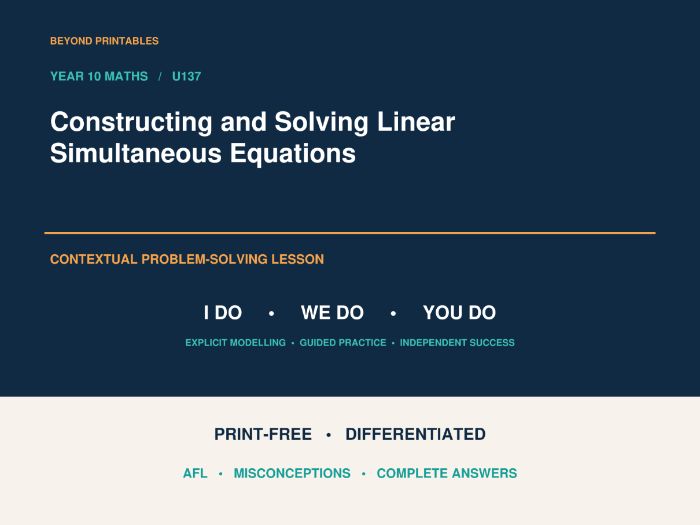
Teach pupils to construct and solve linear simultaneous equations from context with a complete Year 10 maths lesson. This editable 50-slide PowerPoint follows an I Do, We Do, You Do sequence, moving from explicit modelling to guided practice and independent problem solving. It is fully print-free, so there are no worksheets to prepare, photocopy or collect.
The lesson focuses on the demanding step pupils often miss: translating two independent relationships into two correct equations before solving. Pupils define variables clearly, identify what each quantity represents, build total-number, value, difference, perimeter and relationship equations, solve using elimination or substitution, and interpret both values in the original context. The mathematical progression aligns with Sparx U137.
I Do examples model how to move from words to algebra through the stages Identify, Build and calculate, and Interpret and check. We Do examples support participation before a matched six-question 3-column × 2-row grid provides further teacher-led and guided practice. Paired examples help pupils recognise the same structure in different contexts.
Differentiation is built into one coherent pupil-facing task. The lesson contains 8 Developing questions, 8 Secure questions and 5 Greater Depth questions, followed by a substantial Super Challenge. Developing work scaffolds variable definition and equation construction. Secure questions combine modelling and solving across coins, animals, tickets, rectangles, drinks and class totals. Greater Depth tasks require construction, generalisation, inequalities and reasoning about domain restrictions.
Assessment for learning appears throughout the deck. Retrieval questions check prerequisite algebra, substitution and translation. Focused mini-whiteboard questions assess variable definitions, total and revenue equations, interpretation and checking. Staged answer slides make misconceptions visible and allow immediate feedback, self-correction and purposeful whole-class discussion.
Common misconceptions are anticipated explicitly. Pupils distinguish a total-number equation from a weighted-value equation, understand why two independent facts are required, and check that both calculated values satisfy both original relationships. The lesson also stresses contextual validity: quantities representing people, tickets, vehicles or objects must be non-negative whole numbers, even when a fractional or negative algebraic answer satisfies the equations.
What is included:
• Editable 50-slide PowerPoint lesson
• I Do, We Do, You Do teaching sequence
• Six-question matched modelling grid
• Print-free differentiated practice
• 8 Developing, 8 Secure and 5 Greater Depth questions
• Substantial Super Challenge investigation
• AFL checks and misconception prompts
• Fully worked solutions and complete answers
• Sparx U137-aligned progression
Something went wrong, please try again later.
This resource hasn't been reviewed yet
To ensure quality for our reviews, only customers who have purchased this resource can review it
Report this resourceto let us know if it violates our terms and conditions.
Our customer service team will review your report and will be in touch.
£3.00