

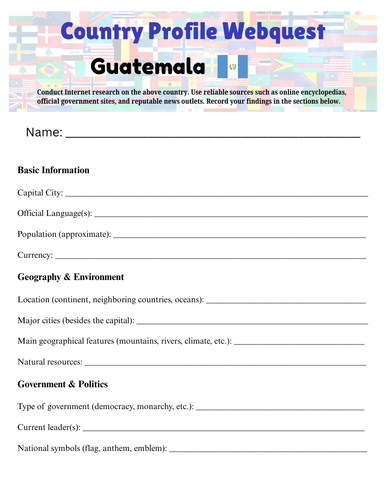

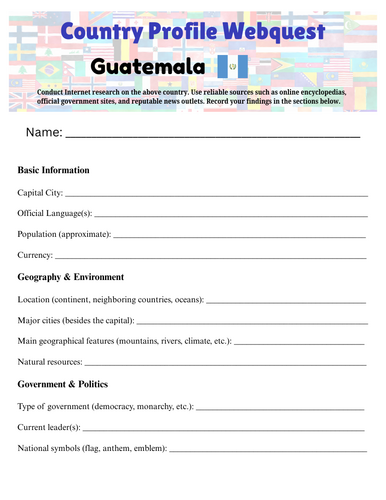
This worksheet on Guatemala leads students through an exploration of the country’s geography, political structure, economy, and vibrant culture. Students begin by identifying key facts such as the capital city Guatemala City, official language (Spanish), population, and currency (Guatemalan quetzal). The geography section highlights Guatemala’s location in Central America, bordered by Mexico, Belize, Honduras, El Salvador, the Pacific Ocean, and the Caribbean Sea. Students learn about its mountainous terrain, rainforests, active volcanoes, and important natural landmarks like Lake Atitlán. In the government and politics section, they research Guatemala’s presidential republic system, current leadership, and national symbols like the quetzal bird and blue-and-white flag. The economy portion focuses on agriculture (coffee, bananas, sugar), textiles, manufacturing, and tourism. The culture and society section explores Guatemala’s rich Indigenous Maya heritage, colonial history, languages, traditional clothing, festivals, music, dance, and cuisine such as tamales and pepian. Tourism highlights include Tikal’s ancient ruins, Antigua Guatemala’s colonial city, volcano hikes, and lakeside villages. Reflection questions prompt students to consider how Guatemala’s history and geography shape its modern identity.
Keywords: Guatemala, Guatemala City, Central America, Spanish language, Lake Atitlán, volcanoes, Maya heritage, presidential republic, coffee, bananas, textiles, tourism, Tikal, Antigua Guatemala, Indigenous culture, history, geography, economy, Model United Nations (MUN), reflection, politics
Something went wrong, please try again later.
This resource hasn't been reviewed yet
To ensure quality for our reviews, only customers who have purchased this resource can review it
Report this resourceto let us know if it violates our terms and conditions.
Our customer service team will review your report and will be in touch.
£2.00