

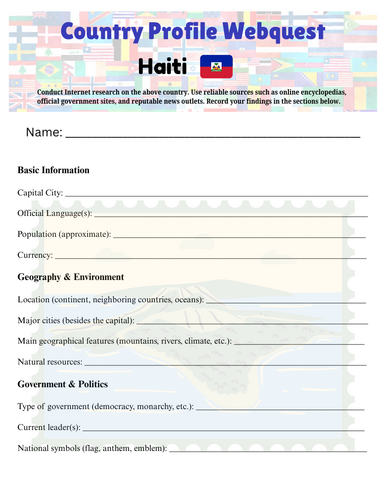

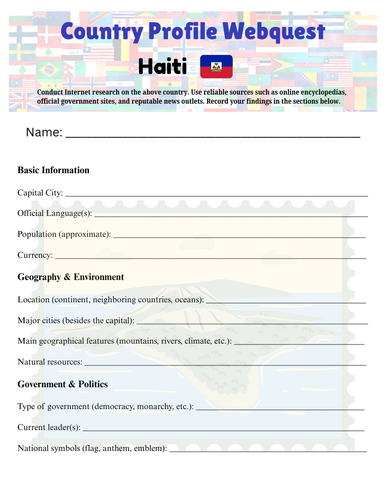
This worksheet on Haiti helps students explore the country’s geography, politics, economy, and culture through structured research activities. Students begin by identifying key facts such as the capital city Port-au-Prince, official languages (French and Haitian Creole), population, and currency (Haitian gourde). The geography section highlights Haiti’s location on the western portion of the island of Hispaniola in the Caribbean, bordered by the Dominican Republic and the Caribbean Sea, with mountainous terrain, coastal plains, rivers, and a tropical climate. In the government and politics section, students examine Haiti’s semi-presidential republic system, current leadership, and national symbols such as the flag, coat of arms, and anthem. The economy portion emphasizes agriculture (mangoes, coffee, sugar), manufacturing, services, and challenges such as natural disasters. The culture and society section explores Haiti’s rich Creole heritage, Vodou traditions, music, art, literature, cuisine (like griot and rice and beans), and major festivals such as Carnival. Tourism highlights include Citadelle Laferrière, Jacmel, Labadee, and national parks. Reflection questions encourage students to consider Haiti’s resilience, cultural richness, and environmental challenges.
Keywords: Haiti, Port-au-Prince, Caribbean, Hispaniola, mountains, tropical climate, French, Haitian Creole, semi-presidential republic, mangoes, coffee, sugar, culture, Vodou, Carnival, tourism, history, geography, economy, Model United Nations (MUN), reflection
Something went wrong, please try again later.
This resource hasn't been reviewed yet
To ensure quality for our reviews, only customers who have purchased this resource can review it
Report this resourceto let us know if it violates our terms and conditions.
Our customer service team will review your report and will be in touch.
£2.00