

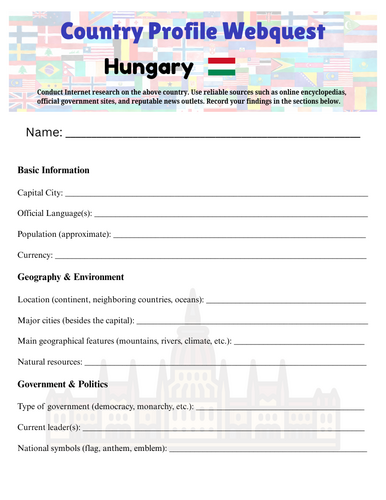

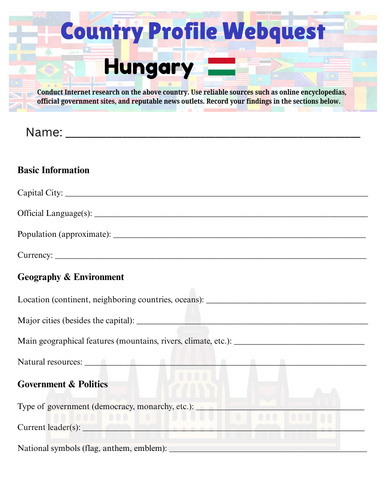
This worksheet on Hungary guides students through an exploration of the country’s geography, political system, economy, and cultural heritage. Students begin by recording key facts such as the capital city Budapest, official language (Hungarian), population, and currency (Hungarian forint). The geography section highlights Hungary’s location in Central Europe, landlocked and bordered by Austria, Slovakia, Ukraine, Romania, Serbia, Croatia, and Slovenia, with features including the Danube and Tisza rivers, the Great Hungarian Plain, and the Balaton Lake. In the government and politics section, students examine Hungary’s parliamentary republic system, current leadership, and national symbols such as the flag and anthem. The economy portion emphasizes key industries like automotive, electronics, agriculture, and tourism. The culture and society section explores Hungary’s rich history, classical and folk music, literature, traditional cuisine (gulyás, lángos), festivals, and national holidays. Tourism highlights include Budapest’s historic architecture, thermal baths, castles, and Lake Balaton. Reflection questions prompt students to consider how Hungary’s geography, history, and culture shape its identity in Europe.
Keywords: Hungary, Budapest, Central Europe, Danube River, Tisza River, Great Hungarian Plain, Lake Balaton, Hungarian language, parliamentary republic, automotive industry, agriculture, culture, gulyás, lángos, tourism, history, geography, Model United Nations (MUN), reflection, politics
Something went wrong, please try again later.
This resource hasn't been reviewed yet
To ensure quality for our reviews, only customers who have purchased this resource can review it
Report this resourceto let us know if it violates our terms and conditions.
Our customer service team will review your report and will be in touch.
£2.00