

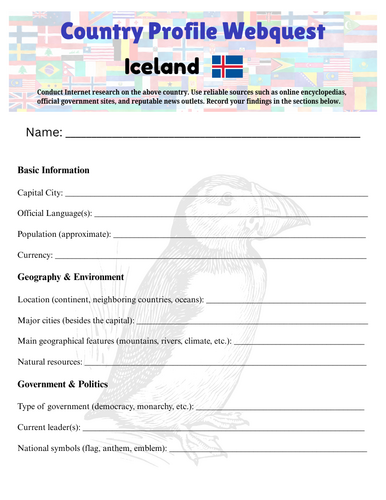

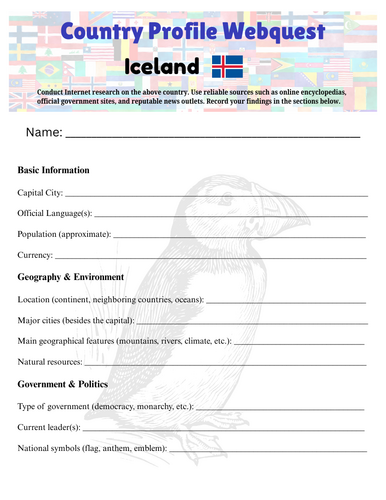
This worksheet on Iceland guides students through a focused exploration of the country’s unique geography, political system, economy, and culture. Students begin by identifying key facts such as the capital city Reykjavík, official language (Icelandic), population, and currency (Icelandic króna). The geography section highlights Iceland’s location in the North Atlantic Ocean, between Greenland and Norway, with striking natural features such as volcanoes, glaciers, geysers, hot springs, fjords, and dramatic coastlines. In the government and politics section, students examine Iceland’s parliamentary republic system, current leadership, and national symbols such as the flag and anthem. The economy portion focuses on fishing, renewable energy (geothermal and hydroelectric power), tourism, and technology sectors. The culture and society section explores Iceland’s Norse heritage, sagas, literature, music, traditional foods, and festivals, along with its strong emphasis on environmental sustainability and education. Tourism highlights include the Blue Lagoon, Golden Circle, Northern Lights, glaciers, and Reykjavik’s cultural attractions. Reflection questions encourage students to consider how Iceland’s geography and history shape its national identity and way of life.
Keywords: Iceland, Reykjavík, North Atlantic Ocean, volcanoes, glaciers, geysers, Icelandic language, parliamentary republic, fishing, geothermal energy, hydroelectric power, Norse heritage, sagas, tourism, Blue Lagoon, Northern Lights, history, geography, economy, Model United Nations (MUN), reflection, politics
Something went wrong, please try again later.
This resource hasn't been reviewed yet
To ensure quality for our reviews, only customers who have purchased this resource can review it
Report this resourceto let us know if it violates our terms and conditions.
Our customer service team will review your report and will be in touch.
£2.00