

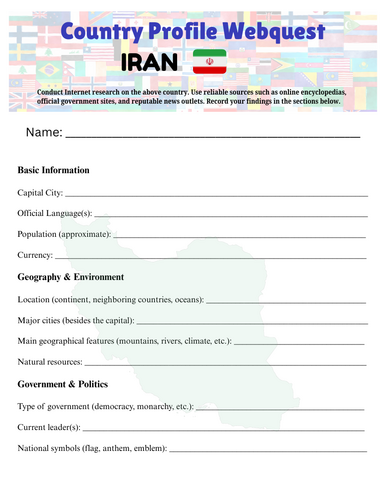

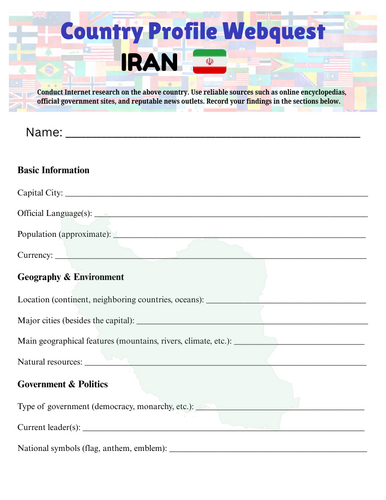
This worksheet on Iran helps students explore the country’s geography, history, politics, economy, and culture in a clear, structured way. Students begin by collecting key facts such as the capital (Tehran), official language (Persian/Farsi), population (around 89 million), currency (Iranian rial), and location in Western Asia, bordered by countries including Iraq, Turkey, Armenia, Azerbaijan, Turkmenistan, Afghanistan, and Pakistan, with coastlines along the Caspian Sea and Persian Gulf.
The geography section covers Iran’s mountainous terrain (notably the Zagros and Alborz ranges), central deserts (Dasht-e Kavir, Dasht-e Lut), and major rivers like the Karun. Students examine Iran’s arid to semi-arid climate, the strategic importance of the Strait of Hormuz, and its role as a bridge between Central Asia, the Middle East, and South Asia.
In the government and politics section, students analyze Iran’s system as an Islamic Republic, combining elements of theocracy and democracy. They learn about the Supreme Leader (highest authority), the President (head of government), and the structure of the Majles (parliament). National symbols include the green-white-red flag with the stylized “Allah” emblem and the national anthem “Soroud-e Melli-ye Jomhouri-ye Eslami-ye Iran.”
The economy section highlights Iran’s significant oil and natural gas reserves, agricultural products (pistachios, saffron, wheat), and industries (petrochemicals, textiles, automotive). Students consider the impact of international sanctions, regional trade, and Iran’s membership in organizations like the UN and OPEC.
The culture and society section explores Iran’s Persian heritage, literature (e.g., Hafez, Rumi, Ferdowsi), art, architecture (Persepolis, mosques with intricate tilework), music, traditional clothing, and cuisine (kebabs, rice dishes, stews). Islam, predominantly Shia Islam, plays a central role in public life, alongside cultural celebrations like Nowruz (Persian New Year). Students also examine tourism highlights such as Isfahan, Shiraz, Yazd, and ancient archaeological sites.
Reflection prompts invite students to think about how Iran’s strategic location, cultural influence, and political system shape its role in regional and global affairs, especially in contexts like Model United Nations (MUN) debates.
Keywords: Iran, Tehran, Persian, Farsi, Islamic Republic, Supreme Leader, President, Majles, Zagros Mountains, Alborz Mountains, Caspian Sea, Persian Gulf, Strait of Hormuz, oil, gas, sanctions, Persian culture, Nowruz, Shia Islam, architecture, literature, politics, economy, geography, MUN
Something went wrong, please try again later.
This resource hasn't been reviewed yet
To ensure quality for our reviews, only customers who have purchased this resource can review it
Report this resourceto let us know if it violates our terms and conditions.
Our customer service team will review your report and will be in touch.
£2.00