


4.6 Fundamentals of computer systems
4.6 Logic gates https://forms.gle/BFvLroLxGfuP5AA57
4.6 Boolean gate combinations https://forms.gle/EWYwWDzhwikC1bSVA
4.6 Building_circuits
4.6 Simplifying boolean equations https://forms.gle/1okaQsUfNR9jsH7C7
4.6 Boolean identities
4.6 De Morgan’s Laws https://forms.gle/VzVG6UQh2VtmFD8G8
4.6 Gate conversion
4.6 Uses of gates
4.6 Hardware and software
This comprehensive guide covers fundamental digital logic concepts including full and half adders, flip-flops, Boolean algebra, and De Morgan’s laws. Full adders perform three-bit addition using Sum = A⊕B⊕Cin and Carry = AB+BCin+ACin equations. Half adders handle two-bit addition with Sum = A⊕B and Carry = A·B. D-type flip-flops store single bits, updating on clock edges. De Morgan’s laws state (A+B)’ = A’·B’ and (A·B)’ = A’+B’, enabling circuit simplification. Boolean algebra simplification reduces complex expressions using absorption, distribution, and complement laws. Logic gates (AND, OR, NAND, NOR, XOR) form the foundation of digital circuits. NAND and NOR are universal gates, capable of implementing any Boolean function. Circuit analysis involves truth tables, Boolean expressions, and gate-level implementation. Understanding these concepts is essential for digital system design, computer architecture, and embedded systems development.
Logic Circuit and Flip-Flop Understanding
Question 1: Full Adder Circuit
1.
Function: To perform addition of three binary digits (A, B, and Cin)
2.
3.
Sum output when A=0, B=1, Cin=1:
Sum = A ⊕ B ⊕ Cin = 0 ⊕ 1 ⊕ 1 = 0
4.
5.
Truth Table for Full Adder (A B Cin → Sum Cout):
6.
1.0 0 0 → 0 0
2.0 0 1 → 1 0
3.0 1 0 → 1 0
4.0 1 1 → 0 1
5.1 0 0 → 1 0
6.1 0 1 → 0 1
7.1 1 0 → 0 1
8.1 1 1 → 1 1
7.
Sum Boolean expression: A ⊕ B ⊕ Cin
8.
9.
Carry Boolean expression: Cout = A·B + B·Cin + A·Cin
10.
Question 2: Half Adder
1.
Boolean equations: Sum = A ⊕ B, Carry = A · B
2.
3.
Circuit diagram: Option 3 is closest (though none are perfectly drawn for a half adder - should be XOR for sum, AND for carry)
4.
D-Type Flip-Flop
1.
Purpose: To store a single bit and update its value on the rising edge of a clock pulse
2.
3.
Output: Q = D (copied from input at rising edge)
4.
De Morgan’s Laws Quiz
Key De Morgan’s Laws:
First law: (A + B)’ = A’ · B’
Second law: (A · B)’ = A’ + B’
Boolean Algebra Simplification
Key simplifications:
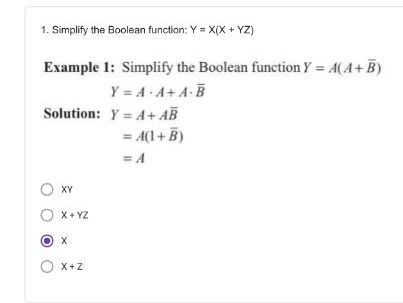
1.Y = X(X + YZ) = X
2.Y = B + BC’ = B
3.Y = (X + Y’)(X + Y’) = X + Y’
4.Y = XYZ + XYZ’ + XY’Z + XY’Z’ = X
5.Y = A’B’C + A’BC + AB’C + ABC = C
6.Y = X’YZ + XY’Z + XYZ = YZ + XZ
Logic Gates Quiz
Key points:
1.EXOR: High output when only one input is high
2.NAND gate: Inverted AND operation
3.NOR gate: Inverted OR operation
4.Making gates with inverters:
NAND from AND: Invert the output
NOR from NAND: Invert both inputs
AND from OR: Invert both inputs and output
Something went wrong, please try again later.
This resource hasn't been reviewed yet
To ensure quality for our reviews, only customers who have purchased this resource can review it
Report this resourceto let us know if it violates our terms and conditions.
Our customer service team will review your report and will be in touch.
£2.00