


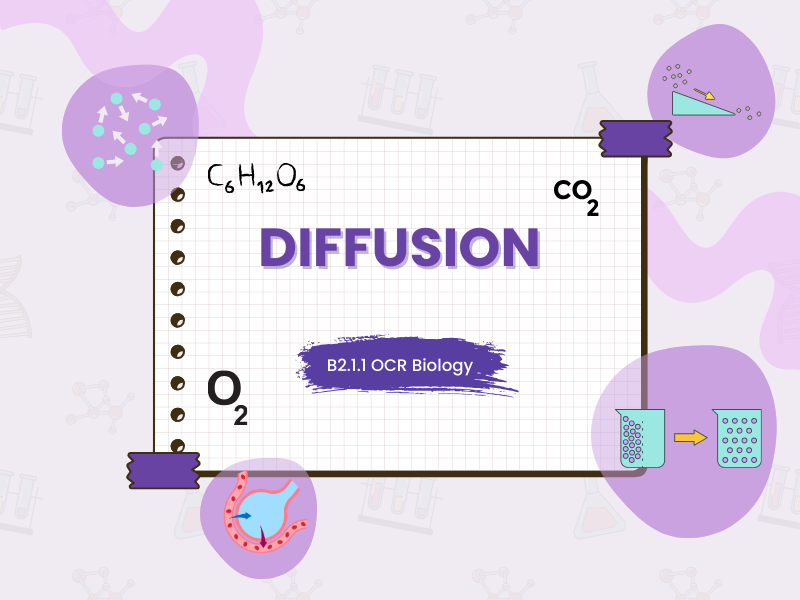
B2.1.1 Diffusion
This lesson introduces diffusion as a key process for the movement of substances in and out of cells. Students learn that diffusion is the net movement of particles from an area of higher concentration to an area of lower concentration, driven by the random motion of particles.
Key Specification Points
Students should be able to:
Define diffusion and describe it as a passive process that does not require energy.
Explain how factors such as:
Concentration gradient
Temperature
Surface area
affect the rate of diffusion.
Recognise examples of diffusion in living organisms, such as:
Oxygen and carbon dioxide moving during gas exchange in the lungs.
The diffusion of oxygen and glucose into cells for respiration.
Interpret and analyse data from practical investigations to explain diffusion patterns.
Lesson Focus
Typical teaching includes:
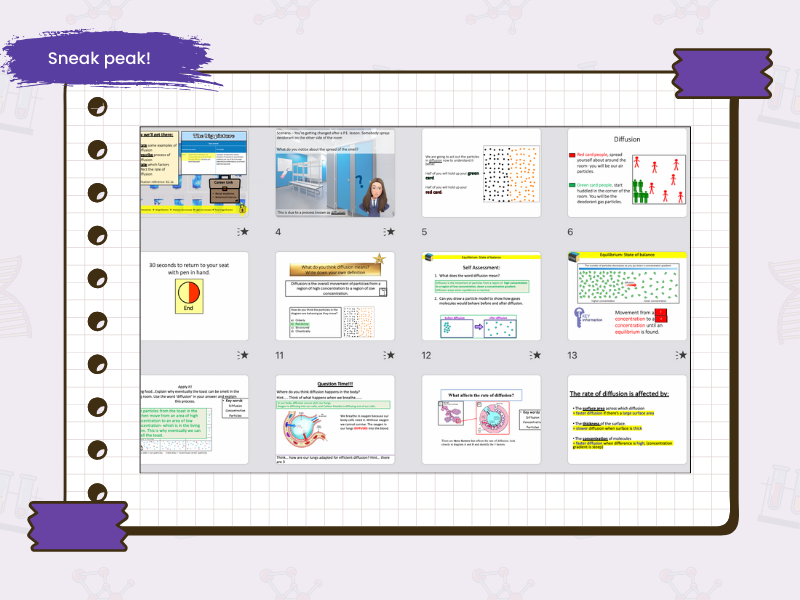
Particle model explanations (using diagrams to show random movement).
Everyday analogies (e.g., perfume spreading in a room, tea in hot vs. cold water).
Links to real biological contexts (lungs).
Get this resource as part of a bundle and save up to 26%
A bundle is a package of resources grouped together to teach a particular topic, or a series of lessons, in one place.
Something went wrong, please try again later.
This resource hasn't been reviewed yet
To ensure quality for our reviews, only customers who have purchased this resource can review it
Report this resourceto let us know if it violates our terms and conditions.
Our customer service team will review your report and will be in touch.
£1.50