


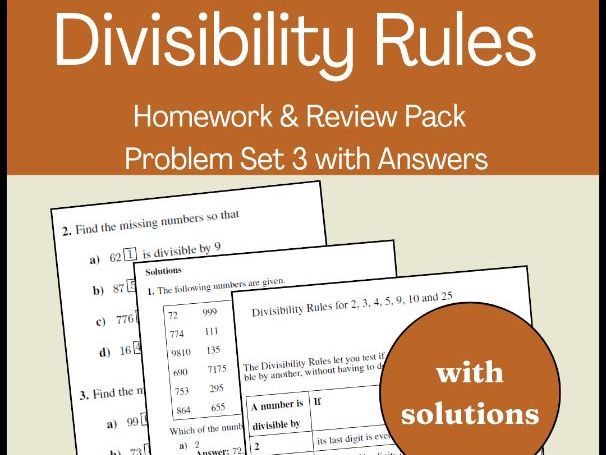
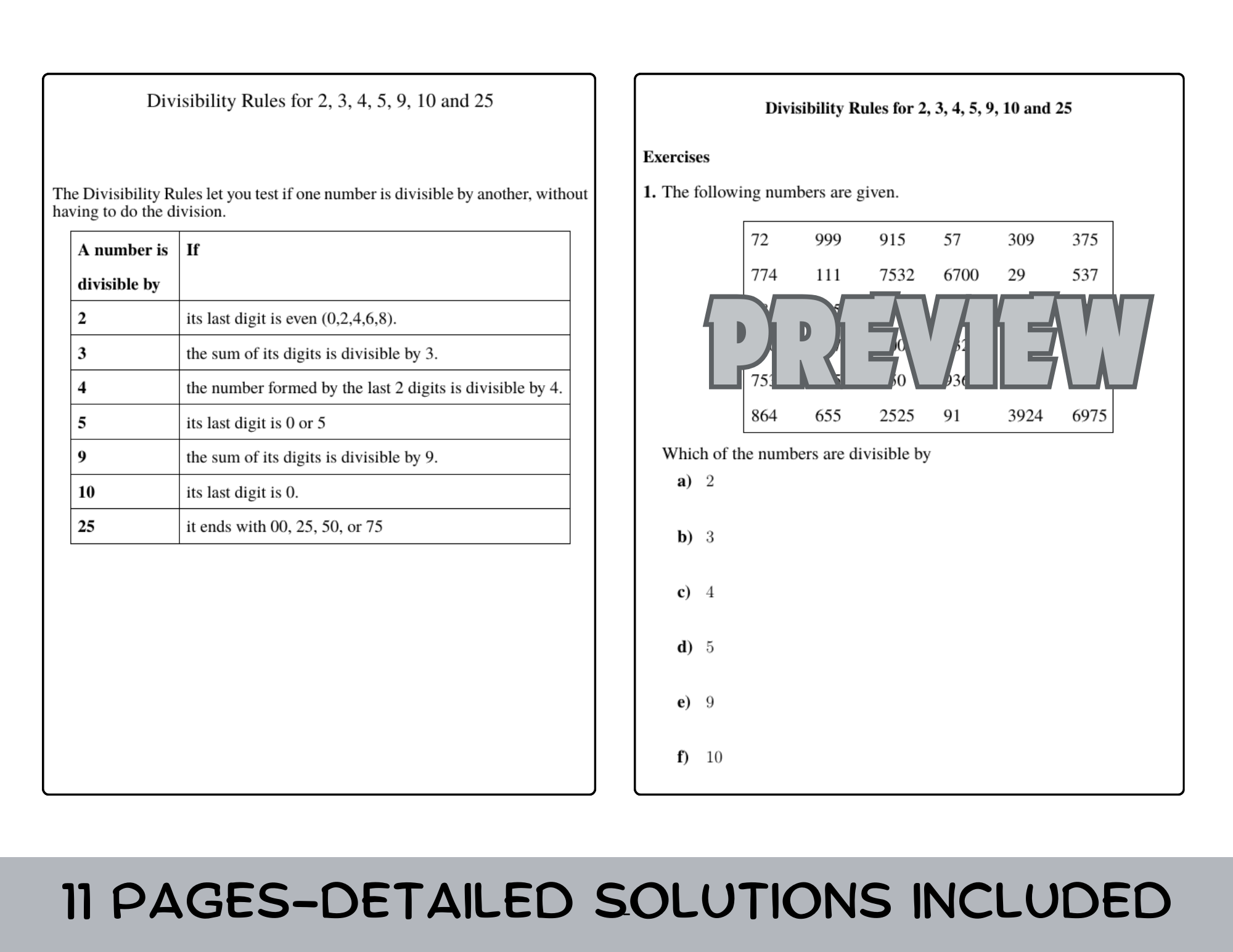
You will download introductory notes (rules and examples) and a long worksheet on the divisibility rules for numbers 2, 3, 4, 5, 9, 10 and 25. There are 2 pages with the divisibility rules and examples and a 6 page worksheet. In the exercises, the students are required to decide whether a given number is divisible by 2, 3, 4, 5, 9, 10 and 25, find missing digits in given numbers so that they are divisible or not divisible by one or more of these numbers, answer word problems on this topic and state whether some given statements are true or false. Detailed solutions are included.
Master divisibility rules with this comprehensive 11-page printable booklet, complete with a full answer key. It features a handy rules cheat sheet, step-by-step examples, a progressive 4-page student activity layout, and a full teacher guide. Pupils practice rules for 2, 3, 4, 5, 9, 10, and 25 through identification grids, missing-digit puzzles, word problems, and true/false logic questions.
Inside This 11-Page PDF Resource:
• Page 1: Reference Cheat Sheet – A clean, easy-to-read reference table outlining the rules for 2, 3, 4, 5, 9, 10, and 25.
• Pages 2–3: Step-by-Step Examples – Guided examples demonstrating how to apply each rule to both successful and unsuccessful number tests.
• Page 4: Target Number Sorting Grid – A comprehensive practice layout where pupils test a large bank of numbers against individual divisibility rules.
• Page 5: Missing Digit Puzzles – Fill-in-the-blank logic challenges where pupils find missing digits to satisfy single, double, and conditional rule combinations.
• Page 6: Word Problems & Reasoning Tasks – Higher-order thinking activities, including practical real-world division problems and maximum/minimum digit sorting.
• Page 7: True or False Concepts – Conceptual maths logic questions that require pupils to critically analyze how different divisibility rules interact with one another.
• Pages 8–11: Full Teacher Answer Key – A complete copy of the worksheets with all answers clearly marked for fast, stress-free marking or pupil self-evaluation.
Core Skills Covered
Pupils will gain fluency in applying rules for:
• Divisibility by 2: Checking if the final digit is even.
• Divisibility by 3 and 9: Evaluating the sum of the digits.
• Divisibility by 4: Checking the value formed by the last two digits.
• Divisibility by 5 and 10: Spotting specific number endings of 0 or 5.
• Divisibility by 25: Looking for endings of 00, 25, 50, or 75.
Curriculum & Age Suitability
• Age Range: Best suited for ages 9 to 12 (Year 5, Year 6, and Year 7).
• UK Curriculum Links: Excellent for upper Key Stage 2 (KS2) and lower Key Stage 3 (KS3) to reinforce prime numbers, factors, long division, and common multiples.
Something went wrong, please try again later.
This resource hasn't been reviewed yet
To ensure quality for our reviews, only customers who have purchased this resource can review it
Report this resourceto let us know if it violates our terms and conditions.
Our customer service team will review your report and will be in touch.
£2.25