


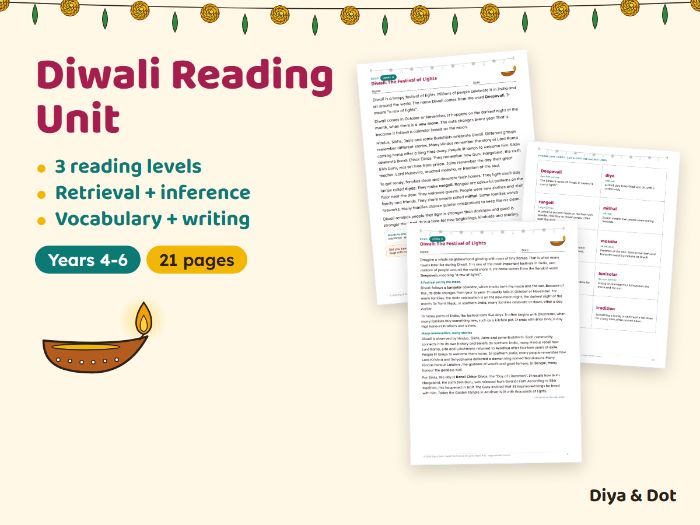
Diwali (Divali) reading comprehension for KS2, Years 4-6: one information text written at three reading levels, so the whole class learns the same core facts while each pupil reads at the right level. With retrieval and inference questions, vocabulary cards, a Venn diagram, a symmetry maths link, a writing task and full answer keys.
What’s inside (21 pages, A4 PDF)
- Page 1: cover
- Pages 2-3: teacher notes: a 3-lesson plan, curriculum links, a two-minute background, inclusive-classroom tips and a pronunciation guide
- Pages 4-5: Level A text (1 page) and 6 questions
- Pages 6-7: Level B text (1 page) and 7 questions
- Pages 8-11: Level C text (2 pages), 8 questions and a stretch question
- Page 12: 10 vocabulary cards (7 with pronunciations); page 13: match each word to its meaning
- Page 14: Venn diagram: compare Diwali with another festival of light
- Page 15: maths link: finish the rangoli across a line of symmetry, then find its other lines
- Pages 16-17: writing: an information text or a story about bringing “light” to someone, with a planner for each and a final-copy page
- Page 18: 3-2-1 exit tickets (2 per page)
- Pages 19-20: answer keys for all three levels, the vocabulary match and the rangoli
- Page 21: terms of use and credits
How to use it
- Lesson 1: pre-teach the vocabulary, then give each pupil Level A, B or C. Levels B and C add detail to the same core facts, so you can still discuss one text together.
- Lesson 2: the questions, the vocabulary match and the Venn diagram.
- Lesson 3: the rangoli page and the writing task, then the 3-2-1 exit ticket.
It also works as a literacy carousel, an RE reading task or a cover lesson. Pupil pages are labelled Level A, B or C; no level is tied to a year group.
Written with care
The text explains how Hindus (including traditions from northern and southern India and Bengal), Sikhs (Bandi Chhor Divas), Jains and some Buddhists celebrate, and describes beliefs as beliefs (“Many Hindus remember…”). The illustrations are simple, original vector drawings: no photographs and no images of gods, goddesses or Gurus. The text was fact-checked and reviewed by Diya & Dot (September 2026). Diwali 2026 is on Sunday 8 November.
Curriculum links
- KS2 English reading: retrieve and record information from non-fiction; explain the meaning of words in context; identify and summarise main ideas; inference
- KS2 English writing: non-narrative (Option A) or narrative (Option B)
- Year 4 maths, geometry: lines of symmetry
- RE: Hinduism, Sikhism and Jainism; festivals of light
Please note: this is a printable PDF, not an editable file. Also in the Diya & Dot shop on Tes: the “What is Diwali?” PowerPoint lesson and Rangoli Symmetry Maths.
Get this resource as part of a bundle and save up to 20%
A bundle is a package of resources grouped together to teach a particular topic, or a series of lessons, in one place.
Something went wrong, please try again later.
This resource hasn't been reviewed yet
To ensure quality for our reviews, only customers who have purchased this resource can review it
Report this resourceto let us know if it violates our terms and conditions.
Our customer service team will review your report and will be in touch.
£4.00