




GCSE KS4 Combined science
AQA specification 4. 6.1. 3 DNA and the genome Combined Science specification.
Complete lesson ready to use, just download, print and go!
Designed for teachers to deliver (specialist and non-specialists) but I have found more & more students need to access resources independently so my lessons are structured in a way that students can navigate for remote learning or to catch up on missed content. Can also be used for a flipped learning approach.
This lesson includes a modelling activity, the equipment is listed below, please remember to complete your own risk assessment if you choose to use sweets.
Equipment:
Sellotape
Cocktail sticks
9 different types of sweet OR you could use coloured plasticine balls/shapes.
Learning Objectives:
Describe the structure of DNA
Define the genome
Describe the importance of understanding the human genome
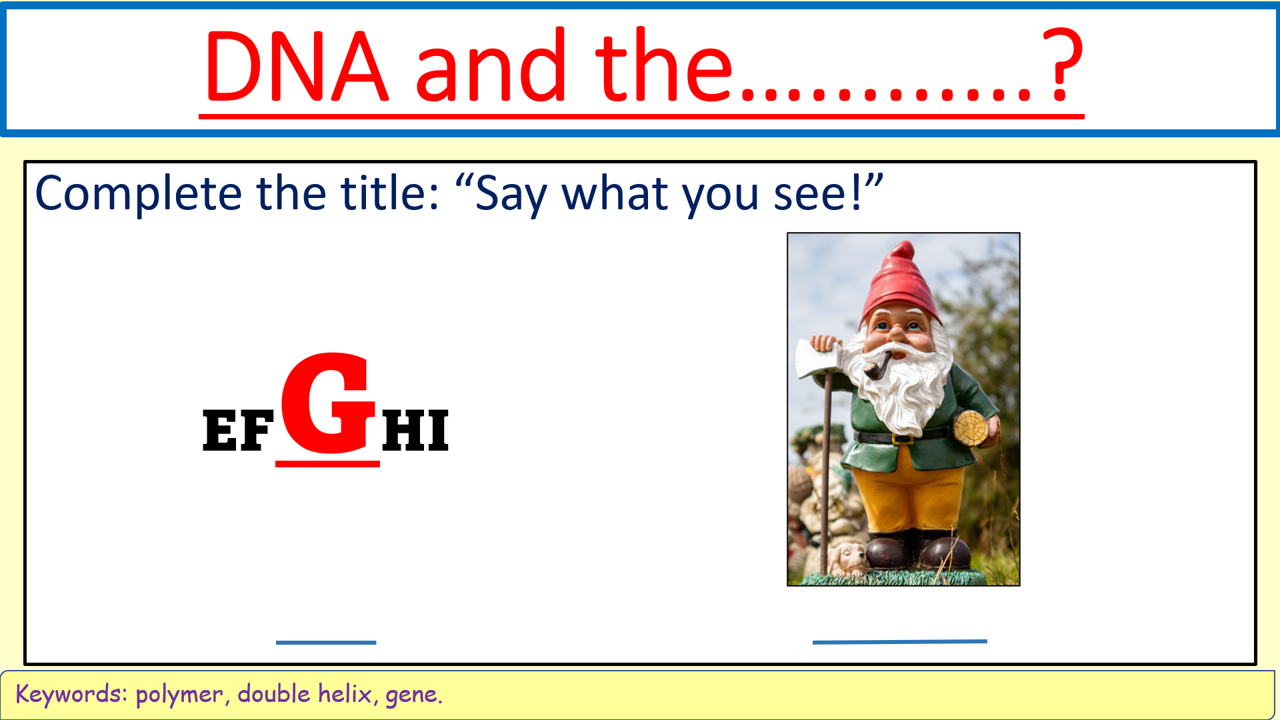
Starter: Complete the title, simple ‘say what you see’ activity to get students immediately thinking about the terminology and the lesson ahead.
Main:
Whole class questioning on terminology ‘monomer/polymer’ linked into chemistry & etymology. Slides 4-7.
Introduce the idea that DNA is a polymer made up of monomers called nucleotides (slide 8).
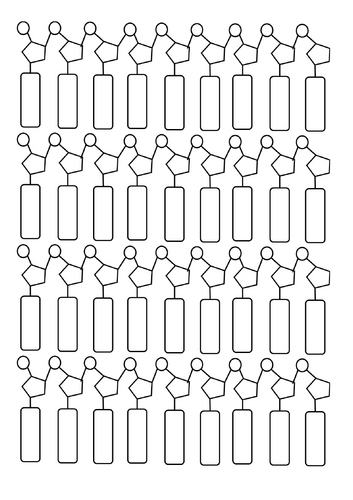
Each student has a model nucleotide (use the worksheet ‘nucleotide’ as your template), each row of students must join nucleotides using the spare ‘bond’ (a strip of card or paper) and glue to make a strand of DNA – thus demonstrating it is a) a polymer & b) made of 2 strands.
The rows of students with the single strands then line up opposite each other holding their single strand which will then be joined together to form the double stranded molecule (use Sellotape).
The penultimate stage of the model will be to twist it forming the helix structure. Emphasis double (2 strands) helix (twisted shape).
Activity 3: Students draw a diagram in their book of the structure of DNA labelling with the correct keywords.
Activity 4: Ask 2 students to ‘condense’ the DNA to form a chromosome, they can just squash it together – all students to then add this onto their diagram. (slide 14 & 15).
Students to discuss links between gene, amino acids, and protein.
Complete summary questions plus extension question linking to mutations, answers provided for self-assessment (slide 21-23).
Plenary:
What is the genome? Write definition. Slides 25-26)
Introduce idea of uses of this information with tracing of native Americans into and through north America.
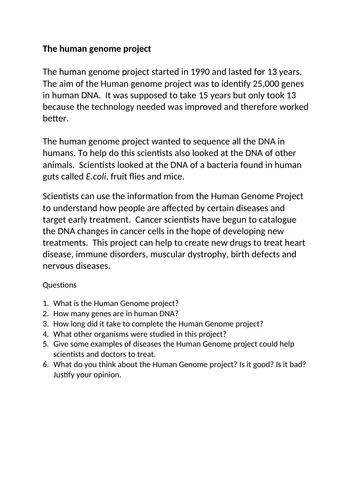
Human genome project comprehension worksheet - activity about the genome including questions on medical applications of genome technology. Answers on next slide for self-assessment
Something went wrong, please try again later.
This resource hasn't been reviewed yet
To ensure quality for our reviews, only customers who have purchased this resource can review it
Report this resourceto let us know if it violates our terms and conditions.
Our customer service team will review your report and will be in touch.
£3.50