


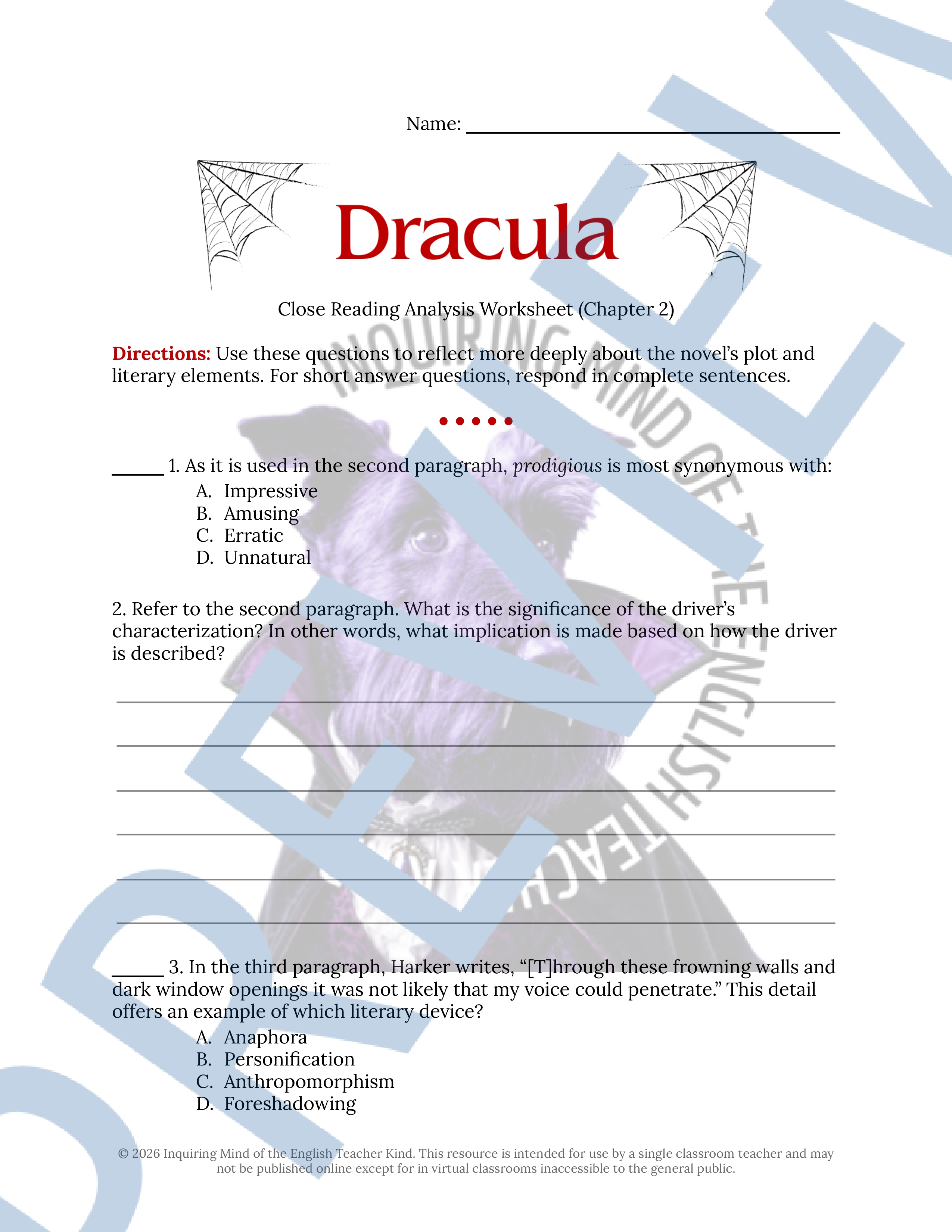
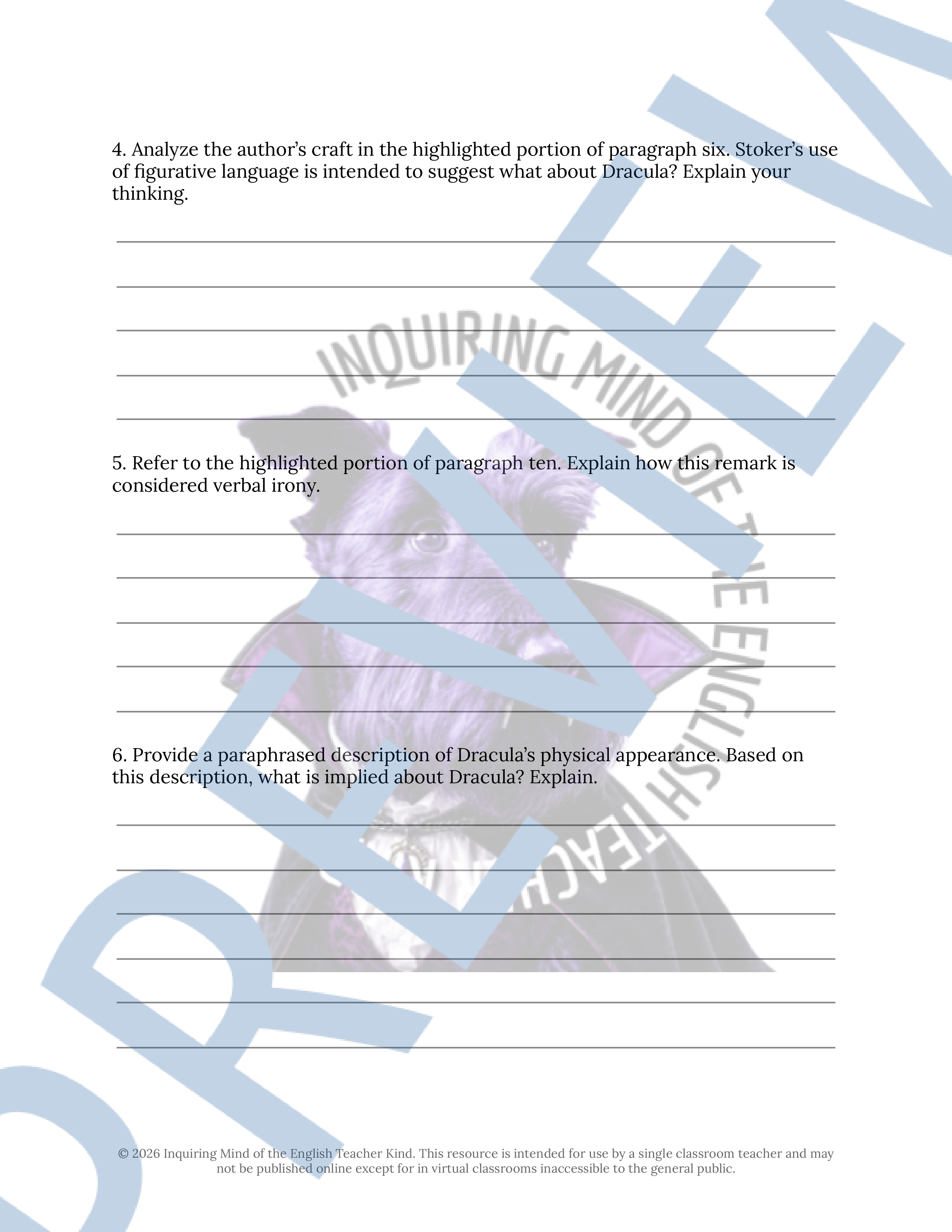
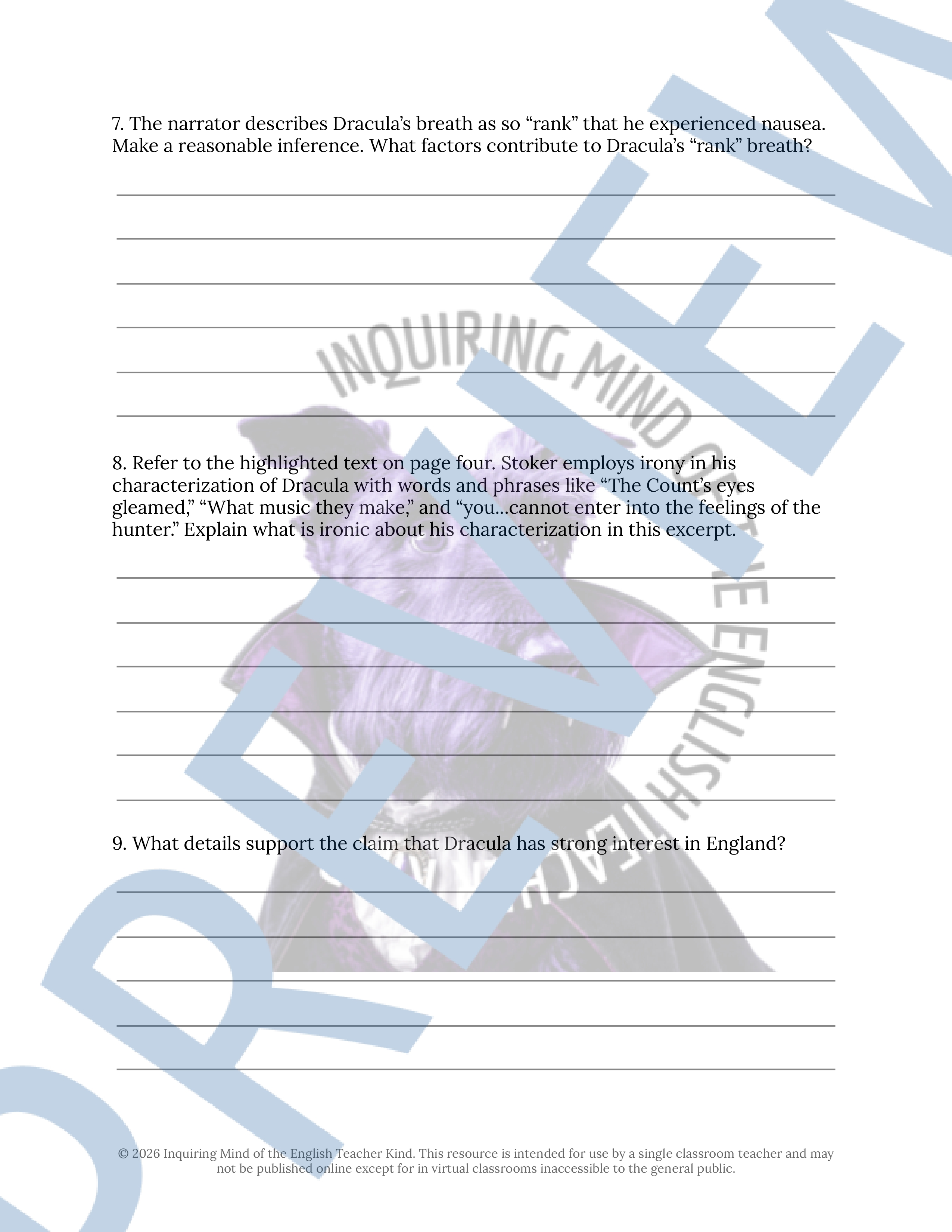
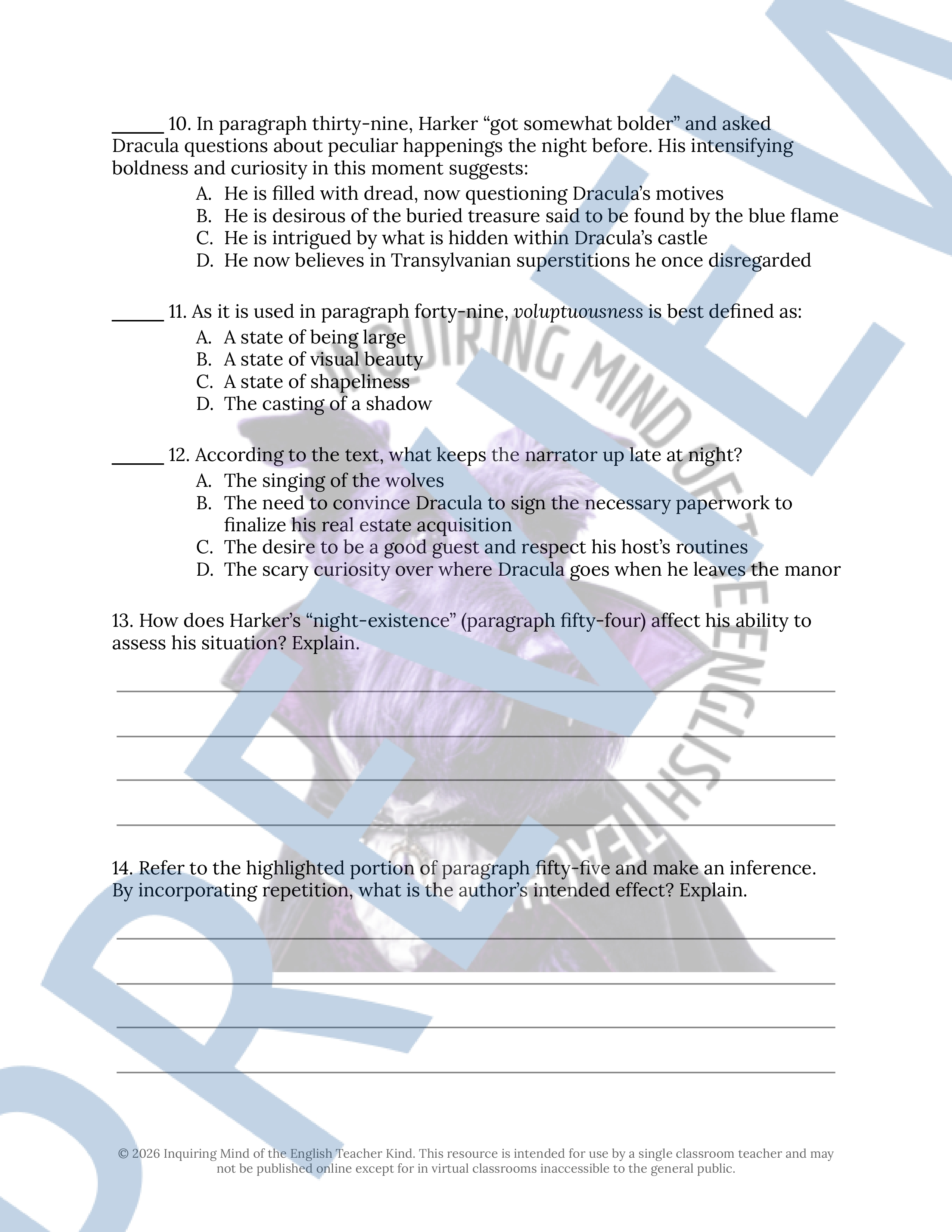
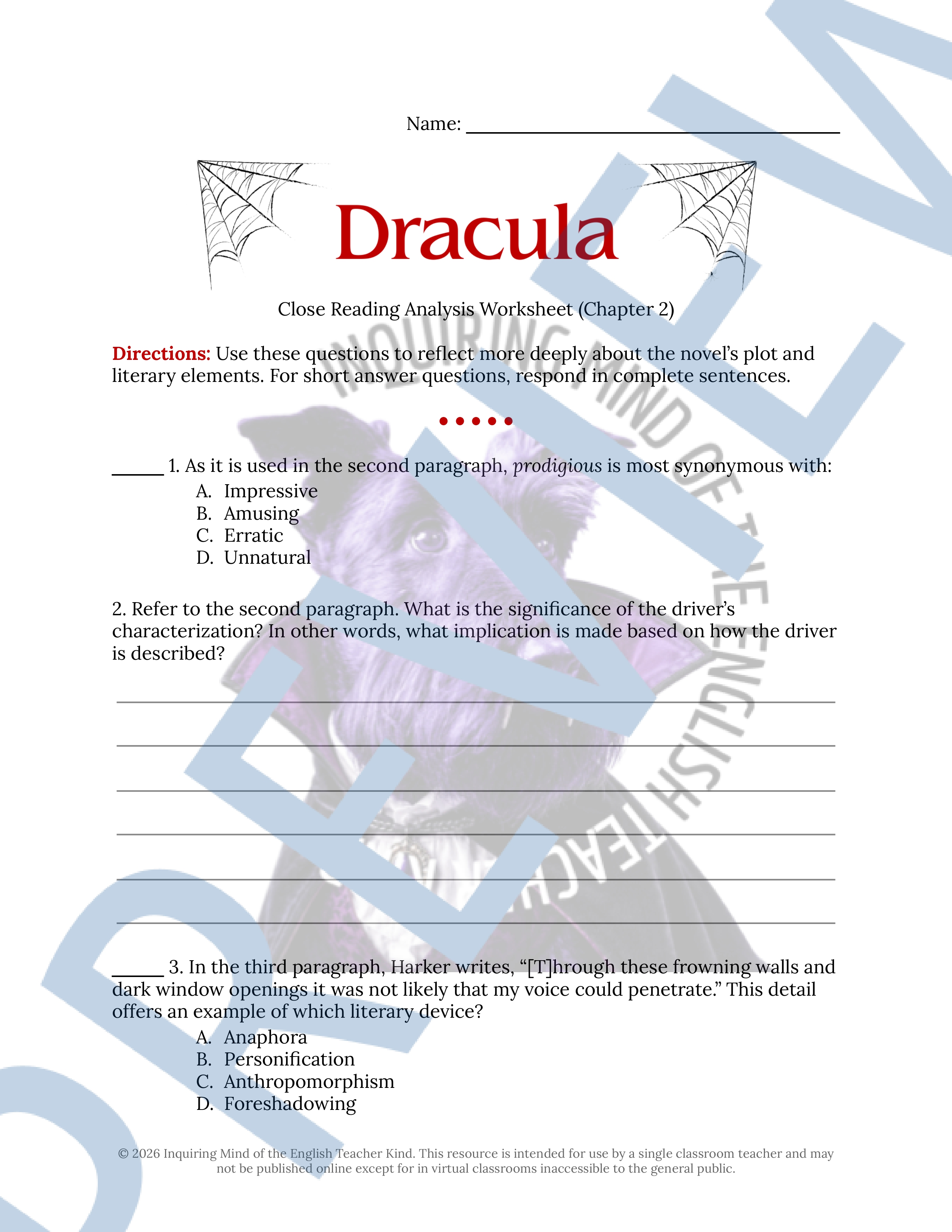
Help readers better understand Gothic horror with this literary analysis worksheet addressing chapter 2 of Bram Stoker’s Dracula. Ideal for high school English classes focusing on Irish authors, vampire literature, or epistolary fiction (especially during the Halloween season), this activity guides students through rigorous, text-based questions that push them to explore characterization, plot development, literary elements, and more. An answer key and copy of the chapter are included. Materials are delivered in editable Word Document and printable PDF formats.
By completing this close reading activity, students will:
- Identify what the text says explicitly and implicitly
- Define words and phrases as they are used in the text
- Select the most appropriate synonym for a word in the text
- Discern the intended effects of the author’s narrative techniques with emphasis on why the author utilizes repetition in context
- Examine how complex characters think, behave, interact, and develop
- Apply knowledge of literary devices with emphasis on personification, verbal irony, and situational irony
- Support claims and inferences with sound reasoning and relevant evidence
- Write about Gothic literature with clarity, accuracy, and precision
Get this resource as part of a bundle and save up to 39%
A bundle is a package of resources grouped together to teach a particular topic, or a series of lessons, in one place.
Bundle
Dracula by Bram Stoker Close Reading Analysis Worksheets Bundle (Chapters 1-14)
Help high school students go beyond general reading comprehension and support the development of critical thinking skills with this set of close reading analysis worksheets covering chapters 1 through 14 of Bram Stoker's Gothic novel *Dracula*. Answer keys and copies of the relevant chapters, which are in the public domain, are included. Materials are delivered in Word Document and PDF formats. By completing these close reading activities, students will do the following: * Identify what the text says explicitly and implicitly * Define words and phrases as they are used in the text * Verify interpretations of language using reference materials as needed * Isolate examples of internal conflict in context * Discern the intended effects of the author's narrative techniques * Determine the function of a given passage * Examine how complex characters think, behave, interact, and develop * Compare and contrast characters * Apply knowledge of various literary devices including situational irony, dramatic irony, foreshadowing, symbolism, metaphor, personification, and more * Conduct brief research on relevant topics * Come to class better prepared to engage in collaborative discussions * Support claims and inferences with sound reasoning and relevant evidence * Write about Gothic literature with clarity, accuracy, and precision * And more
$30.00
Bundle
Dracula Chapters 1, 2, 3, and 4 Quiz, Literary Analysis Worksheets, Vocabulary Activities, and Answer Keys
This bundle covers chapters 1, 2, 3, and 4 of Bram Stoker's *Dracula* and includes a **reading comprehension quiz**, **vocabulary worksheet**, **crossword puzzle**, **word search**, **four literary analysis activities**, and **answer keys**. Ideal for high school English classes focusing on Gothic literature and epistolary fiction (especially during the Halloween season), these resources make differentiating based on student readiness levels easier. By engaging with these materials, students will: * Identify what the text states explicitly * Define challenging vocabulary * Discern the best application of words as they are used in sentences * Determine the function of a given excerpt * Explore how setting contributes to mood * Discern the intended effects of the author's narrative techniques * Examine how complex characters think, behave, interact, and develop * Explain how gender norms of 19th Century England are broken * Apply knowledge of literary devices including situational irony, verbal irony, dramatic irony, foreshadowing, metaphor, oxymoron, epiphany, and more * Read a portion of Emily Gerard's "Transylvanian Superstitions" to make sense of a character's actions and thinking * Conduct brief research on gypsies to explain why Harker believes they may be helpful to him * Support claims and inferences with sound reasoning and relevant evidence * Write about Gothic literature with clarity, accuracy, and precision
$15.75
Something went wrong, please try again later.
This resource hasn't been reviewed yet
To ensure quality for our reviews, only customers who have purchased this resource can review it
Report this resourceto let us know if it violates our terms and conditions.
Our customer service team will review your report and will be in touch.
$3.50