


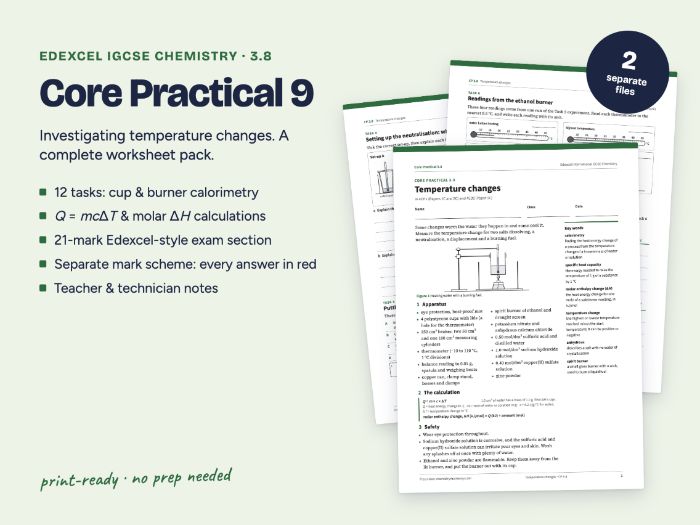
A complete Edexcel International GCSE Chemistry (4CH1) and Science Double Award (4SD0) Core Practical 3.8 worksheet: investigating temperature changes accompanying salts dissolving in water, neutralisation, displacement and combustion, with full mark scheme.
Two separate files
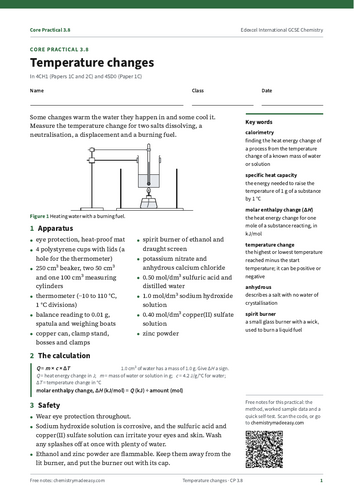
- Worksheet (12 pages): the student copy, print-ready in black and white
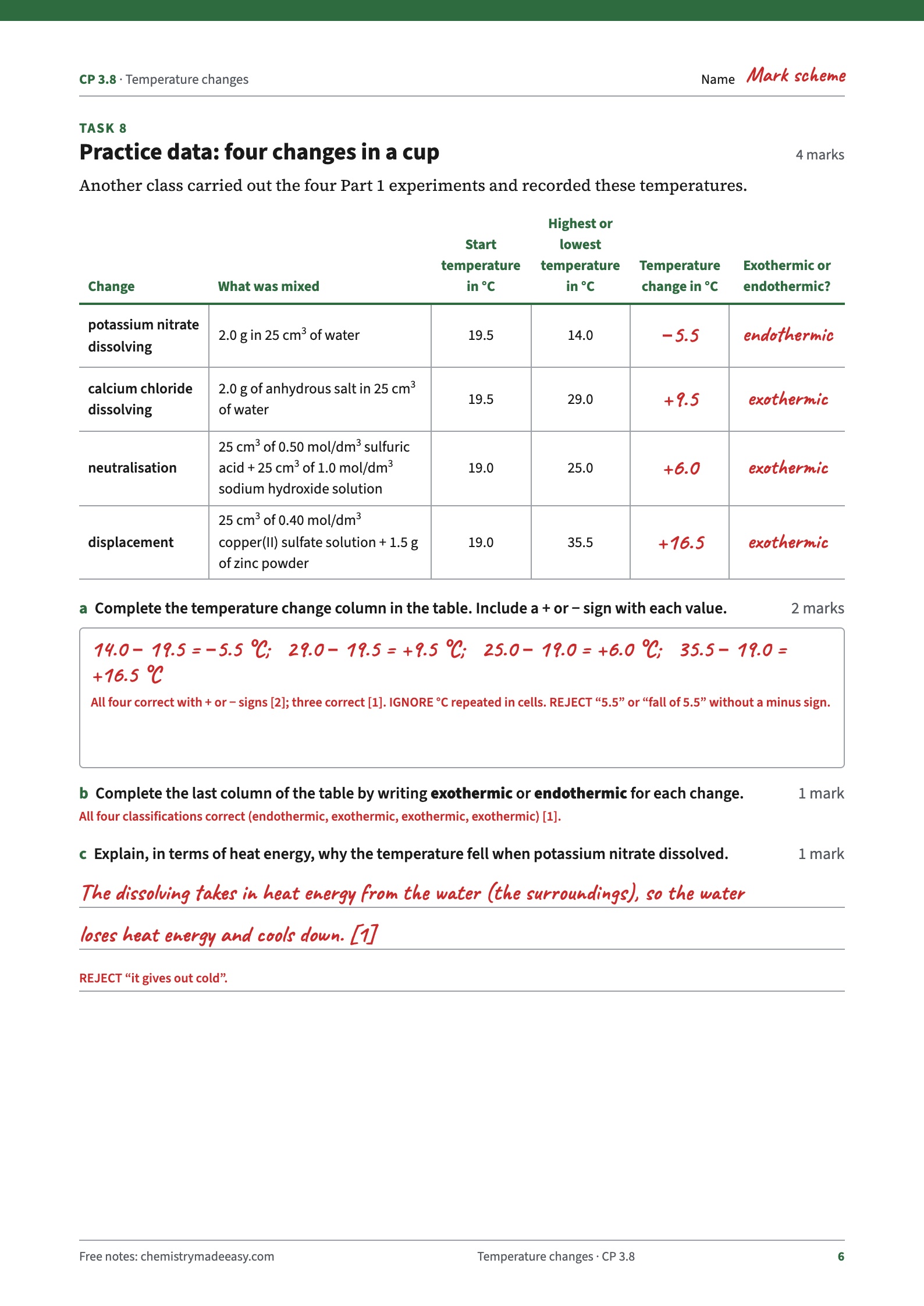
- Mark scheme (16 pages): every answer written in red with marks, plus teacher and technician notes, marking guidance and an Edexcel-style mark scheme for the exam
Use it during the practical, as a follow-up lesson or as homework. Students who miss the lab can still work through a full set of thermometer and balance readings and a practice data table.
What students do
- Label the calorimetry burner set-up from a 10-word bank (with two distractors)
- Explain three practical choices for the burner run (copper can, weighing the burner with its cap on, thermometer bulb off the base)
- Follow the 10-step polystyrene cup method for two salts dissolving, a neutralisation and a displacement, with two “why?” prompts
- Pick the correct neutralisation set-up from three drawn panels, and explain what is wrong with each of the other two
- Put eight steps for the ethanol spirit burner experiment in order
- Read two thermometer scales to 0.5 °C and two two-decimal-place balance displays from an ethanol combustion run
- Record their own results for both parts, or use the practice table to calculate signed temperature changes (+ or -), classify each change as exothermic or endothermic, and explain why the temperature falls during endothermic dissolving
- Calculate heat energy Q = mcΔT in J and kJ, moles of ethanol burned, and the molar enthalpy change ΔH in kJ/mol with its sign
- Give two reasons why the spirit burner value is much smaller than the data-book value, and calculate the percentage of the data-book value
- Circle an anomalous repeat for the zinc displacement, calculate the mean of the other four results, and explain why doing more repeats does not bring the mean closer to the theoretical rise
- Decide how five changes to the method affect the size of the temperature change (bigger, smaller or no change) and explain each one
- Answer 8 exam-style questions (21 marks) in the Edexcel style, including two multiple-choice questions, a neutralisation equation, burning fuel in a poorly ventilated room, zinc with copper(II) sulfate, a fuel-mass calculation, acid rain and a 6-mark displacement plan
For teachers
- Quantities per group, timings for a 60-minute lesson (or two shorter sessions), the practical and maths skills covered, and a safety note for each substance used
- Notes on realistic class efficiencies, a 4CH1-only molar enthalpy extension, and live-lab options so the practice data is not the answer key
- Common slips to watch for
All questions are original. This is an independent resource, not endorsed by Pearson Edexcel.
Something went wrong, please try again later.
This resource hasn't been reviewed yet
To ensure quality for our reviews, only customers who have purchased this resource can review it
Report this resourceto let us know if it violates our terms and conditions.
Our customer service team will review your report and will be in touch.
£2.00