


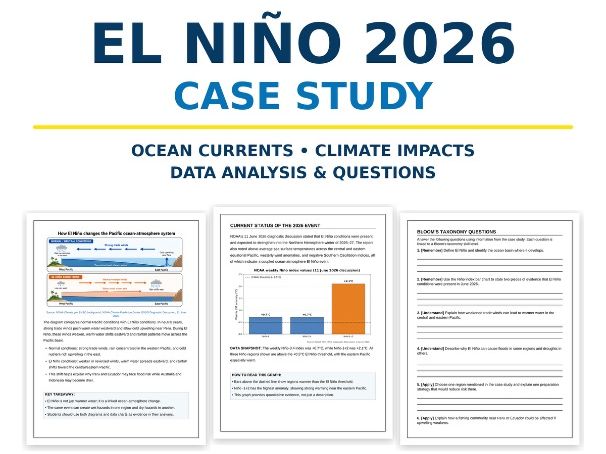
Explore El Niño, ocean currents, and global climate impacts with this 16-page science case study examining the 2026 El Niño event. Students investigate how changes in Pacific Ocean temperatures and trade winds influence weather patterns, marine ecosystems, and communities around the world.
Designed for high school Environmental Science, Geography, and IB Environmental Systems and Societies (ESS), this resource combines scientific explanations, diagrams, data interpretation, and critical thinking questions.
What’s Included?
-
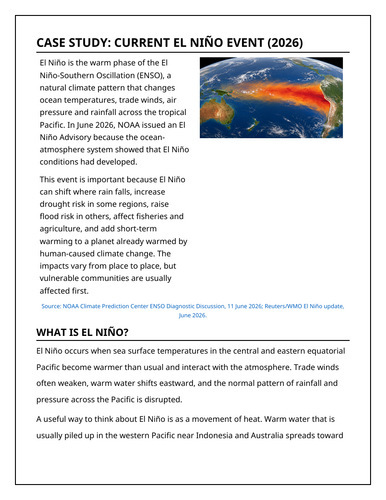
2026 El Niño Case Study – Explore the causes, development, and potential impacts of the event using information and forecasts from June 2026.
-
Ocean–Atmosphere Diagrams – Compare normal Pacific conditions with El Niño conditions, including trade winds, warm water movement, and upwelling.
-
Data Analysis Graphs – Interpret Pacific sea surface temperature anomalies and forecast probabilities.
-
Environmental Impacts – Examine flooding, drought, marine food webs, biodiversity, and coral stress.
-
Social & Economic Impacts – Investigate effects on food security, fisheries, agriculture, water resources, and human health.
-
Management Strategies – Evaluate early warning systems, disaster preparedness, and adaptation.
-
Systems-Thinking Diagram – Connect ocean changes to environmental hazards and societal consequences.
-
10 Bloom’s Taxonomy Questions – Progress from understanding scientific concepts to analysis, evaluation, and application.
-
Extended Response Task – Examine connections between environmental, social, and economic challenges.
-
Answer Key & Extension Guidance – Includes suggested responses to support marking and discussion.
Learning Outcomes
Students will explain the processes responsible for El Niño, interpret climate data, analyse environmental and socioeconomic impacts, and evaluate strategies for reducing vulnerability.
Curriculum Connections
IB ESS: Relevant to the study of ocean circulation, climate systems, environmental change, natural hazards, and sustainability.
Environmental Science & Geography: Supports learning about ocean–atmosphere interactions, global climate patterns, and human responses to environmental hazards.
This case study provides a practical way to connect climate science with real-world environmental challenges.
Note: The case study uses June 2026 observations and forecasts. Forecasts may change as the event develops.
The Caffeinated Science Teacher
Something went wrong, please try again later.
This resource hasn't been reviewed yet
To ensure quality for our reviews, only customers who have purchased this resource can review it
Report this resourceto let us know if it violates our terms and conditions.
Our customer service team will review your report and will be in touch.
£3.00