


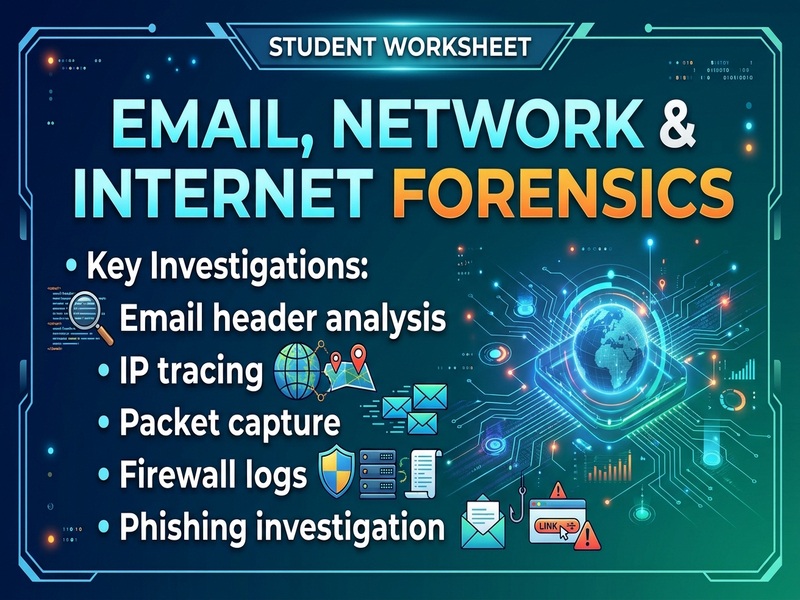
Transform Your Classroom into a Real-World Cybersecurity Operations Center!
Are you looking for a dynamic, project-based curriculum to teach the fundamentals of digital network forensics? This comprehensive unit provides everything you need to guide your students from theory to practice, turning them into Junior Security Analysts ready to tackle real-world cyber threats.
This isn’t just a set of worksheets; it’s a complete, simulated investigation experience. Students will learn to think like digital pathologists, dissecting the evidence left behind by cybercriminals. They will move beyond theory to actively analyze phishing emails, trace malicious IP addresses, examine packet captures (PCAPs), and decode firewall logs. The entire unit is framed as a “Security Operations Center (SOC) Simulation,” promoting critical thinking, collaboration, and career-ready skills.
What’s Included in This Turnkey Unit?
Part 1: The Instructional Guide (18 Pages): A professional-grade textbook covering the core concepts of network forensics.
Chapter 1: Email Header Analysis & Phishing Investigation
Chapter 2: IP Tracing & Network Attribution (WHOIS, BGP, Geolocation)
Chapter 3: Packet Capture (PCAP) Analysis (TCP Handshake, DNS Tunneling)
Chapter 4: Firewall Logs & Intrusion Detection
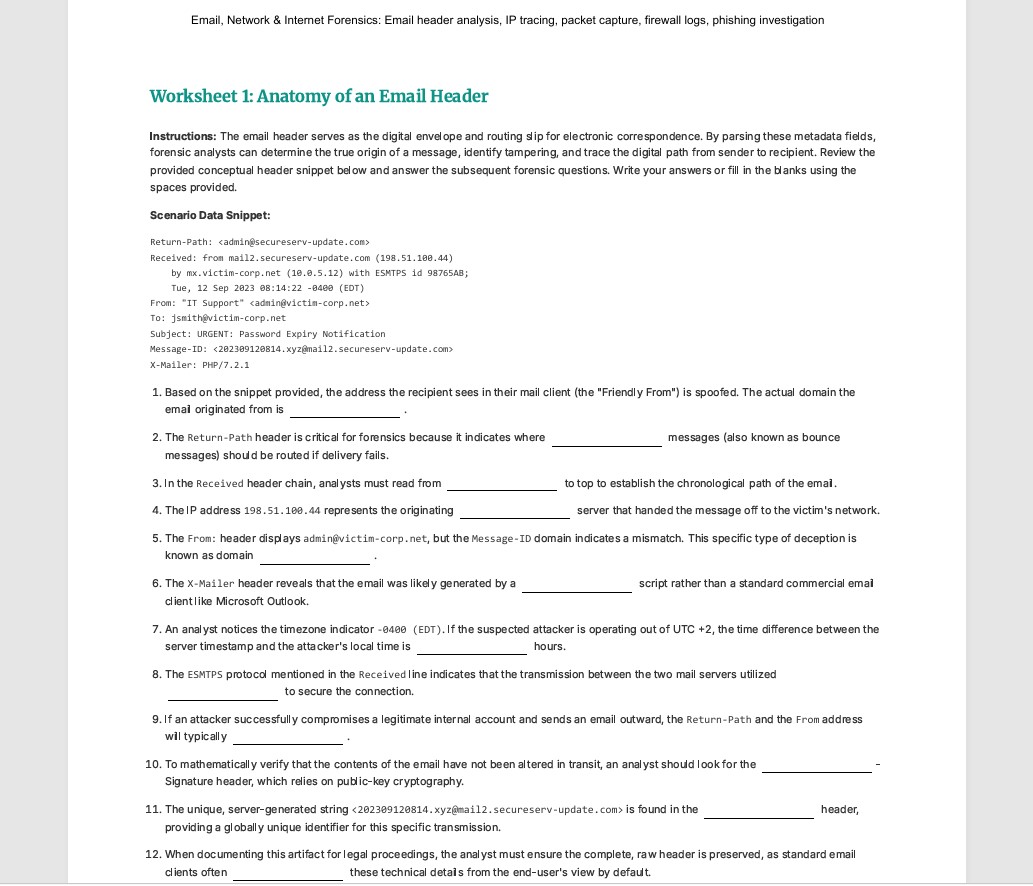
Part 2: The Student Workbook (12 Pages): Ten engaging, scenario-based worksheets that put students in the role of a Junior Security Analyst. Includes a final capstone project that ties all concepts together.
Part 3: The SOC Manager’s Toolkit (13 Pages - For Teachers Only):
Forensic Visualizations: High-quality diagrams of email headers, TCP handshakes, and firewall logs to deconstruct complex topics. Perfect for presentations and classroom displays.
Comprehensive Answer Key: Authoritative answers for every single question in the guide and workbook.
Teacher Implementation Guide: A step-by-step pedagogical playbook on how to run the “Simulated SOC,” including classroom setup, lesson workflow, Socratic questioning techniques, and differentiation strategies for advanced students.
Students Will Learn To:
Analyze raw email headers to identify spoofing and trace a message’s true origin.
Investigate suspicious IP addresses using real-world attribution techniques.
Dissect network traffic in packet captures to identify malicious behavior.
Read and interpret firewall logs to reconstruct the timeline of a cyberattack.
Understand critical protocols and concepts like SPF, DKIM, DMARC, TCP, DNS, and more.
Perfect for Cybersecurity, Digital Forensics, Computer Science, and CTE Information Technology pathways. The curriculum uses an immersive “Junior Security Analyst” role-play model that dramatically increases student engagement while building authentic workplace skills.
Whether you’re teaching high school cybersecurity pathways, community college intro forensics, or running after-school cyber clubs, this resource provides everything needed to deliver high-impact, career-ready instruction
Something went wrong, please try again later.
This resource hasn't been reviewed yet
To ensure quality for our reviews, only customers who have purchased this resource can review it
Report this resourceto let us know if it violates our terms and conditions.
Our customer service team will review your report and will be in touch.
$27.00