


A complete cross-curricular dance unit that turns Escher-inspired pattern, symmetry and transformation into choreography. It includes a teacher handbook, student workbook, activity guide, 12 visual stimulus cards and a presentation.
How can mathematical patterns and visual illusions be translated into movement? This ready-to-teach unit gives students a clear way into composition. They explore translation, rotation, reflection, tessellation and perspective through their bodies, then use them to make a 1-2 minute group dance.
Students experience each concept physically before naming it. Dance stays the central learning area, and the maths and visual art give them a framework for making and describing choreographic choices. No dance or maths expertise is needed from you, and no acrobatics are needed from them.
What’s included
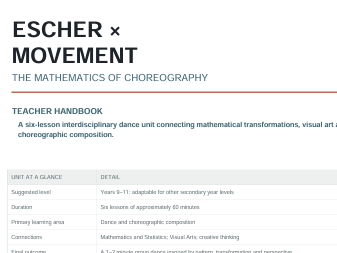
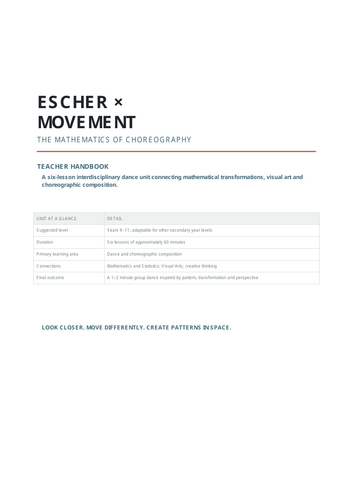
Teacher Handbook: six fully planned 60-minute lessons with timings, questions to deepen learning, teaching notes, and differentiation and extension for each lesson. It also has a four-level assessment rubric, a teacher evidence record, safety and inclusion guidance, and a pre/during/post-unit checklist.
Student Workbook (Years 9-11): about 30 pages covering artwork investigation, the mathematics of movement, practical tasks, motif development, a choreographic map, rehearsal notes, peer and viewer response, self-assessment and extension challenges.
Teacher Activity Guide: a practical companion to the cards. It has a four-step routine (Look, Interpret, Experiment, Refine), warm-ups and group tasks for each card category, a culminating composition challenge with success criteria, and a Glow + Grow peer feedback structure.
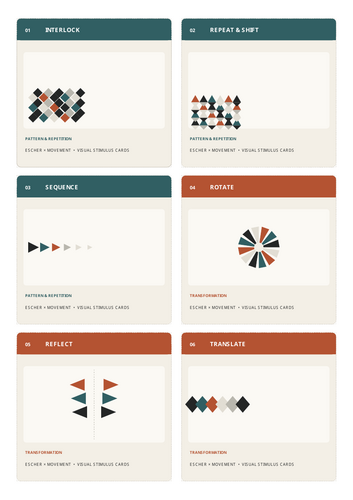
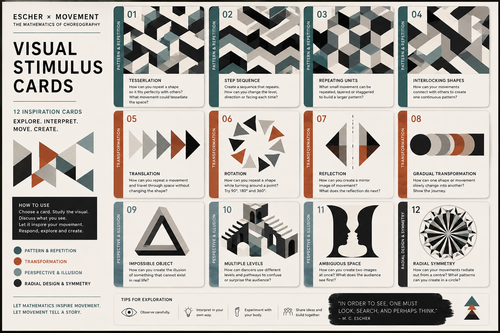
12 Visual Stimulus Cards: original abstract geometric illustrations, each with a visual prompt, dance challenge and “push your idea” extension. They are grouped as Pattern & Repetition, Transformation, Perspective & Illusion, and Radial Design & Symmetry.
Teacher Presentation (PowerPoint): slides to support delivery in the classroom.
Artwork teaching notes: focus questions and dance translations for four Escher works (Sky and Water I, Metamorphosis II, Relativity, Circle Limit IV), with links to official collections for viewing.
Students will
Identify and explain pattern, symmetry, tessellation and perspective
Demonstrate at least three transformations through movement
Create, develop and refine an original movement motif
Use space, levels, pathways and group structures (unison, canon, accumulation) deliberately
Explain how visual and mathematical ideas shaped their choreographic decisions
Why teachers like it
Supports Dance, Maths and Visual Arts links in one unit
Fully differentiated, with seated and upper-body options, and no physical contact required
Assesses the quality of choreographic decisions, not athleticism
Cards can be used alone as quick starters or composition stimuli
Print-friendly, with editable-style planning pages
Something went wrong, please try again later.
This resource hasn't been reviewed yet
To ensure quality for our reviews, only customers who have purchased this resource can review it
Report this resourceto let us know if it violates our terms and conditions.
Our customer service team will review your report and will be in touch.
£8.00