


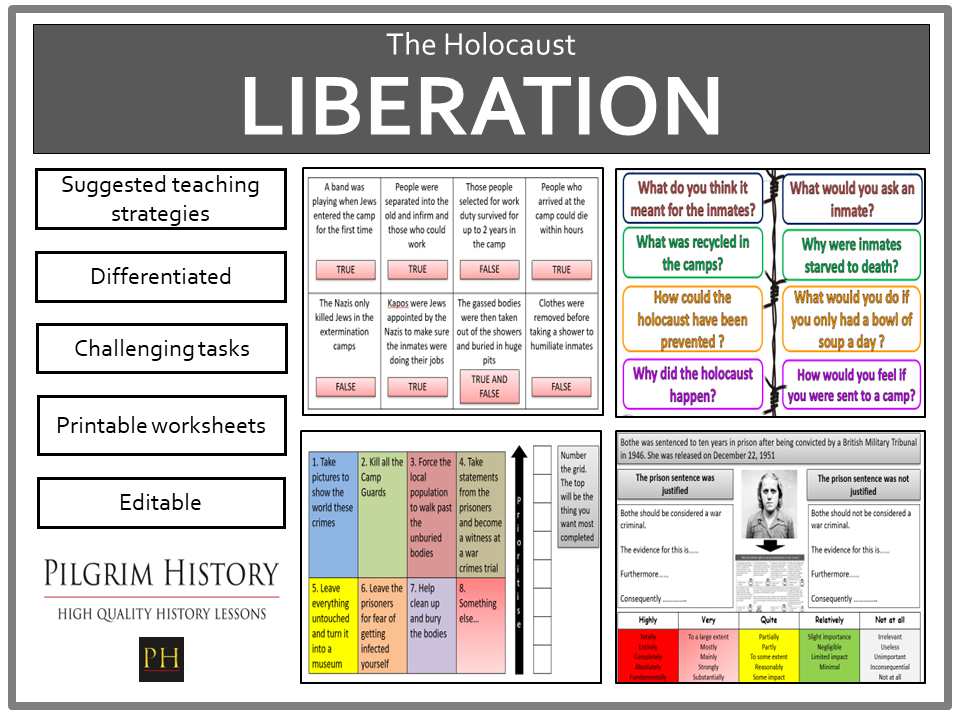
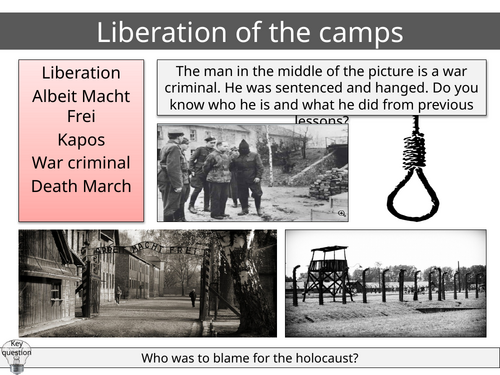
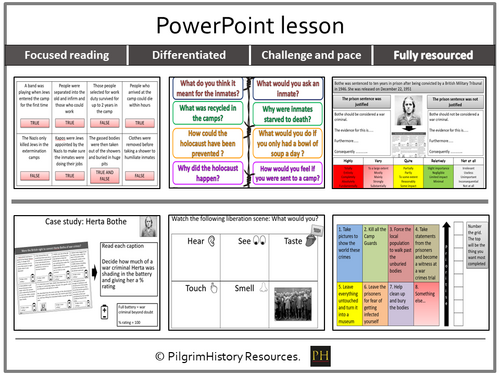
The aim of this lesson is to investigate the liberation of Nazi concentration and extermination camps in 1945 and examine how Allied soldiers reacted when confronted with evidence of Nazi persecution and mass murder.
Students begin by investigating the liberation of camps including Auschwitz and Bergen-Belsen, exploring what Allied soldiers discovered and how their reactions changed as the scale of Nazi atrocities became clear. Using historical photographs, testimony and carefully selected film footage, students consider the responsibilities of those who entered the camps and the importance of recording and preserving evidence.
Students are placed in the position of the liberators and asked to consider how they might have responded to what they encountered. They explore different possible responses, including documenting evidence, helping survivors and preserving the camps as historical evidence. This encourages thoughtful discussion about responsibility, evidence and historical judgement.
The lesson is supported by powerful contemporary film footage and visual sources. Due to the distressing nature of some of this material, it should be used carefully and sensitively.
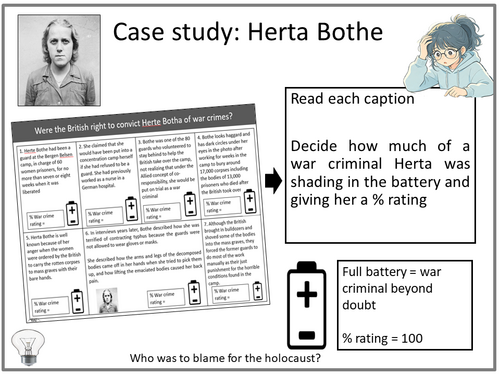
The second part of the lesson focuses on Herta Bothe, a former concentration camp guard who was tried by a British military tribunal after the Second World War. Students examine the evidence surrounding her role and actions and consider the difficult question of individual responsibility within the Nazi camp system.
The central enquiry running throughout this lesson and the wider sequence asks: “Who was to blame for the Holocaust?” Students revisit this question using a structured lightbulb activity, allowing them to track how their ideas develop as they encounter further evidence. This helps students recognise the complexity of responsibility and avoid reducing the Holocaust to the actions of a single individual.
The lesson concludes by asking students to use the evidence they have gathered to develop and support their own historical interpretation of responsibility for the Holocaust.
This enquiry-based lesson provides an excellent foundation for GCSE History, developing students’ skills in historical interpretation, source analysis, responsibility, evidence and extended historical judgement.
Included in this lesson:
Fully editable PowerPoint
Liberation of Auschwitz and Bergen-Belsen
Allied reactions to the Nazi camps
Contemporary photographs, sources and film footage
Herta Bothe case study
British military tribunal investigation
Individual responsibility and obedience
Retrieval practice
Differentiated resources
Suggested teaching strategies
Please leave a review if you find this resource useful. Your feedback is greatly appreciated.
Something went wrong, please try again later.
This resource hasn't been reviewed yet
To ensure quality for our reviews, only customers who have purchased this resource can review it
Report this resourceto let us know if it violates our terms and conditions.
Our customer service team will review your report and will be in touch.
£3.50