


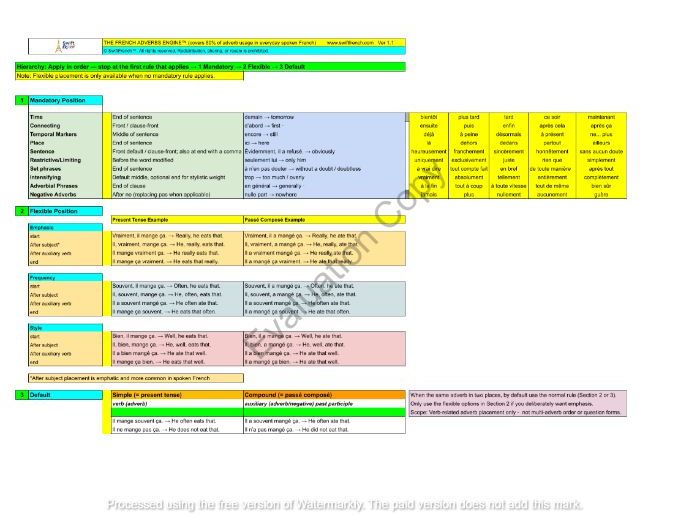

A one-page decision chart that makes French adjective placement predictable — replacing “it just sounds right” with a clear, top-down rule hierarchy.
Part of a wider French grammar reference collection, available separately.
Full gram
Why this exists
French adjective position isn’t random, and it isn’t purely about memorising a list of “adjectives that go before the noun.” Position can be fixed, can change meaning entirely, or can depend on adjective type - and these rules override each other in a set order. Most resources present them as separate facts. This chart shows the hierarchy.
What it is
A structural reference chart, provided as a print-ready PDF and as an editable Excel worksheet, so you can adapt wording, colours, or layout for your own classroom or printing setup.
What it does well
Replaces memorisation with a top-down decision system - start at Level 1, stop as soon as a rule applies
Separates fixed pre-noun adjectives, meaning-changing adjectives, BAGS-type descriptive adjectives, and default post-noun placement
Shows clearly where position changes meaning (un ancien professeur vs un professeur ancien)
Covers agreement (gender/number) alongside placement, without treating them as separate topics
Includes adjectives functioning adverbially, where normal agreement and placement rules don’t apply
How to use it
Start at Level 1 - is the adjective one of the fixed pre-noun exceptions (beau, bon, grand, jeune, etc.)? If yes, it goes before the noun, stop there
If not, check Level 2 - does position change the meaning?
If not, check Level 3 - is it a short, high-frequency descriptive adjective (beauty, age, goodness, size)?
If nothing above applies, use the default: after the noun (colours, shapes, nationalities, technical descriptions)
Separately, check whether the adjective is functioning as an adverb - if so, none of the above applies
What’s included
1-page PDF (colour)
1-page PDF (black and white)
A3 poster PDF
High-resolution PNG
Editable Excel worksheet (colour) - adapt wording, formatting, and layout for your own printing
Teacher instructions and guidance document (PDF)
Read-me file (PDF)
Licensing and editing notes (PDF)
Who this is for
KS4 French teachers (Years 10-11, GCSE)
Sixth-form and post-16 French programmes
Independent language teachers and tutors
Language centres and private providers
What this chart doesn’t try to do
This isn’t a full adjective list or a substitute for graded teaching and practice. It covers the core placement and agreement decision system, using the highest-frequency rules and override points, not every possible adjective or stylistic exception.
Licence
Single-teacher licence, lifetime.
Classroom use permitted for one teacher
Printing and projection allowed for that teacher’s own classes
Not for redistribution, sharing, or resale
Institutional or multi-teacher use is not included - contact support@swiftfrench.com for those enquiries
Part of the SwiftFrench rule-driven grammar reference series
Something went wrong, please try again later.
This resource hasn't been reviewed yet
To ensure quality for our reviews, only customers who have purchased this resource can review it
Report this resourceto let us know if it violates our terms and conditions.
Our customer service team will review your report and will be in touch.
£3.99