


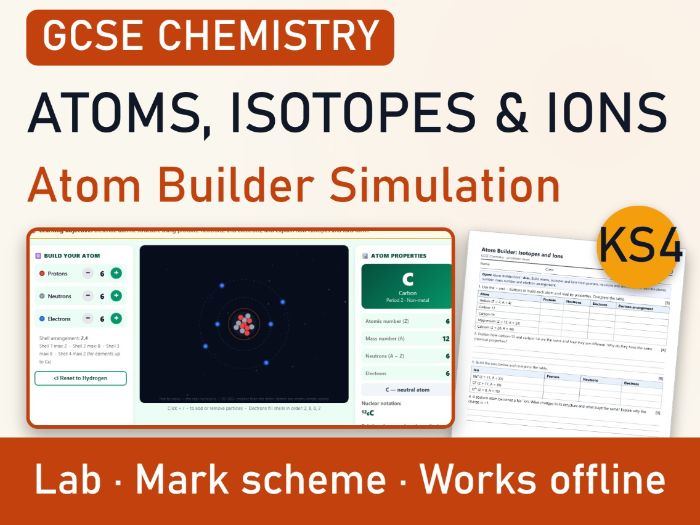

A complete chemistry simulation for GCSE-level science (ages 14 to 16): an atom builder where students add protons, neutrons and electrons to make atoms, isotopes and ions, with an A4 student sheet, an answer key and teacher notes. One offline file; no website, no login and nothing to install.
What is this?
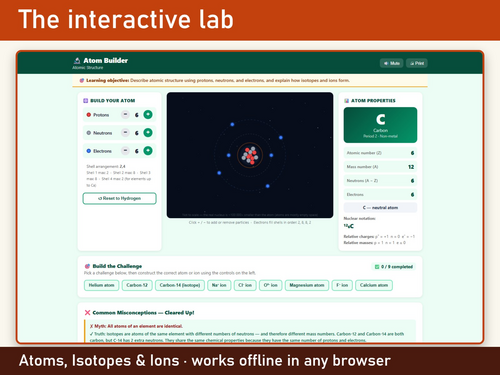
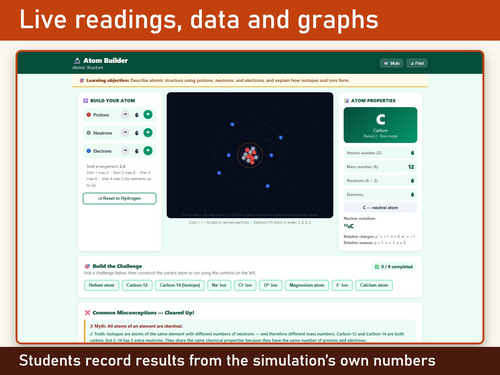
Students click + and − to add or remove protons, neutrons and electrons, watch the electron shells fill and read the atomic number, mass number, nuclear notation and charge. A message appears when they have made an isotope or an ion, and nine build challenges give clues and hints.
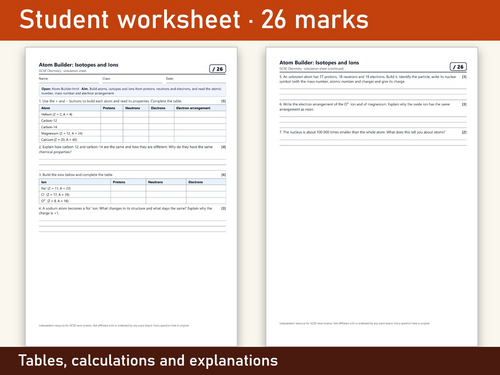
It runs offline from a single file on any device, from a Chromebook to a projector. It comes with a two-page student sheet (26 marks) written for this simulation, with tables to fill in from the simulation’s own numbers, short explanations, calculations and an evaluation question. The answer key gives every number the simulation produces, so marking is quick.
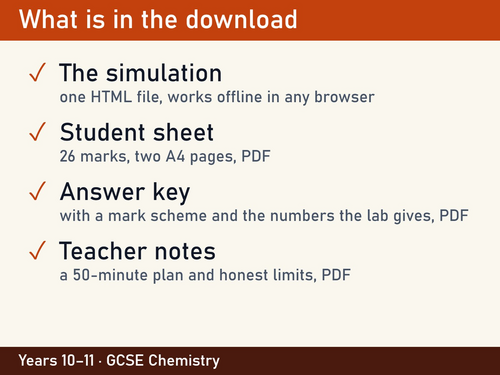
What is in the zip
- The simulation (Atom-Builder.html): one file for any modern browser. Works offline, sends nothing anywhere and uses no live AI at run time.
- Student sheet (PDF, 2 pages, 26 marks) for printing or sharing.
- Answer key (PDF) with a mark scheme and the numbers the simulation gives.
- Teacher notes (PDF): how to run a 50-minute lesson, how the simulation behaves, and its honest limits.
What the simulation includes
- Add and remove protons, neutrons and electrons with live shell filling (2, 8, 8, 2)
- A properties panel with Z, A, neutrons, electrons, charge and nuclear notation
- Isotope and ion detection messages
- Nine build challenges with clues and hints
- A misconceptions panel and reflection questions
What students learn
- Protons, neutrons and electrons: relative charges and masses.
- Atomic number, mass number and nuclear notation.
- Isotopes: same protons, different neutrons.
- How ions form by gaining or losing electrons.
- Electron arrangements up to calcium.
Where it fits
GCSE Chemistry: atomic structure, isotopes, ions and electron arrangements. Use it as a starter, for prep, cover work, homework or revision.
What it does, and what it does not
The numbers come from a model, not from measurements, so real data will look messier. It does not replace working with real apparatus: use it to prepare, to practise reading and plotting data, or when the practical cannot be run. There is a free demo of this simulation on Tes with one fixed set-up and a one-page sheet, so you can try the format first.
Written by a British science and maths teacher who taught for more than 12 years in international schools, including a spell as Head of Science. An independent resource, not affiliated with or endorsed by any exam board. Every question and the simulation are original.
Something went wrong, please try again later.
This resource hasn't been reviewed yet
To ensure quality for our reviews, only customers who have purchased this resource can review it
Report this resourceto let us know if it violates our terms and conditions.
Our customer service team will review your report and will be in touch.
£3.95