

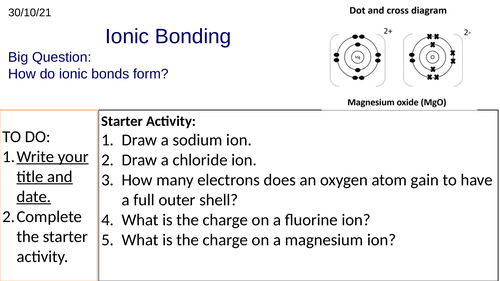

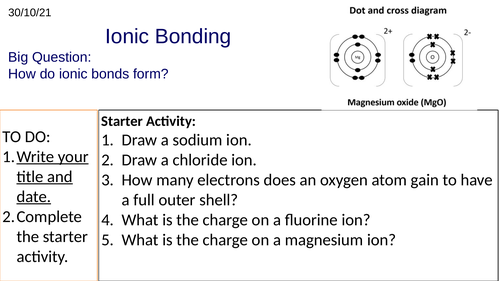
This detailed PowerPoint presentation on Ionic Bonding is an ideal teaching resource for secondary school chemistry lessons. It provides a clear explanation of how ionic bonds form, alongside interactive and engaging activities to help students consolidate their understanding. The resource includes learning objectives, step-by-step examples, and practice exercises designed to develop students’ skills in drawing dot-and-cross diagrams for ionic compounds.
Key topics covered include the definition of ionic bonding, the formation of positive and negative ions through electron transfer, and the role of electrostatic forces of attraction. The presentation explores common examples such as sodium chloride, magnesium oxide, and potassium oxide, and provides detailed instructions on working out ion charges for elements in Groups 1, 2, 6, and 7. Students are encouraged to practice constructing ionic bonding diagrams for compounds like lithium fluoride, calcium chloride, and sodium oxide, with extension tasks to deepen their understanding.
This PowerPoint (.pptx file) is fully editable, making it easy for teachers to adapt the content to their specific curriculum requirements. Updated recently for improved clarity and functionality, the resource is suitable for classroom use, homework assignments, or independent study. Its structured approach and clear visuals make complex concepts accessible and engaging for learners.
Whether you’re teaching bonding for the first time or revising for exams, this resource provides everything you need to support your students’ mastery of ionic bonding.
Get this resource as part of a bundle and save up to 64%
A bundle is a package of resources grouped together to teach a particular topic, or a series of lessons, in one place.
Bundle
GCSE Chemistry Ionic Compounds Bundle: 4 Lessons & Quiz
Elevate your chemistry teaching with this ionic bundle, a comprehensive package of PowerPoints designed to guide students through the fundamentals of ionic bonding and the unique properties of ionic compounds. This bundle is perfect for middle and high school science educators aiming to deliver engaging lessons with hands-on activities and assessments. What’s Included: * Clear explanations on how ions form from atoms. * Interactive activities such as drawing ions and dot-and-cross diagrams for ionic compounds. * Examples featuring elements from Groups 1, 2, 6, and 7. * Step-by-step guidance on understanding electrostatic forces of attraction. * Real-world examples of ionic bonding (e.g., sodium chloride, magnesium oxide). * Explore the giant lattice structure of ionic compounds. * Understand why ionic compounds have high melting/boiling points. * Practical tasks to solidify knowledge. * Practical experiment to test electrical conductivity of ionic compounds in solid, molten, and aqueous states. * Safety guidelines for lab work and step-by-step experiment instructions. * Quiz on Bonding and Structure (Lessons 1–4) - 24-mark assessment covering ionic bonding, properties of ionic compounds, and practical applications. Includes marking scheme for quick and effective grading. Why Choose This Bundle? Interactive and Practical: Combines theory with hands-on experiments to engage students. Comprehensive Coverage: Covers key concepts from ionic bonding to the properties of ionic compounds. Assessment Ready: Quiz and activities ensure students grasp and retain concepts. Empower your students to master ionic bonding and its properties with this all-in-one teaching bundle!
£4.00
Bundle
GCSE Chemistry Chemical Bonding and Structure Bundle: 9-Lesson Unit
This comprehensive resource bundle provides an in-depth exploration of chemical bonding and the structure and properties of compounds, ideal for secondary school students studying chemistry. Updated on 20th December 2024, it covers nine detailed lessons, taking learners on a journey from the fundamentals of ionic and covalent bonding to advanced topics like fullerenes and graphene. The bundle includes: * Atoms into Ions: Exploring how and why atoms gain or lose electrons to achieve stability, making it an essential tool for understanding ionic bonding. * Ionic Bonding: Introducing the basics of ionic bonding, how ions form, and their role in compound stability. * Structure of Ionic Compounds: Exploring lattice structures, explaining why ionic compounds have high melting points and can conduct electricity when molten or dissolved. * Properties of Ionic Compounds: A detailed look at the physical and chemical properties of ionic substances. * Metallic Bonding: Understanding the 'sea of electrons' model and why metals are strong, malleable, and conductive. * Covalent Bonding: Breaking down how atoms share electrons to form molecules, including single, double, and triple bonds. * Structure and Properties of Simple Covalent Molecules: Examining how molecular structures affect boiling points, solubility, and conductivity. * Giant Covalent Structures: Focusing on diamond, graphite, and silicon dioxide, analyzing their properties and real-world applications. * Fullerenes and Graphene: Delving into cutting-edge materials science with these unique carbon allotropes, their remarkable properties, and potential uses. How to use: Each lesson includes engaging starter activities, detailed explanations, and review questions to ensure student comprehension. This bundle is perfect for teachers seeking a structured, curriculum-aligned approach to teaching bonding and materials science. With clear progression, interactive activities, and real-world examples, it’s designed to inspire curiosity and deepen understanding of key chemistry concepts. Updated in December 2024 to include Atoms into Ions. Lesson 1 - Atoms into Ions Lesson 2 - Ionic Bonding Lesson 3 - Structure of Ionic Compounds Lesson 4 - Properties of Ionic Compounds Lesson 5 - Metallic Bonding Lesson 6 - Covalent Bonding Lesson 7 - Structure and Properties of Simple Covalent Molecules Lesson 8 - Giant Covalent Structures Lesson 9- Fullerenes and Graphene
£7.00
Something went wrong, please try again later.
This resource hasn't been reviewed yet
To ensure quality for our reviews, only customers who have purchased this resource can review it
Report this resourceto let us know if it violates our terms and conditions.
Our customer service team will review your report and will be in touch.
£2.00