pptx, 6.92 MB
pptx, 6.92 MB
docx, 17.97 KB
docx, 17.97 KB

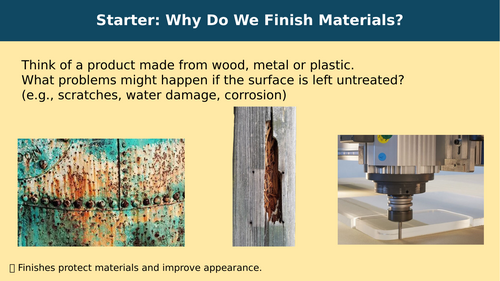
This GCSE Design & Technology lesson sequence on Surface Finishes provides a clear, structured introduction to why materials are finished and how different finishes are selected for paper and card, timber, metals, and plastics.

Designed in the CloudForge house style, the resource uses low cognitive load slides, 24pt student-friendly text, and dual-coded visuals to support understanding for KS3–KS4 learners and mixed-ability groups.

The lesson covers:

What surface finishes are and why they are used

How finishes protect materials and improve appearance or function

Surface finishes for paper/card, timber, metals, and plastics

The difference between finishes and treatments (including tanalised timber)

Surface preparation and keying for better adhesion

Safe use of finishes (PPE, ventilation, manufacturer guidance)

Whole-class discussion activities and a self-marking plenary

An optional real-world process video is included to support understanding of industrial timber treatment (tanalising) Galvanising, electro plating, and powder coating alongside exam-focused explanations and model answers.

This resource is suitable for Edexcel GCSE Design & Technology and fully transferable to AQA, with clear links to materials knowledge, surface treatments, and manufacturing processes.

What’s included:

Full PowerPoint lesson sequence

Retrieval starter and recap slide

Board-led activity with product scenarios

Self-marking plenary slide

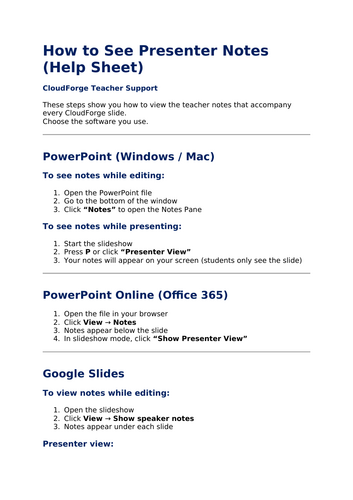
Teacher notes written for non-specialists

Why teachers like this resource:

Clear exam language and classification

Strong focus on finish + reason (exam technique)

Accessible layout and dual coding

No worksheets or printing required

Calm, professional tone throughout

Created by CloudForge — practical, exam-ready Design & Technology resources built for real classrooms.

Get this resource as part of a bundle and save up to 25%

A bundle is a package of resources grouped together to teach a particular topic, or a series of lessons, in one place.

Bundle

GCSE D&T Core Materials Mega-Bundle (14 Lessons) | Edexcel & AQA | CloudForge

This CloudForge GCSE D&T Mega-Bundle delivers every lesson required to teach the full Edexcel Core Materials content, with complete coverage of woods, metals, plastics, papers & boards, textiles, joining methods, surface finishes, smart materials, and modern materials. Each lesson is designed for clarity, strong dual coding, and low cognitive load, making it ideal for KS3–KS4 theory, revision, or cover work. Students learn where materials come from, how they are formed, their properties and uses, and the processes used to cut, shape, finish, and join them. Retrieval practice features throughout, alongside exam-style questions and self-marking slides to build confidence for written assessments. Ideal for: • Edexcel GCSE D&T (complete Core Materials coverage) • AQA GCSE D&T (secure foundation materials knowledge) • KS4 theory sequences, revision lessons, or non-specialist delivery What’s included: Material properties (physical and aesthetic) Timbers (included free): hardwoods, softwoods, sustainability, felling, uses, common species Manufactured boards: plywood, MDF, chipboard, OSB, blockboard, veneers, laminates Metals: ferrous, non-ferrous, alloys, stock forms, extraction, heat treatment, joining Plastics: sources and origins, polymerisation, crude oil processing, thermoplastics vs thermosets, biodegradable plastics Plastics processing: vacuum forming, injection moulding, extrusion, blow moulding, rotational moulding, line bending Paper & board: types, GSM, corrugated fibreboard, printing processes, die-cutting, creasing, finishes Textiles: fibre origins, woven/knitted/bonded fabrics, technical & smart textiles Textile joining: machine stitches, seams, fastenings, bonding techniques, method selection Surface finishes: timber, metals, plastics, papers & boards, preparation, keying, safety Smart / robotic materials: stimuli and responses, thermochromic, photochromic, shape memory alloys (Nitinol), smart polymers (Polymorph), QTC, piezoelectric materials, pH-sensitive materials Modern materials (included free): Bioplastics (corn starch polymers, PLA, PHB), sustainability drivers, flexible MDF, titanium alloys and medical uses, fibre optics, LCD displays, nanomaterials (including graphene), porous metal structures, and performance-led material selection Additional features: Built-in retrieval practice across PowerPoints Exam-style questions with model self-marking slides Teacher notes written for non-specialists (Say / Ask / Remind / Watch For) Clean, copyright-safe dual-coded diagrams throughout Designed to match the visual clarity and accessibility of the free CloudForge Natural Timbers and free CloudForge Modern Materials lessons, and updated regularly as resources are refined in the classroom.

£19.99

Reviews

Something went wrong, please try again later.

This resource hasn't been reviewed yet

To ensure quality for our reviews, only customers who have purchased this resource can review it

Report this resourceto let us know if it violates our terms and conditions.
Our customer service team will review your report and will be in touch.