


pdf, 5.06 MB
pdf, 5.06 MB
pptx, 80.2 MB
pptx, 80.2 MB
mp4, 61.36 MB
mp4, 61.36 MB
mp4, 2.23 MB
mp4, 2.23 MB
docx, 209.8 KB
docx, 209.8 KB
html, 7.69 KB
html, 7.69 KB

Debouncing Switches & Signal Conditioning | GCSE Electronics | WJEC Eduqas (9–1)

Fully Editable Lesson | Specification-Aligned | Practical Circuit Focus

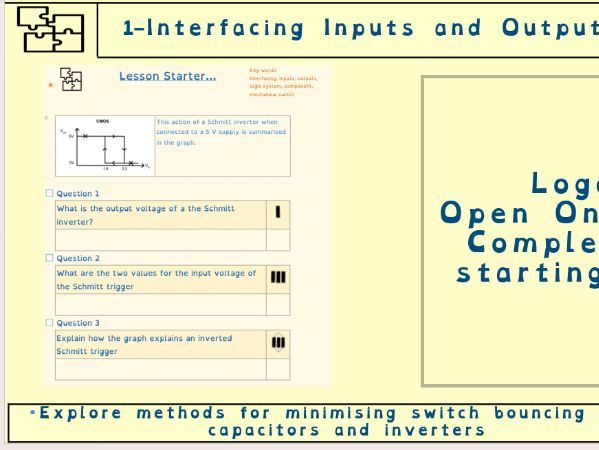
This lesson explores the problem of switch bounce in digital systems and how engineers solve it using capacitors and Schmitt inverters.

Students investigate why mechanical switches can generate multiple rapid pulses when pressed, leading to false counts in counters, timers, and display systems. They then design and analyse practical debounce circuits to ensure reliable digital inputs.

Written to support the WJEC Eduqas GCSE Electronics specification, this lesson builds both conceptual understanding and circuit analysis skills.

Key Learning Objectives

• Understand what switch bounce is and why it occurs
• Explain how bounce affects digital counters and logic systems
• Use capacitors to reduce unwanted signal fluctuations
• Apply Schmitt inverters to create clean, stable digital signals
• Design and analyse debounced input circuits
• Apply debouncing in real-world electronic systems

Lesson Content The Problem: Switch Bounce

• Mechanical contact vibration
• Multiple rapid pulses from a single press
• False triggering in counters and displays
• Timing diagrams showing bounce effects

Capacitor-Based Debouncing

• RC smoothing circuits
• Time constant and signal stabilisation
• Limitations of capacitor-only solutions

Schmitt Inverters & Signal Conditioning

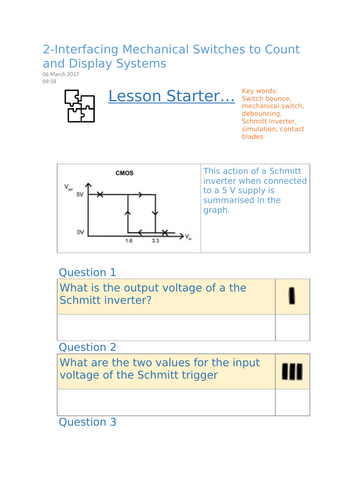
• Hysteresis and threshold switching
• Converting noisy analogue inputs into clean digital outputs
• Why Schmitt devices are ideal for switch inputs

Designing Debounce Circuits

• Combining RC networks with Schmitt inverters
• Circuit diagrams and waveform analysis
• Testing and troubleshooting designs

Practical Applications

• Digital counting systems
• Push-button control circuits
• Sensor trigger systems
• Industrial input conditioning
• Light and motion detection circuits

What’s Included

• Fully editable PowerPoint with circuit diagrams and waveform visuals
• Clear explanations of RC and Schmitt behaviour
• Investigation tasks (light sensors, counting systems)
• Circuit design exercises with worked examples
• Practice questions and assessment tasks

Why Teachers Choose This Lesson

• Directly aligned to WJEC Eduqas GCSE Electronics
• Strong practical focus with real circuit examples
• Builds confidence in signal conditioning
• Clear progression from problem → solution → application
• Saves planning time with ready-to-teach materials

Keywords

GCSE Electronics, WJEC Eduqas, Switch Bounce, Debouncing, Schmitt Inverter, Counters, Sensors, Signal Conditioning, Input Interfacing

Get this resource as part of a bundle and save up to 20%

A bundle is a package of resources grouped together to teach a particular topic, or a series of lessons, in one place.

Bundle

Interfacing Digital to Analogue Circuits | GCSE Electronics | WJEC Eduqas (9–1) | Complete Module

Interfacing Digital to Analogue Circuits | GCSE Electronics | WJEC Eduqas (9–1) | Complete Module Fully Editable Lesson Bundle | Specification-Matched | Exam-Focused Deliver the entire **Interfacing Digital to Analogue Circuits** module with this complete, ready-to-teach bundle designed for **WJEC Eduqas GCSE Electronics (9–1)**. This pack includes three fully sequenced lessons with clear explanations, worked examples, circuit diagrams, and structured practice activities — providing full coverage of the specification while reducing teacher workload. --- ## Lessons Included ### 1️⃣ Schmitt Inverters & Signal Conditioning • How Schmitt inverters work • Upper and lower trigger thresholds • Cleaning noisy or slow analogue signals • Preventing logic errors in digital systems • Worked examples and annotated circuit diagrams --- ### 2️⃣ Debouncing Switches & Sensors • The problem of switch bounce • Timing effects in mechanical switches • Using RC networks and Schmitt inverters • Preventing false triggering and double counts • Real-world digital counter applications --- ### 3️⃣ Interfacing Logic to Outputs • Using transistors as switches • MOSFET operation and advantages • Driving motors, heaters, relays and high-current loads • Comparator circuits for signal conditioning • Protecting logic circuits from overload --- ## What’s Included • Fully editable PowerPoint presentations (clear explanations and diagrams) • Student worksheets with guided tasks and exam-style questions • Worked examples and circuit analysis practice • Clear teacher notes and assessment opportunities • Practice tasks to reinforce design skills • Suitable for classroom delivery, homework, or revision --- ## Curriculum Coverage Aligned directly to **WJEC Eduqas GCSE Electronics – Interfacing Digital to Analogue Circuits (Chapter 3)**, including: • Action of Schmitt inverters • Switch debouncing techniques • Use of comparators for signal conditioning • Transistors and MOSFETs as interface devices • Designing reliable digital–analogue interface circuits • Avoiding logic errors caused by slow or noisy signals --- ## Why Teachers Choose This Bundle • Complete module coverage in one package • Lesson-ready materials save hours of planning • Clear diagrams and structured explanations • Strong focus on exam application and circuit design • Builds confidence in analysing and designing interface circuits • Flexible for teaching, homework, flipped learning, or revision --- Perfect for teachers delivering GCSE Electronics who want structured, specification-aligned resources that support strong conceptual understanding and exam success.

£5.99

Reviews

Something went wrong, please try again later.

This resource hasn't been reviewed yet

To ensure quality for our reviews, only customers who have purchased this resource can review it

Report this resourceto let us know if it violates our terms and conditions.
Our customer service team will review your report and will be in touch.