


GCSE Psychology lesson and workbook exploring decay, displacement, interference and retrieval failure through applied memory scenarios.
Why do we forget information we once knew? This GCSE Psychology lesson introduces students to four key explanations of forgetting: trace decay, displacement, interference and retrieval failure.
The resource combines an 18-slide PowerPoint presentation with a student workbook, allowing students to learn the core theory and then apply it through structured examples, scenarios and exam-style practice. The presentation begins with familiar everyday memory failures before introducing the four explanations and the different roles of short-term and long-term memory.
Students explore trace decay and the role of rehearsal, displacement and the limited capacity of short-term memory, and the difference between proactive and retroactive interference. Retrieval failure is then developed through context-dependent and state-dependent cues, giving students clear examples they can relate to real situations.
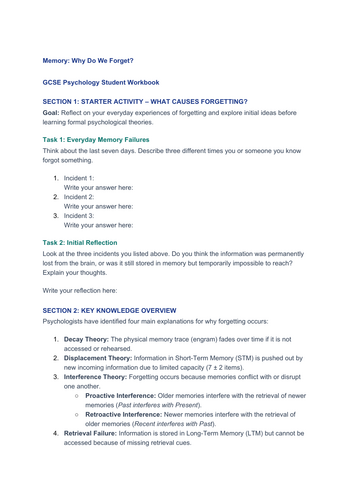
The accompanying workbook provides further opportunities to define concepts, analyse scenarios and justify psychological explanations. Activities include everyday applications, interference classification, retrieval-cue analysis and a fictional case study in which students diagnose different causes of forgetting.
Students also complete a GCSE-style six-mark application task, supported by guided planning, before finishing with retrieval questions and a confidence-based review of the topic.
This would work well as a taught GCSE Psychology lesson, revision lesson or consolidation resource for students who need to strengthen their ability to distinguish between explanations of forgetting and apply them accurately to unfamiliar situations.
gcse psychology memory
why do we forget psychology
explanations of forgetting gcse
trace decay psychology
displacement theory memory
interference theory psychology
proactive retroactive interference
retrieval failure psychology
context dependent memory
gcse psychology memory lesson
Something went wrong, please try again later.
This resource hasn't been reviewed yet
To ensure quality for our reviews, only customers who have purchased this resource can review it
Report this resourceto let us know if it violates our terms and conditions.
Our customer service team will review your report and will be in touch.
£3.00