


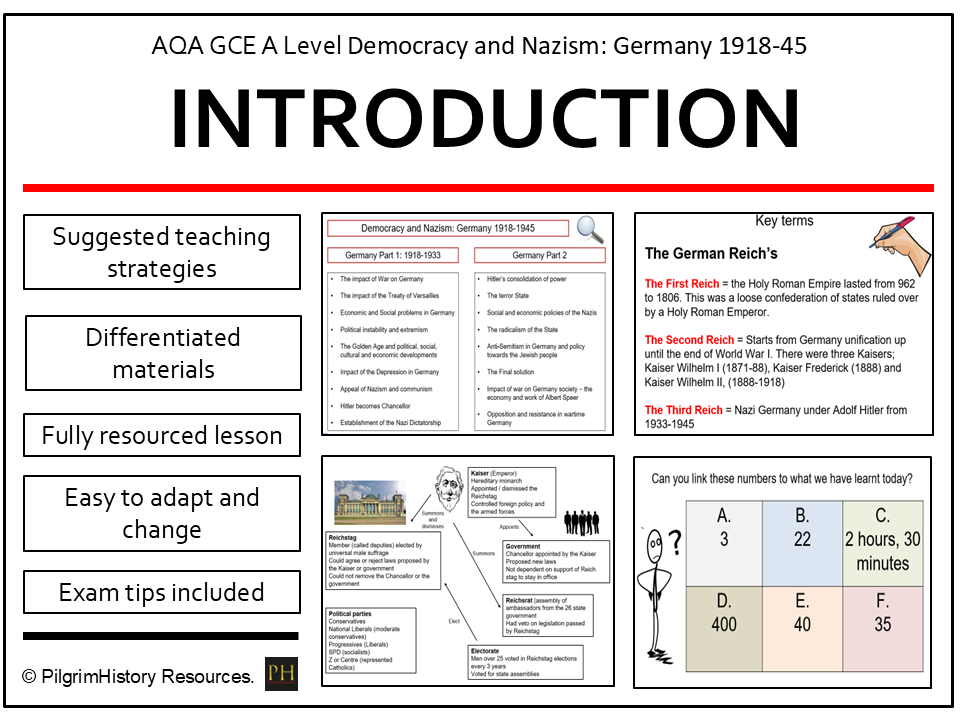
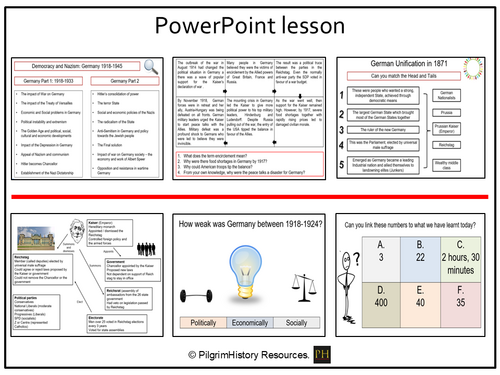
This lesson introduces students to the AQA A Level course on Democracy and Nazism: Germany 1918–45, while also building a strong foundation for understanding the political development of Germany before 1914.
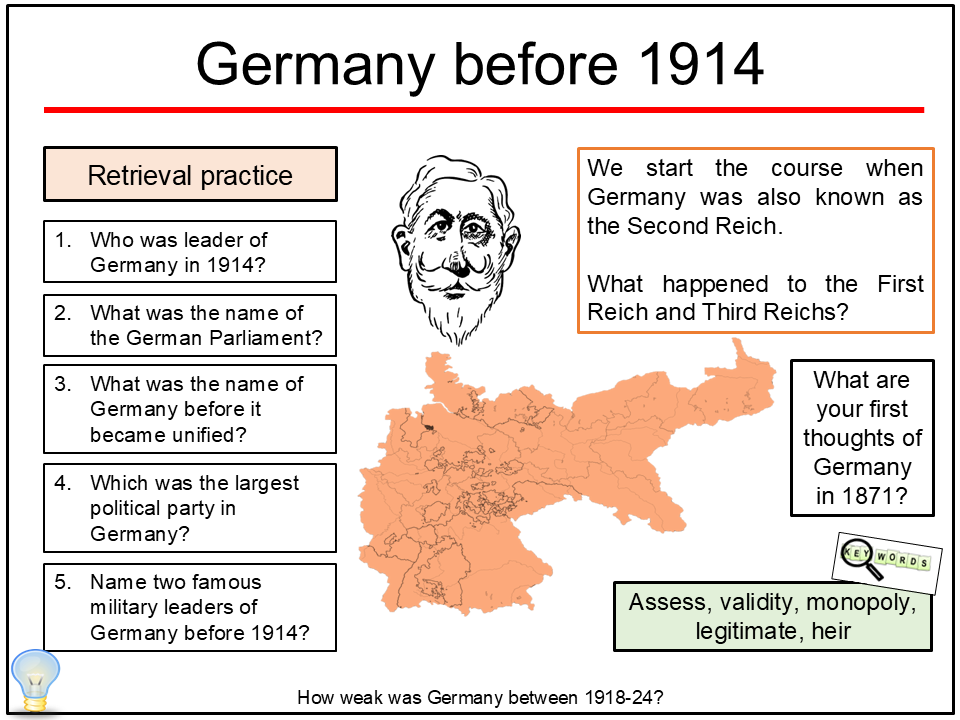
The aim of the lesson is twofold: to familiarise students with the structure, demands and assessment objectives of the A Level course, and to assess the strengths and weaknesses of Germany prior to the First World War.
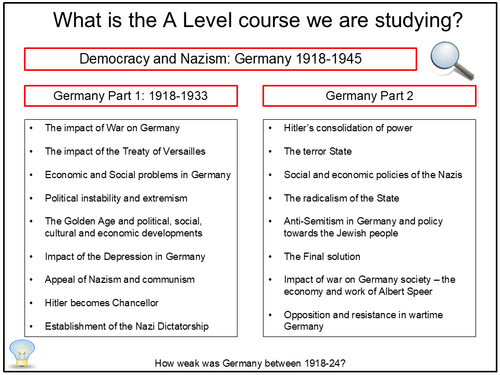
Students are introduced to the two examined components of the course, source analysis and essay writing and gain an understanding of the skills required to succeed.
The second part of the lesson explores the development of the German state from unification in 1871 through the three Reichs, with a particular focus on how Germany was governed under the Kaiser. Students examine the political system of the Second Reich and consider how stable or fragile Germany was by 1914.
Through a colour-coding activity on German unification, targeted questions on the impact of the First World War, and analysis of political structures under the Kaiser, students evaluate the strengths and weaknesses of Germany on the eve of 1914. This encourages early development of A Level analytical thinking, judgement and historical argument.
An enquiry question is introduced at the start of the lesson and revisited throughout to track understanding and progress across the lesson and wider unit.
Included in this lesson:
Fully editable PowerPoint
Introduction to AQA A Level course structure and assessment objectives
Activities on German unification and the Second Reich
Source-style questions and analytical tasks
Colour-coding and evaluation activities
Suggested teaching strategies and differentiation throughout
Please leave a review if you find this resource useful. Your feedback is greatly appreciated
Get this resource as part of a bundle and save up to 28%
A bundle is a package of resources grouped together to teach a particular topic, or a series of lessons, in one place.
Bundle
Complete Weimar Republic 1918–1928 Bundle | AQA A Level History: Democracy and Nazism, Germany 1918–1945
**AQA GCE 2O A Level Democracy and Nazism: Germany 1918-45** I have produced this bundle of resources on Weimar Germany 1918-1928 to help A Level students access the course and help them to gain a deeper understanding of Germany’s past through political, social, economic and cultural perspectives. The enquiry question throughout these lessons will be to question how weak or strong Germany was politically, economically or socially. Students will learn how the impact of war had a profound effect on the establishment of the Weimar Republic and the significance and consequences of the Peace Settlement at Versailles. They will also learn about political instability, with extremism from the left and right, the problems of coalition government and the state of the Weimar Republic by 1923 with the invasion of the Ruhr and hyperinflation. Finally students will assess the issues facing Germany from 1924 and the role of individuals such as Gustav Stresemann and his impact on the Golden Age of Weimar Germany in his domestic and foreign policy. The resources provided include detailed lesson plans and suggestions, case studies, source documents for analysis, chronological tasks and exam practice questions. The lessons are as follows: L1 Introduction and pre-war Germany L2 Political crisis of 1918 L3 The German Revolution L4 The Weimar Constitution L5 Treaty of Versailles L6 Hyperinflation L7 Invasion of the Ruhr (free resource) L8 Political instability and extremism L9 100 Days of Stresemann L10 Economic miracles L11 Weimar Women L12 Weimar Youth L13 Jewish people in Weimar L14 Weimar Culture L15 Weimar Politics, 1924-8 L16 Germany’s international position The lessons include the two types of exam question used, with examples of how to tackle them, using model answers, helpful hints and tips, structuring and scaffolding as well as markschemes. However, please refer to the AQA website for further assessment materials as they are subject to copyright. The lessons are also differentiated and fully resourced and allow students to reach the very top marks. If you have any questions about the lessons, please email me via my TES shop, or any other information about the course. I would also welcome any reviews, which would be gratefully appreciated.
£36.00
Bundle
Weimar Republic: Problems and Weaknesses 1918–1923 Bundle | AQA A Level History: Democracy and Nazism, Germany 1918–1945
This bundle has been designed to support the teaching of the AQA GCE A Level Democracy and Nazism: Germany 1918–45 specification. It focuses on the origins and early challenges of the Weimar Republic, helping students develop a secure understanding of the political, economic and social problems Germany faced between 1918 and 1923. The enquiry running throughout the lessons asks students to evaluate how weak Germany was politically, economically and socially during this period. They investigate the impact of defeat in the First World War, the collapse of Imperial Germany and the creation of the Weimar Republic before assessing whether the new democracy had any realistic chance of survival. Students examine the significance of the German Revolution, the strengths and weaknesses of the Weimar Constitution and the consequences of the Treaty of Versailles. Students also consider the challenges posed by coalition government, political extremism from both the left and right, the Kapp and Munich Putsches, the French occupation of the Ruhr and the devastating effects of hyperinflation. By the end of the unit, students are able to make supported judgements about the condition of the Weimar Republic by 1923. The bundle contains the following lessons: L1 Germany before 1914 L2 Political Crisis of 1918 L3 The German Revolution L4 The Weimar Constitution L5 Treaty of Versailles L6 Hyperinflation L7 Invasion of the Ruhr (FREE resource) L8 Political Instability and Extremism The lessons incorporate a range of historical skills, including source analysis, interpretation, explanation and evaluation. Students regularly practise the two AQA examination question styles using model responses, planning activities, writing frames, examiner guidance and mark schemes. Please note that additional AQA assessment materials are available from the AQA website and remain subject to copyright. All lessons are fully resourced, differentiated and designed to encourage discussion, independent thinking and historical enquiry. They include a variety of activities to support students of differing abilities while also providing appropriate challenge for those aiming for the highest grades. If you have any questions about the resources, please contact me through my TES shop. I would also be very grateful if you could leave a review, as your feedback is gratefully appreciated. The Complete Scheme of Work for this unit of study can be found here: https://www.tes.com/teaching-resource/resource-13149508
£18.00
Something went wrong, please try again later.
This resource hasn't been reviewed yet
To ensure quality for our reviews, only customers who have purchased this resource can review it
Report this resourceto let us know if it violates our terms and conditions.
Our customer service team will review your report and will be in touch.
£3.00