pptx, 3.15 MB
pptx, 3.15 MB
PNG, 248.45 KB
PNG, 248.45 KB
PNG, 252.06 KB
PNG, 252.06 KB

Edexcel Superpower Relations and the Cold War, 1941-91

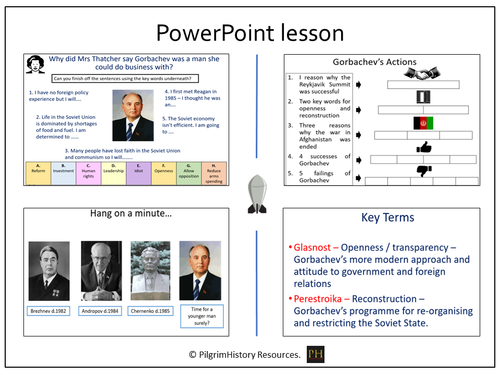
The aim of this lesson is to assess the importance of Gorbachev’s new thinking and reforms of Glasnost and Perestroika and evaluate the consequences of his new policies with the collapse of Soviet control in Eastern Europe

Therefore this lesson is divided into two parts and can be delivered over two lessons.

The first part of the lesson analyses Gorbachev’s problems when he became the leader of the Soviet Union.

Students will analyse sources and decide on the biggest problems he faced before prioritising these in an evaluation task.

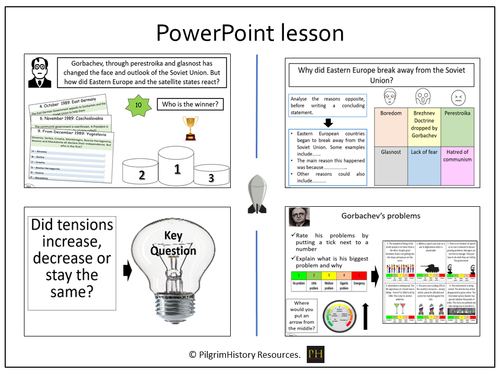
The second part of the lesson requires the students to undertake a quiz, picking up points on the way with the correct decisions made on Gorbachev’s reforms, as Eastern European satellite states began to increase their freedoms and break away, leading to the collapse of the Soviet Union.

Students can write an extended answer from what they have learnt with literacy help given.

A GCSE practice question on the importance of Gorbachev’s policies can be completed after a colour coding plenary task to summarise Gorbachev’s Premiership.

The lesson is enquiry based with a key question using a lightbulb posed at the start of the lesson and revisited throughout this and subsequent lessons to show the progress of learning.

The resource includes retrieval practice, suggested teaching strategies, differentiated material and GCSE question practice.

It comes in PowerPoint format if there is a wish to adapt and change.

Get this resource as part of a bundle and save up to 50%

A bundle is a package of resources grouped together to teach a particular topic, or a series of lessons, in one place.

Bundle

Edexcel GCSE Superpower relations and the Cold War Lessons and Resources Bundle

This bundle is the second part in a series of lessons created for Edexcel GCSE 9–1 Superpower Relations and the Cold War, 1941–91. It contains fully resourced, differentiated and editable lessons designed to save planning time while helping students develop the knowledge and exam skills needed to achieve the highest grades. The lessons are enquiry based and the central question in each lesson is revisited throughout to help students track the development of Cold War tensions and cooperation over time. Students will build their understanding of: * changing relations between the USA and USSR * the causes and consequences of key Cold War events * the impact of ideology, diplomacy, propaganda and conflict * continuity and change across the period * the factors leading to the end of the Cold War Each lesson includes: * retrieval practice * differentiated tasks * source and interpretation activities * GCSE exam practice questions * suggested teaching strategies * editable PowerPoint resources The lessons are designed to work together as a coherent unit, helping students build a clear narrative understanding of how Cold War tensions escalated, changed and eventually declined between 1958 and 1991. The lessons are as follows: L12 Berlin Ultimatum L13 Building the Berlin Wall L14 Cuba and the Bay of Pigs L15 Cuban Missile Crisis L16 Prague Spring L17 Détente and SALT 1 L18 Helsinki Accords and SALT 2 ***(free resource)*** L19 Soviet invasion of Afghanistan L20 Reagan and the Second Cold War L21 Gorbachev’s new ideas L22 Fall of the Berlin Wall A complete set of lessons for this unit can be found here: https://www.tes.com/teaching-resource/resource-13325744

£16.00

Reviews

Something went wrong, please try again later.

This resource hasn't been reviewed yet

To ensure quality for our reviews, only customers who have purchased this resource can review it

Report this resourceto let us know if it violates our terms and conditions.
Our customer service team will review your report and will be in touch.