


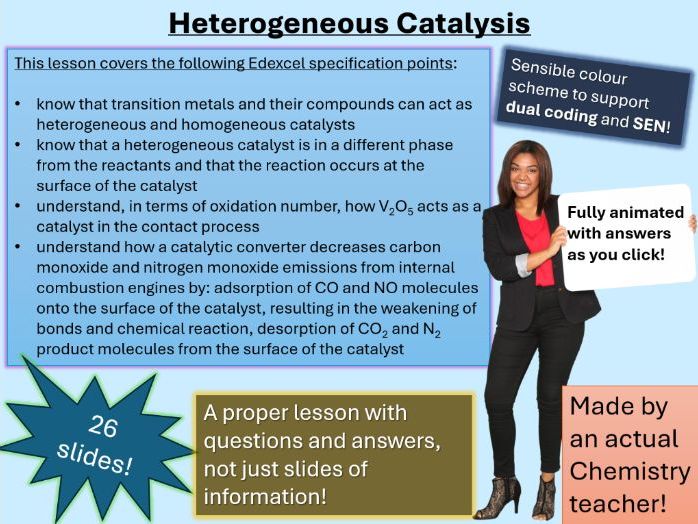
Contact process steps. Heterogeneous catalysts examples. Why contact process is called contact process. How do catalytic converters work? Adsorption vs absorption. All this and more covered in this comprehensive lesson with questions and answers! This is a Year 13 A level lesson for Edexcel International Unit 5 – WCH15, but it can also be used for all UK exam boards. All the slides in this lesson are fully animated and include answers to every mini plenary question and exam question.
Slide 1 - Title and 5-minute starter. The starter is a grid of four questions entitled ‘last week, last lesson, today’s learning and future learning’. Use this generic slide for all your lessons by simply changing the questions and the answers each time.
Slide 2 - Lesson objectives (see thumbnail image)
Slide 3 – hinge question: which substance acts as a catalyst in the Haber Process? ( The answer animates on the screen)
Slide 4 – hinge question: Which substance acts as a catalyst in the decomposition of hydrogen peroxide? (The answer animates on the screen)
Slide 5 - hinge question: Which substance acts as a catalyst in catalytic converters? (The answer animates on the screen)
Slides 6 – 7: students invited to consider a pattern in the answer to the previous hinge questions (all the catalysts mentioned are transition metals)
Slide 8 – definition of heterogeneous catalysts
Slide 9 – a side note about why heterogeneous catalysts are preferred in industry
Slide 10 – an overview of how heterogeneous catalysts work
Slides 11 – 12: a general overview of the Contact process
Slide 13 – the first two steps in the contact process are explained. This includes the burning of sulfur to form sulfur dioxide, and the catalysed oxidation of sulfur dioxide to form sulfur trioxide
Slide 14 – explains in detail, with the chemical equations, the reactions involving sulfur dioxide and vanadium(V) oxide
Slide 15 – this slide explains how the sulfuric acid is formed from sulfur trioxide
Slide 16 – (bonus content) explains what would happen if no catalyst was used in the Contact process
Slide 17 – introductory slide for catalytic converters
Slide 18 – Y12 recap quiz on combustion and pollutants
Slide 19 – diagram of a three-way catalytic converter
Slide 20 – steps involved in converting carbon monoxide and nitrogen monoxide to carbon dioxide and nitrogen gas (including adsorption and bond weakening, reaction of CO and NO, and desorption of the products)
Slide 21 – (bonus content) – diesel engines, due to the additional soot they produce, have a special catalytic converter
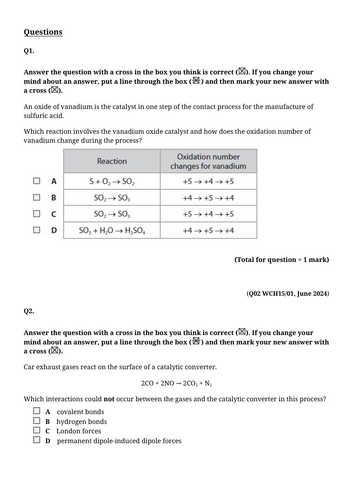
Slides 22 – 26: exam questions with mark scheme answers included with this resource
Please consider leaving a review! This really helps promote our store! Thanks!
Something went wrong, please try again later.
This resource hasn't been reviewed yet
To ensure quality for our reviews, only customers who have purchased this resource can review it
Report this resourceto let us know if it violates our terms and conditions.
Our customer service team will review your report and will be in touch.
£3.50