


Combined SL and HL. Structure 3.2.1 to 3.2.6 are SL and HL content. Structure 3.2.7 to 3.2.12 are additional higher level and are flagged HL throughout, so SL teachers can skip them and HL teachers get the full subtopic in one resource.
Teach functional groups through play. A complete teaching bundle for Structure 3.2 (first assessment 2025): a 30-page guide (Word and PDF), a 35-slide deck with speaker notes on every slide, 12 games, and 18 original exam-style questions with a fully worked answer key.
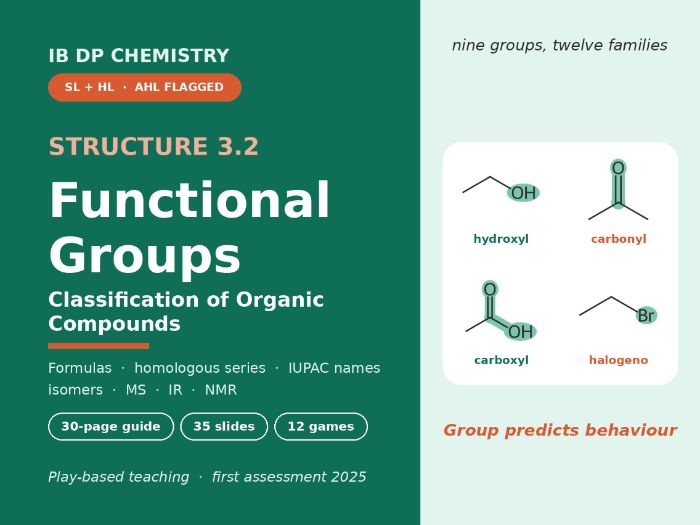
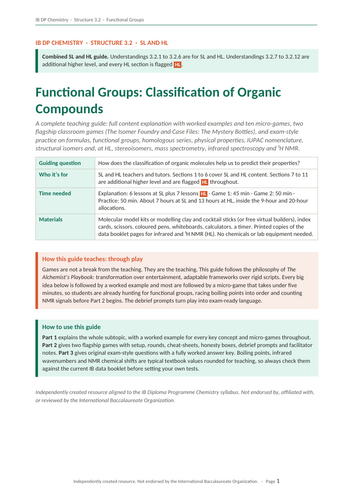
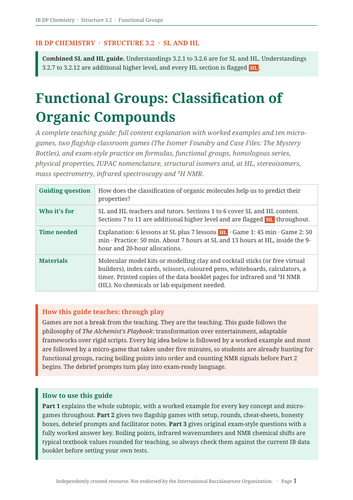
How does the classification of organic molecules help us to predict their properties? The guide covers all twelve understandings: formula types and converting between them; the nine functional groups by name and structure; homologous series and general formulas; boiling point trends with chain length, branching and functional group; IUPAC names for up to six carbons with halogeno, hydroxyl, carbonyl and carboxyl groups; and structural isomers, including primary, secondary and tertiary. At HL: cis-trans isomers and enantiomers, mass spectrometry, infrared spectroscopy, ¹H NMR with splitting, and combining data to solve structures.
Games are the teaching. Ten micro-games are woven through the explanation (Formula Swap, Group Hunt, Series Sort, Boiling Point Ladder, Name It Draw It, Spot the Imposters, Mirror Mirror, Fragment Detective, Peak Match and Signal Count). Two flagship games: The Isomer Foundry, where teams forge every isomer from the exact atoms in their bag, and Case Files: The Mystery Bottles, where teams buy evidence with coins to solve five unknown compounds. Each has setup, numbered rounds, a teacher cheat-sheet, a “where the model runs out” honesty box, debrief prompts in IB command-term language and facilitator notes with 1-to-1 tutoring options.
Inside: a worked example after every key concept; 17 original diagrams; cross-topic hooks; nature of science and TOK prompts; a vocabulary glossary. No lab equipment needed; a molecular model kit or modelling clay is helpful.
Independently created resource aligned to the IB Diploma Programme Chemistry syllabus. Not endorsed by, affiliated with, or reviewed by the International Baccalaureate Organization.
Something went wrong, please try again later.
This resource hasn't been reviewed yet
To ensure quality for our reviews, only customers who have purchased this resource can review it
Report this resourceto let us know if it violates our terms and conditions.
Our customer service team will review your report and will be in touch.
£9.00