


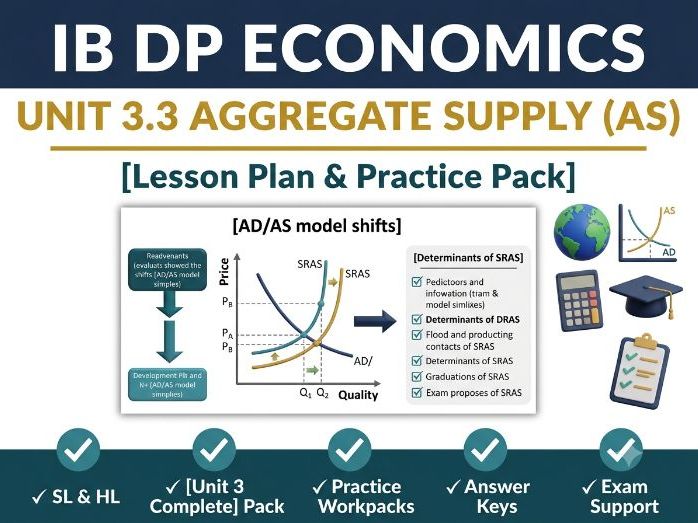
Complete 75-min IB Economics Aggregate Supply lesson with SL/HL differentiation, concept cards, quizzes, and self-correction models.
Deliver a comprehensive, exam-focused lesson on Subtopic 3.3 (Aggregate Supply) with this premium, fully differentiated lesson plan and practice pack. Structured entirely around an engaging real-world case study of the Kaimura economy, this resource provides a rigorous framework for navigating the critical macro concepts your students need to master for their IB DP assessments.
What is Included?
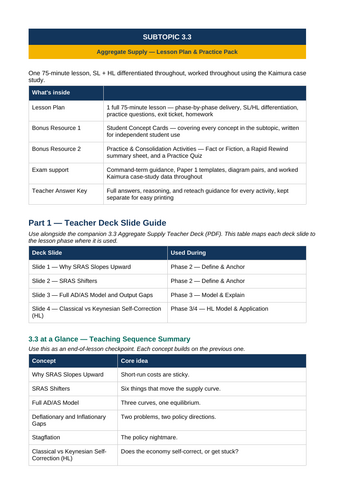
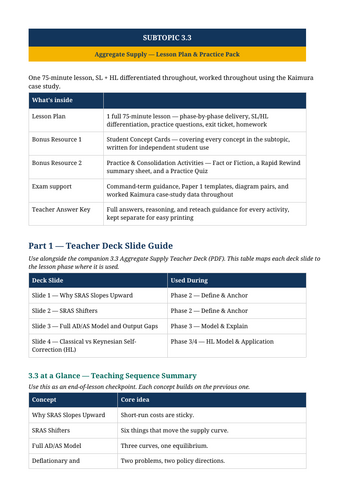
75-Minute Lesson Plan: A phase-by-phase classroom delivery guide tracking from hook to final assessment.
Teacher Deck Slide Guide: A dedicated mapping table that aligns your presentation slides to each phase of the lesson.
Student Concept Cards (Bonus Resource 1): A standalone, student-friendly handout utilizing an “In one line | Meaning | Apply it” framework for independent study.
Practice & Consolidation Pack (Bonus Resource 2): Includes a “Fact or Fiction” worksheet, a “Rapid Rewind” summary sheet, and a 5-question Practice Quiz.
Exam & IA Support: Complete paper template setups, diagram pairs analysis, and highly relevant Internal Assessment (IA) article tags.
Teacher Answer Key & Reteach Guide: Full answers, mathematical workings, and strategic pedagogical guidance kept separate for seamless printing.
Topics Covered
Why the SRAS Curve slopes upward (Sticky wages, menu costs, and worker misperceptions)
The six short-run aggregate supply shifters: input costs, wages, commodity prices, indirect taxes, technology, and regulation
The full AD/AS model equilibrium with vertical LRAS at potential output
Deflationary and inflationary gaps, alongside the policy nightmare of stagflation
HL Only: The Classical self-correction mechanism vs. the Keynesian objection of downward wage rigidity
Learning Outcomes
Students will be able to:
Explain the short-run stickiness factors that give the SRAS curve its upward slope.
Identify, list, and apply the specific determinants that shift the SRAS curve.
Draw a full AD/AS diagram and accurately label inflationary gaps, deflationary gaps, and stagflation.
Diagram and analyze a dual-shock scenario affecting both aggregate demand and aggregate supply simultaneously.
HL Only: Explain the Classical market-driven self-correction process and evaluate the Keynesian objection to it.
Classroom Uses
Whole-Class Teaching: Deliver a cohesive, 75-minute interactive lecture using the step-by-step teacher script and slide guide.
Differentiated Learning: Run seamless parallel tracks for SL and HL cohorts during application, practice, and evaluation phases.
Revision & Homework: Deploy the standalone concept cards and summary sheets for independent student study or post-lesson consolidation.
Exam Preparation: Use the guided practice questions and “Examiner Tips” to stamp out high-frequency diagram and data interpretation errors.
Something went wrong, please try again later.
This resource hasn't been reviewed yet
To ensure quality for our reviews, only customers who have purchased this resource can review it
Report this resourceto let us know if it violates our terms and conditions.
Our customer service team will review your report and will be in touch.
£12.00