


Help students move from simply describing their fieldwork data to genuinely analysing and explaining geography with this comprehensive IB Geography IA Analysis Writing Toolkit.
Designed specifically to support Criterion D – Written Analysis, this resource tackles an area where many students lose marks: they can identify what their graphs show, but struggle to explain why the pattern exists, how the evidence relates to geographical theory, what anomalies mean, and how findings answer the investigation. Criterion D is worth 8 marks, with the highest band requiring students to explain trends, patterns, statistics and anomalies while linking them to the question, theory, fieldwork location and methods.
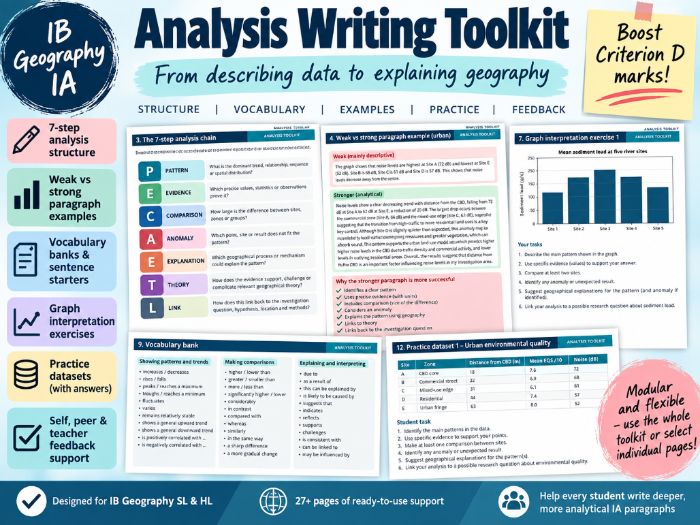
At the centre of the toolkit is an easy-to-use 7-step analysis structure:
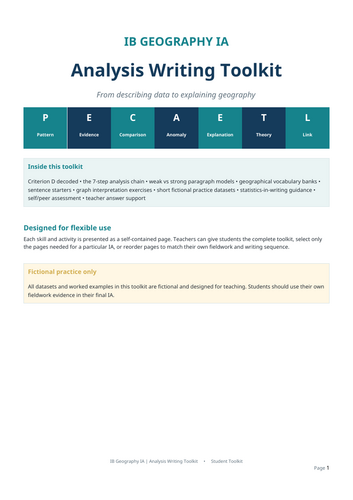
Pattern → Evidence → Comparison → Anomaly → Explanation → Theory → Link
Students are taught what each stage means, what questions to ask themselves and how to turn raw observations into an evidence-led geographical argument.
Flexible for teachers
A major advantage of this resource is its modular design. Each skill or activity is presented as a self-contained page, so teachers can use the full toolkit or select only the support individual students need.
Because each page focuses on one skill, the toolkit works particularly well for:
- whole-class modelling
- targeted IA redrafting
- individual student conferences
- peer assessment
- small-group intervention
- supporting students who remain stuck at descriptive analysis
The resource itself specifically supports these flexible uses, allowing teachers to target individual weaknesses rather than reteaching the entire analysis section.
It can also be used alongside a teacher IA feedback and marking checklist. Teachers can identify an area for improvement — for example evidence, anomalies, explanation, theory or linking back to the question — and attach the relevant toolkit page to the student’s feedback. This gives students much more specific guidance on how to fix the problem and improve their mark, rather than simply being told that their analysis needs more depth.
Inside the toolkit
Students receive support with:
- decoding the Criterion D expectations
- the 7-step analytical paragraph structure
- weak-versus-strong paragraph examples
- urban, river and coastal fieldwork examples
- geographical vocabulary banks
- extensive analytical sentence starters
- graph interpretation exercises
- short fictional practice datasets
- integrating statistics into written analysis
- explaining anomalies and outliers
- linking analysis to theory, location and methodology
- self-assessment and peer/teacher feedback
- teacher answer and marking support
Something went wrong, please try again later.
This resource hasn't been reviewed yet
To ensure quality for our reviews, only customers who have purchased this resource can review it
Report this resourceto let us know if it violates our terms and conditions.
Our customer service team will review your report and will be in touch.
£4.00