


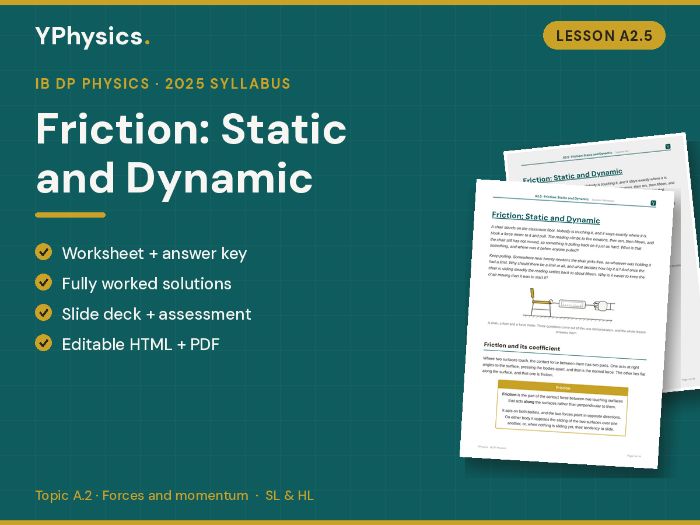

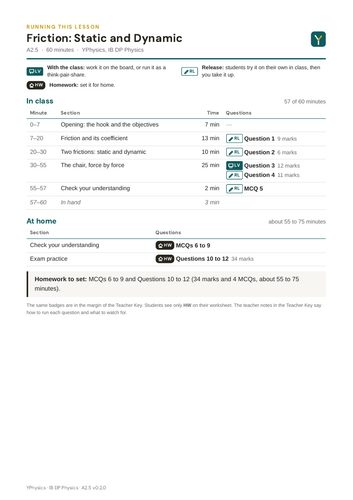
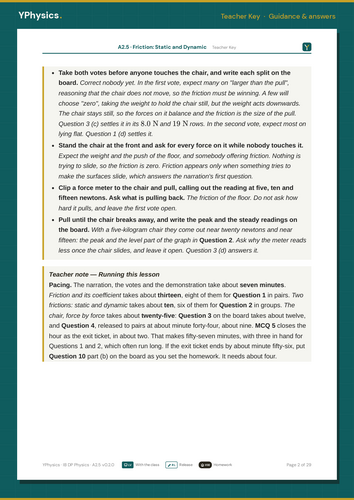
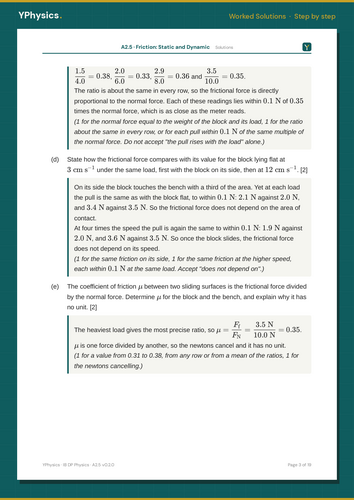
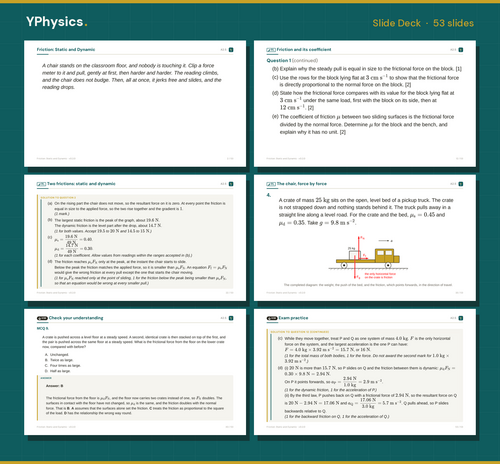
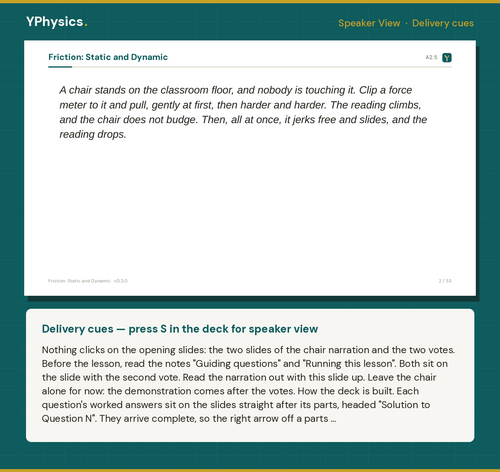
IB DP Physics lesson pack on static and dynamic friction for Topic A.2 Forces and momentum, SL and HL, first assessment 2025. Each taught section opens with a question the class works. Editable worksheet, 53-slide lesson deck, teacher key, worked solutions and a questions-only assessment, as self-contained HTML plus colour and black-and-white PDF.
What students learn
- Friction acts along the surfaces, on both bodies, in opposite directions. Students draw the pair.
- A student’s readings show friction proportional to the normal force, unchanged by contact area or speed.
- The coefficient of friction has no unit and belongs to a pair of surfaces.
- A friction graph gives both coefficients. Static friction matches the pull up to a limit, so its law is an inequality.
- Comparing the pull with the largest static friction decides whether a body slides. If it does, dynamic friction gives its acceleration.
IB skills (Tool 3: Mathematics), all practised:
- Draw and interpret free-body diagrams.
- Resolve vectors into two perpendicular components.
- Interpret features of graphs: maxima and changes in gradient.
- Understand direct proportionality.
What’s included:
- Student Worksheet - 17 pages
- Teacher Key - 29 pages
- Worked Solutions - 19 pages
- Assessment - 13 pages
- Lesson deck - 53 slides
Seven written questions carry 72 marks across 31 parts, plus five multiple-choice items. The class works Questions 1 to 4, worth 38 marks, then an exit ticket. Students draw force arrows on five of the nine figures. In Question 3 a chair is pulled with 19 N against a limit of 19.6 N, so the friction is 19 N, not 19.6 N. That settles one of two opening votes. In Question 4 a truck pulls away and the friction on its loose crate points forwards.
The slope and the angled push are exam practice, outside the taught hour. So is a 10-mark challenge: a block on a trolley. Students find the largest pull before the block slides, then both accelerations. A Nature of Science box treats the law as the pattern in Question 1’s readings. SI units, IB notation and IB command terms throughout. Use it with grades 11-12 (ages 16-19) as a lesson, cover lesson, homework or revision.
Part of the A.2 Forces and Momentum Complete Unit Bundle, 30% off buying the packs separately.
Related resources:
- Newton’s Second Law: F = ma, the lesson before this one
- Free-Body Diagrams and Force Pairs, where those diagrams are taught
- Upthrust, Viscous Drag and Terminal Velocity, the lesson that comes next
- Resultant Force, Inertia and Newton’s First Law, where zero resultant force is taught
Updated 12 Nov 2026: please reprint.
A rating helps other teachers find this.
Something went wrong, please try again later.
This resource hasn't been reviewed yet
To ensure quality for our reviews, only customers who have purchased this resource can review it
Report this resourceto let us know if it violates our terms and conditions.
Our customer service team will review your report and will be in touch.
£9.00