


**This Powerpoint specifically uses the Cambridge iGCSE Chemistry Syllabus and covers all criteria for – Unit 6.3 Reversible reactions and equilibrium
**
Students will be able to -
CORE
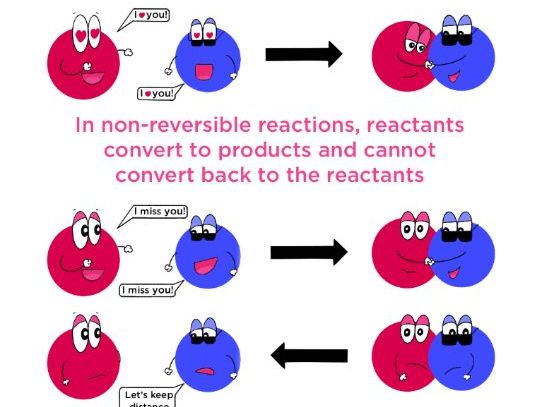
1 State that some chemical reactions are
reversible as shown by the symbol ⇌
2 Describe how changing the conditions can
change the direction of a reversible reaction for:
(a) the effect of heat on hydrated compounds
(b) the addition of water to anhydrous
compounds
limited to copper(II) sulfate and
cobalt(II) chloride
Supplement
3 State that a reversible reaction in a closed
system is at equilibrium when:
(a) the rate of the forward reaction is equal to
the rate of the reverse reaction
(b) the concentrations of reactants and
products are no longer changing
4 Predict and explain, for a reversible reaction,
how the position of equilibrium is affected by:
(a) changing temperature
State the typical conditions for the conversion
of sulfur dioxide to sulfur trioxide in the Contact
process as 450°C, 200kPa/2atm and a
vanadium(V) oxide catalyst
11 Explain, in terms of rate of reaction and position
of equilibrium, why the typical conditions
stated are used in the Haber process and
in the Contact process, including safety
considerations and economics
(b) changing pressure
© changing concentration
(d) using a catalyst
using information provided
5 State the symbol equation for the production of
ammonia in the Haber process,
N2(g) + 3H2(g) ⇌ 2NH3(g)
6 State the sources of the hydrogen (methane)
and nitrogen (air) in the Haber process
7 State the typical conditions in the Haber
process as 450°C, 20000kPa/200atm and an
iron catalyst
8 State the symbol equation for the conversion
of sulfur dioxide to sulfur trioxide in the Contact
process, 2SO2(g) + O2(g) ⇌ 2SO3(g)
9 State the sources of the sulfur dioxide (burning
sulfur or roasting sulfide ores) and oxygen (air)
in the Contact process
10 State the typical conditions for the conversion
of sulfur dioxide to sulfur trioxide in the Contact
process as 450°C, 200kPa/2atm and a
vanadium(V) oxide catalyst
11 Explain, in terms of rate of reaction and position
of equilibrium, why the typical conditions
stated are used in the Haber process and
in the Contact process, including safety
considerations and economics
**Every Powerpoint includes learning objectives, a starter and plenary, suitable activities and review questions with mark scheme. We also provide a FREE pdf version of the file so it can easily be printed for students as a handout or uploaded to the school VLE system
**
Bring your Cambridge iGCSE Chemistry lessons to life with our expertly designed teaching resources. Each unit is tailored to the latest syllabus, offering ready-to-use lesson plans, engaging experiments, and visually clear notes that save hours of prep time. Whether you’re new to the course or refining your approach, The Science Shelf gives you everything you need to boost student understanding and exam success — all in one place.
Something went wrong, please try again later.
This resource hasn't been reviewed yet
To ensure quality for our reviews, only customers who have purchased this resource can review it
Report this resourceto let us know if it violates our terms and conditions.
Our customer service team will review your report and will be in touch.
£3.00