


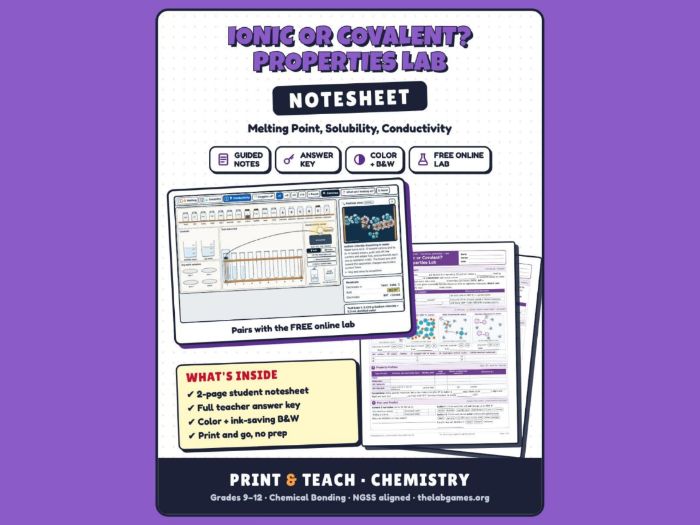
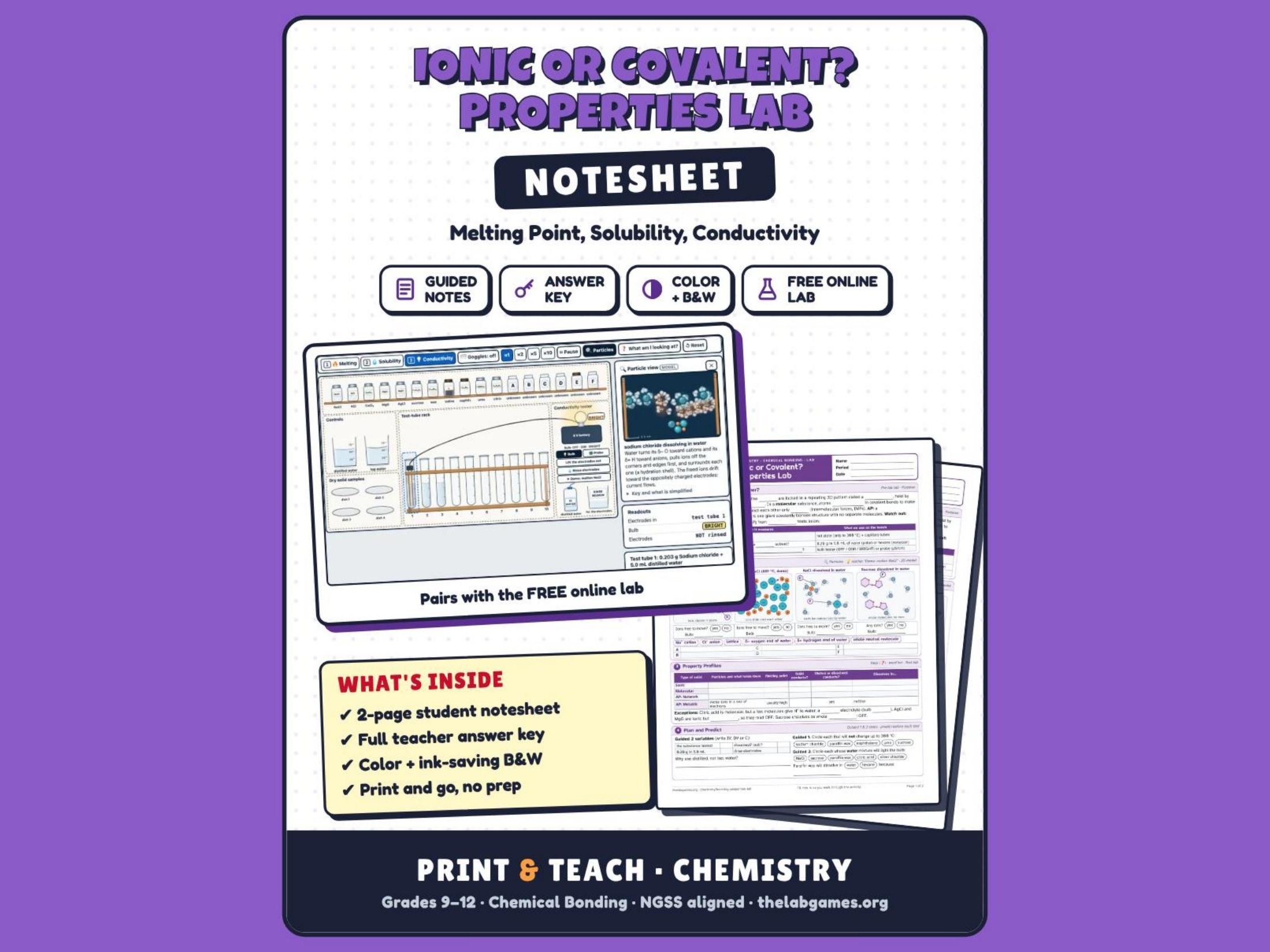
Students find out how to tell ionic compounds from molecular (covalent) substances by testing them. They label a particle model of solid, molten and dissolved sodium chloride next to dissolved sugar, fill in a property-profile chart, and plan the tests. Then they record melting behavior for five substances and graph it, test solubility in water and hexane and the conductivity of each water mixture, and classify mystery unknowns with a decision chart. Along the way they meet substances that break the usual shortcuts: sugar dissolves but doesn’t conduct, citric acid is only a weak electrolyte, and silver chloride is ionic but insoluble.
This 2-page notesheet pairs with the free online Ionic or Covalent? Properties Lab at thelabgames.org. It works for class lab days, absent-student makeups and sub days.
What’s Included
- Student notesheet (2 pages) in full color AND black & white
- Teacher answer key (red answers) in full color AND black & white
What Students Do
- Complete fill-in notes on ions, lattices, covalent bonds, intermolecular forces and network covalent solids, and on what each of the three tests measures
- Label a particle model of solid NaCl, molten NaCl, NaCl dissolved in water (hydration shells) and dissolved sucrose, and decide whether each one lights the bulb
- Fill in a property-profile chart for ionic, molecular, network covalent and metallic solids, including the shortcut breakers
- Identify independent, dependent and controlled variables and circle predictions for melting, solubility and conductivity
- Record hot-plate and capillary melting results for five substances and draw a bar graph of them
- Record solubility in water and hexane, temperature change, bulb and probe readings for five substances and two water controls, then classify each one
- Use a decision chart to classify four mystery unknowns from all three tests
- AP: rank lattice energies with Coulomb’s law, compare conductivity at two concentrations, and explain silicon dioxide’s high melting point
- Write a claim, evidence and reasoning conclusion
Skills & Standards
- Ionic, molecular, network covalent and metallic solids; melting point; solubility and “like dissolves like”; electrolytes (strong, weak, non-electrolyte); conductivity; hydration of ions
- Supports NGSS HS-PS1-3, HS-PS1-1, HS-PS2-6
- AP Chemistry: Coulomb’s law and lattice energy, properties of solids (Unit 2)
- Grades 9–12 Chemistry and AP Chemistry
Great For
- Lab days with the online Ionic or Covalent? Properties Lab
- Absent-student lab makeups
- Sub days
- Chemical bonding unit notes
- Review before a bonding test
Something went wrong, please try again later.
This resource hasn't been reviewed yet
To ensure quality for our reviews, only customers who have purchased this resource can review it
Report this resourceto let us know if it violates our terms and conditions.
Our customer service team will review your report and will be in touch.
$4.00