pptx, 10.22 MB
pptx, 10.22 MB

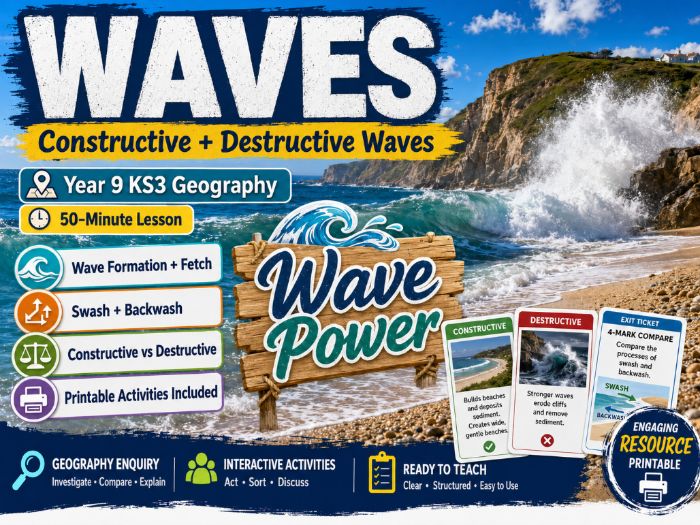
Bring coastal processes to life with this engaging and fully structured Year 9 / KS3 Geography lesson on Waves.

Designed for a Coasts unit, this 50-minute ready-to-teach lesson helps students understand how waves form, what controls their energy and how constructive and destructive waves shape beaches and coastlines.

Students begin by exploring how wind, friction and fetch create waves before investigating what happens as waves approach the shore. Clear explanations and diagrams introduce key processes including swash, backwash, erosion, transportation and deposition, helping students build the foundations needed for later learning about coastal landforms and management.

The lesson then develops understanding of constructive and destructive waves, encouraging students to compare wave energy, weather conditions, wave height, wavelength, swash, backwash and their impact on beaches.

A varied range of activities keeps students actively involved throughout the lesson, including retrieval, vocabulary work, geographical questioning, diagram drawing, partner discussion, evidence sorting and exam-style writing.

Students develop and apply essential geographical vocabulary including wave, fetch, prevailing wind, swash, backwash, tide, tidal range, erosion, transportation, deposition, constructive wave and destructive wave.

The lesson also places a strong emphasis on geographical writing. Students work towards an exam-style 4-mark comparison question, with success criteria, sentence support and comparative language such as whereas, however, compared with and in contrast. A model response allows students to improve their own work rather than simply copy an answer.

Activities include:

• Wave sketch retrieval starter
• Vocabulary charades
• Wave formation and fetch investigation
• Swash and backwash diagram task
• Quick knowledge checks
• Constructive vs destructive wave comparison
• “Wave Battle” evidence activity
• Printable card sort
• Wave comparison worksheet
• 4-mark exam-style question
• Peer assessment and improvement
• 3-2-1 exit ticket
• Optional Coastal Wave Diary homework

Get this resource as part of a bundle and save up to 25%

A bundle is a package of resources grouped together to teach a particular topic, or a series of lessons, in one place.

Bundle

KS3 / Middle School Geography Coast Lesson Bundle

Teach an entire KS3 Coasts unit with this comprehensive, engaging and classroom-ready bundle containing 9 complete lessons plus a full end-of-unit assessment and mark scheme. Designed primarily for Year 9 Geography, this sequence takes students from the basic question of “What is a coast?” through waves, erosion, transportation and landform formation, before progressing to coastal deposition, management and a detailed Holderness Coast case study. The lessons are designed to be active rather than lecture-heavy. Across the unit, students investigate photographs, complete geographical enquiries, take part in team challenges, sort and sequence evidence, construct diagrams, analyse real places, make management decisions and develop increasingly sophisticated written explanations. The bundle includes: Lesson 1 – What are Coasts? An engaging introduction exploring coastal features, why coasts matter and natural versus human environments. Lesson 2 – Waves Wave formation, fetch, swash and backwash, constructive and destructive waves. Lesson 3 – Weathering & Mass Movement Mechanical, chemical and biological weathering alongside rock falls, landslides and rotational slumping. Lesson 4 – Erosion & Transportation Hydraulic action, abrasion, attrition, solution, sediment transport and longshore drift. Lesson 5 – Headlands & Bays Differential erosion, hard and soft rock, concordant and discordant coastlines and Dorset examples. Lesson 6 – Old Harry Rocks A memorable coastal detective lesson exploring the sequence from crack → cave → arch → stack → stump. Lesson 7 – Coastal Deposition Longshore drift, deposition, spits, bars and lagoons, including Hel Peninsula, Poland. Lesson 8 – Coastal Management Hard and soft engineering, costs, effectiveness and sustainability, including an engaging £500,000 council decision-making challenge. Lesson 9 – Holderness Coast Case Study A full evidence-based case study exploring erosion, impacts, management and decision-making. Includes a detailed student worksheet that can be used independently or alongside the PowerPoint lesson. PLUS: End-of-Unit Assessment Finish the unit with a ready-to-use 50-minute, 50-mark KS3 Coasts test covering knowledge, understanding and application across the entire topic. The assessment includes varied question styles and comes with a separate detailed teacher mark scheme, making it straightforward to assess progress and identify gaps. Across the bundle students develop: - geographical vocabulary - map and location skills - diagram and annotation skills - cause / process / consequence explanations - data interpretation - comparison and evaluation - decision-making - named case-study knowledge - exam-style geographical writing Many lessons also include printable cards, worksheets, sequencing activities, exit tickets, writing scaffolds and teacher guidance, helping reduce preparation time. Perfect for Year 8–9 Geography, KS3 Coasts, GCSE preparation, revision or curriculum planning. A complete Coasts unit that moves students from understanding the processes to applying, explaining and evaluating real coastal landscapes — with the lessons, case studies, activities and assessment all prepared for you.

£15.00

Reviews

Something went wrong, please try again later.

This resource hasn't been reviewed yet

To ensure quality for our reviews, only customers who have purchased this resource can review it

Report this resourceto let us know if it violates our terms and conditions.
Our customer service team will review your report and will be in touch.