pdf, 327.93 KB
pdf, 327.93 KB
pdf, 71.59 KB
pdf, 71.59 KB
pdf, 70.48 KB
pdf, 70.48 KB

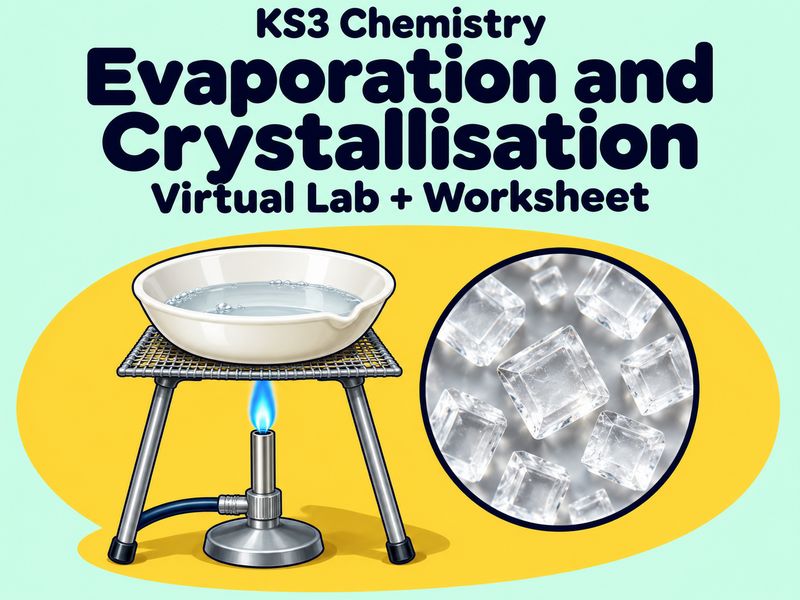
Grow salt crystals in a KS3 evaporation and crystallisation virtual lab. Includes a printable pupil worksheet and answer sheet.

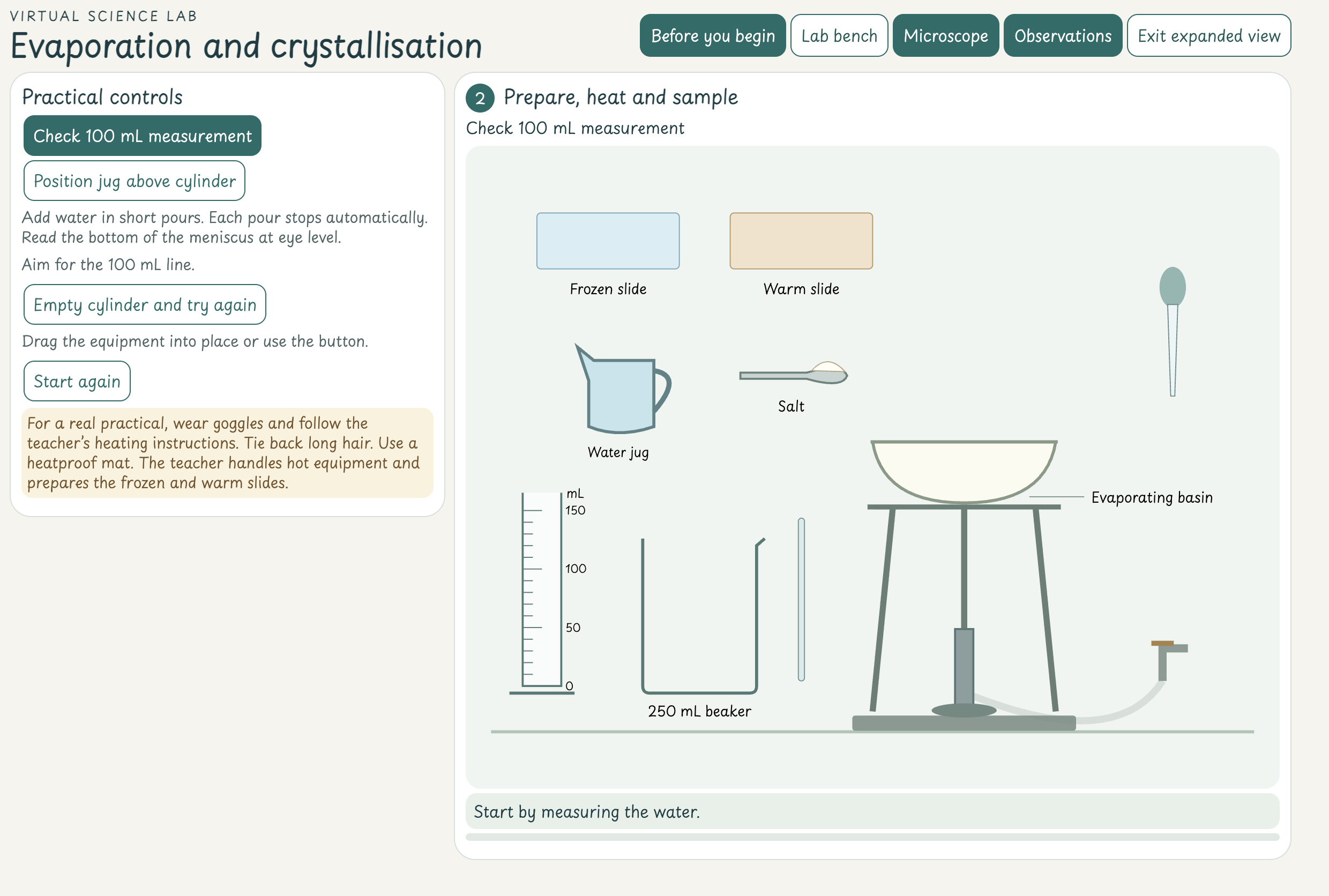
Which will produce larger salt crystals: a frozen slide or a warm slide? Pupils make a prediction, prepare a saturated salt solution and gently heat it until crystals appear at the edge of the evaporating basin. They then place a drop on each slide and use a virtual light microscope to see whether the evidence supports their prediction.

What pupils investigate

  • Saturation. Measure the water, add salt and stir until no more salt dissolves.
  • Evaporation. Transfer the clear solution to an evaporating basin. Watch for the first crystals at the edge and decide when to stop heating.
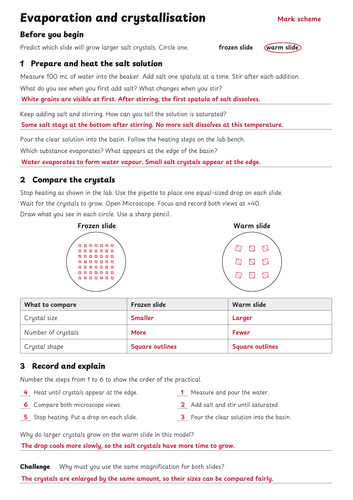
  • Crystallisation. Compare the size, number and shape of the crystals on both slides. In the simulation, the frozen slide produces many small crystals, while the warm slide produces fewer, larger crystals.
  • Fair comparisons. Focus the microscope on each slide using the same magnification. Explain why changing the magnification could make one sample appear to have larger crystals.

What’s included

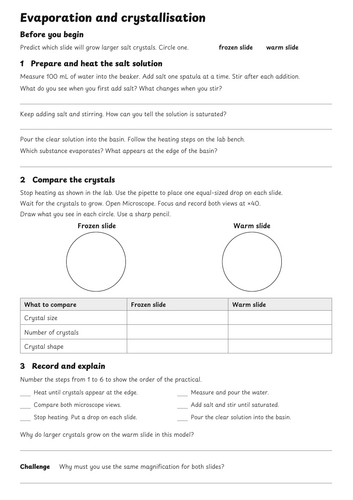
The interactive online experiment comes with a one-page printable worksheet and a completed answer sheet. Pupils record their prediction, compare their microscope observations in a table, put six practical steps in order and explain what happens to the water and the dissolved salt.

Where it fits in your scheme of work

Use this alongside the White Rose Science Year 7 lesson on Crystallisation and evaporation in the separation techniques unit. For Exploring Science, including Exploring Science International, and AQA Activate, use it when teaching mixtures and how to recover a dissolved solid from a solution.

For a whole-class lesson, project the lab and pause before revealing the microscope views. Pupils can sketch what they expect to see, then check their predictions against the crystals on each slide.

Get this resource as part of a bundle and save up to 33%

A bundle is a package of resources grouped together to teach a particular topic, or a series of lessons, in one place.

Bundle

KS3 and GCSE Science Virtual Labs – Growing Bundle

Explore 16 interactive KS3 biology and chemistry virtual labs with printable worksheets and mark schemes in one growing science bundle. Pupils dissect a stargazer lily, count stomata under a virtual microscope, separate the dyes in ink and use bubbling in test tubes to rank metals by reactivity. Each practical gives pupils something to observe, record and explain. Project a lab for the whole class while pupils work on paper, or let them repeat the investigation independently for revision. **Biology – 5 virtual labs** - **Desert plant adaptations.** Compare a saguaro cactus, an aloe and a violet. Use visible features to explain how plants collect and store water. - **Flower dissection.** Dissect a stargazer lily, examine pollen and open the ovary to find the ovules. - **Leaf cross-section.** Prepare a wet mount, focus the microscope and identify the tissues that help a leaf absorb light and exchange gases. - **Seed dispersal and germination.** Test four dispersal methods, then investigate how water, oxygen and temperature affect germination. - **Stomata and guard cells.** Make impressions of both leaf surfaces, count pores in six microscope fields and compare the mean counts. **Chemistry – 6 virtual labs** - **Dissolving.** Test sugar, salt and sand in water. Use balance readings and particle models to explain where dissolved sugar goes. - **Filtration.** Fold filter paper, separate sand from water and identify the residue and filtrate. - **Evaporation and crystallisation.** Heat a salt solution and compare the crystals that form on warm and frozen slides. - **Simple distillation.** Follow an ethanol and water mixture through boiling and condensation, then measure the distillate collected. - **Paper chromatography.** Separate three inks and use the pattern of spots to identify which contain more than one dye. - **Metal reactivity.** Compare magnesium, zinc, iron and copper in cold water and dilute hydrochloric acid. Test for hydrogen and use observations to build a reactivity series. **Where it fits in your scheme of work** Use the bundle alongside **White Rose Science** for Year 7 separation techniques and Year 8 plants and metal reactivity. For **Exploring Science**, including **Exploring Science International**, and **AQA Activate**, select individual labs when teaching mixtures and separation, reactions of metals, plant reproduction, leaf structure or adaptations. The printable worksheets give pupils a written record of their practical work, and the mark schemes support teacher marking or pupil self-assessment. The growing bundle currently contains all 11 labs listed above.

£15.00

Reviews

Something went wrong, please try again later.

This resource hasn't been reviewed yet

To ensure quality for our reviews, only customers who have purchased this resource can review it

Report this resourceto let us know if it violates our terms and conditions.
Our customer service team will review your report and will be in touch.