


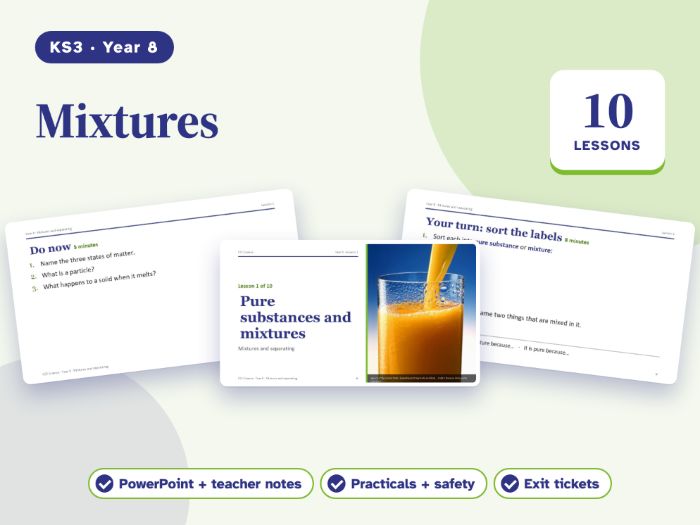
Pupils learn what pure means in science, how substances dissolve, and how to separate mixtures by filtration, crystallisation, distillation and chromatography, ending with elements, compounds and mixtures.
10 complete lessons for Year 8, ready to teach as editable PowerPoint.
The lessons
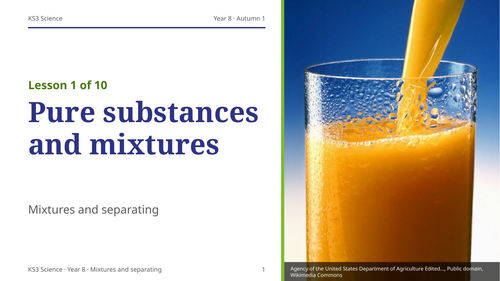
- Pure substances and mixtures: Explain what pure means in science.
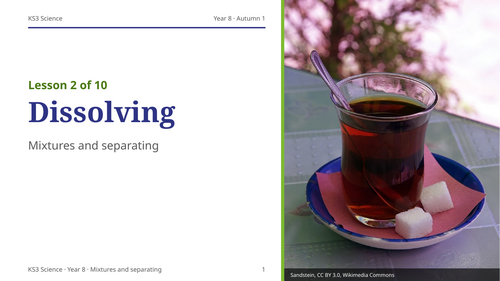
- Dissolving: Explain dissolving with particles and show that mass is conserved.
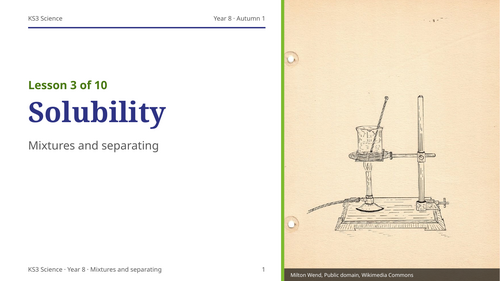
- Solubility: Investigate how temperature changes how much solute dissolves.
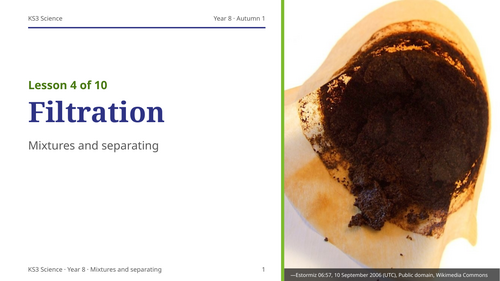
- Filtration: Separate an insoluble solid from a liquid.
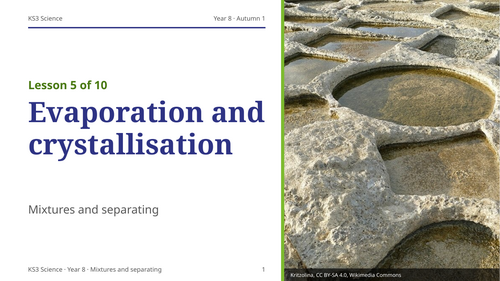
- Evaporation and crystallisation: Get a soluble solid back from a solution.
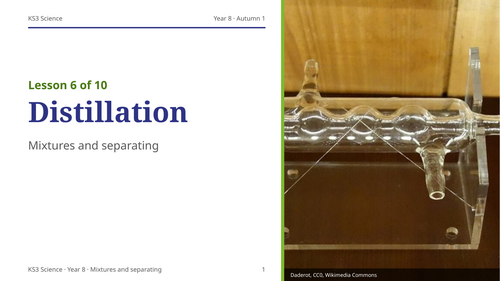
- Distillation: Explain how distillation separates a liquid from a solution.
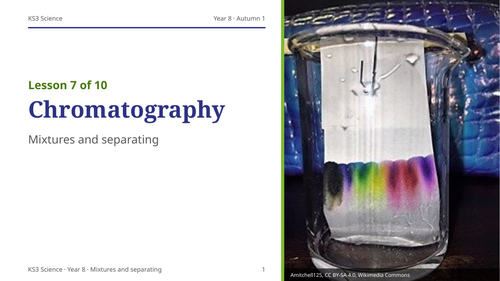
- Chromatography: Use chromatography to separate the dyes in an ink.
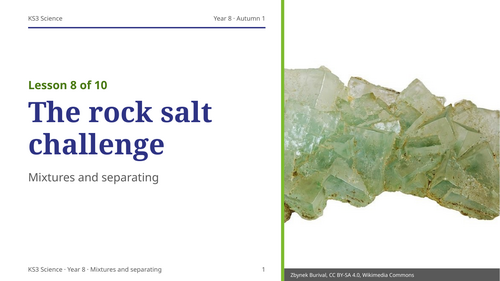
- The rock salt challenge: Plan and carry out a method to purify rock salt.
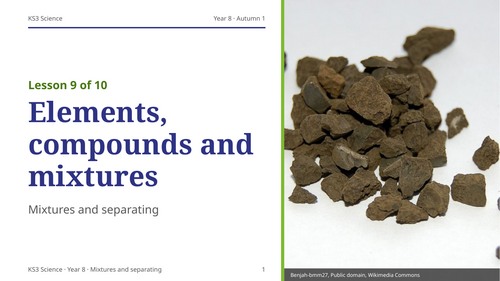
- Elements, compounds and mixtures: Tell elements, compounds and mixtures apart with particle diagrams.
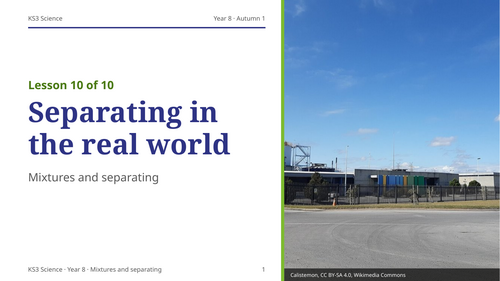
- Separating in the real world: Choose a separation method for a real problem and justify it.
Practicals and demonstrations: Dissolving salt in water on a balance; Dissolving sugar at 20, 35 and 50 °C; Filtering a sand and salt water mixture; Evaporating salt solution over a Bunsen burner; Demo: Distilling inky water with a Liebig condenser; Paper chromatography of felt-tip inks in water; Purifying rock salt by dissolving, filtering and evaporating; Demo: Separating an iron and sulfur mixture with a magnet; a sample of iron sulfide to compare.
Key words: pure, impure, mixture, solute, solvent, solution, soluble, insoluble, solubility, saturated, filtration, filtrate, residue, crystallisation, distillation, chromatography, element, compound.
Assessment: End-of-unit test (40 minutes) plus the rock salt practical write-up.
What is included
- 10 editable PowerPoint decks (12 to 14 slides each) with teacher notes on every slide
- A Do Now retrieval starter, with a photograph or diagram (credited on the slide)
- Practical slides with the method, equipment and safety notes, or a teacher demonstration
- Worked examples for the maths, with units
- Tasks with answer slides for self-marking
- A self-check and an exit ticket to close every lesson
- Picture credits slide in every deck
Everything is in real text boxes, so you can change wording, add your own slides and print handouts. Planned against the National Curriculum for science in England (Key Stage 3). Practicals are suggestions: check each against your school’s risk assessments and CLEAPSS guidance. British English throughout. Part of a complete KS3 Science course for Years 7 to 9.
Something went wrong, please try again later.
This resource hasn't been reviewed yet
To ensure quality for our reviews, only customers who have purchased this resource can review it
Report this resourceto let us know if it violates our terms and conditions.
Our customer service team will review your report and will be in touch.
£22.50