


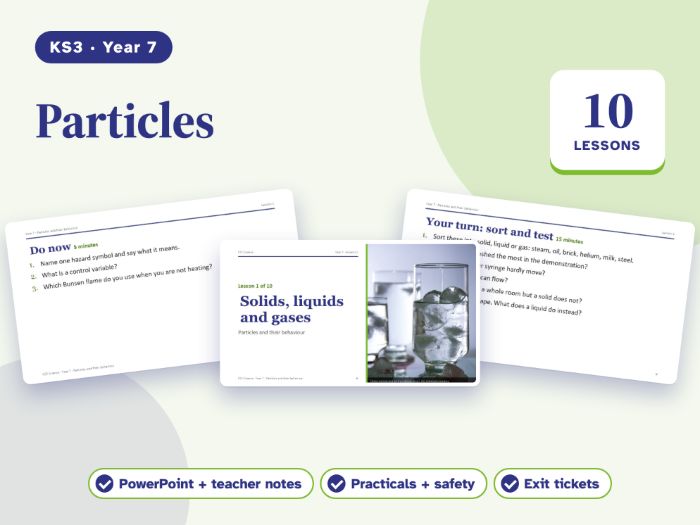
Pupils use the particle model to explain the properties of solids, liquids and gases, changes of state, density, diffusion, gas pressure and expansion.
10 complete lessons for Year 7, ready to teach as editable PowerPoint.
The lessons
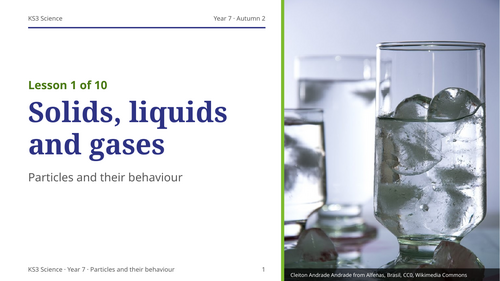
- Solids, liquids and gases: Describe the properties of the three states of matter.
- The particle model: Use particle diagrams to explain the properties of each state.
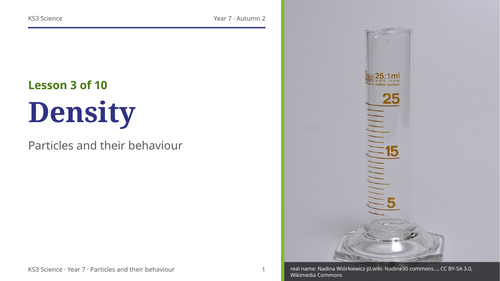
- Density: Calculate density and explain it with particles.
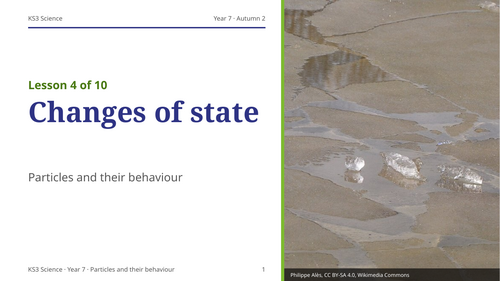
- Changes of state: Name and explain melting, freezing, boiling, evaporating, condensing and subliming.
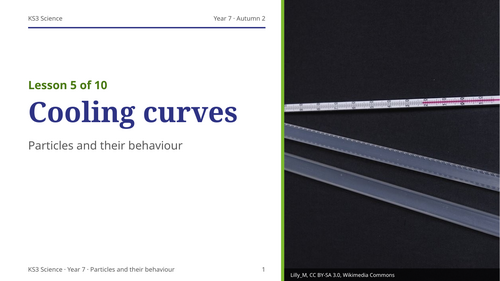
- Cooling curves: Plot a cooling curve and find a melting point.
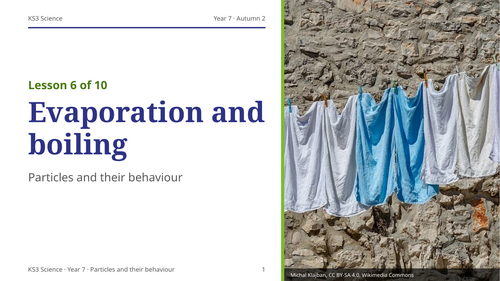
- Evaporation and boiling: Explain the difference between evaporation and boiling.
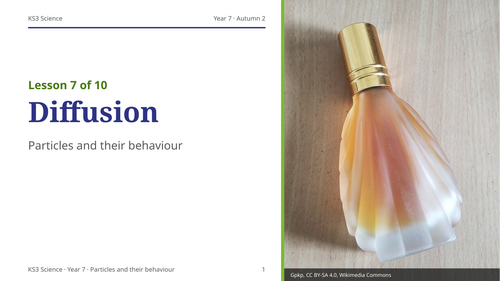
- Diffusion: Explain diffusion in liquids and gases.
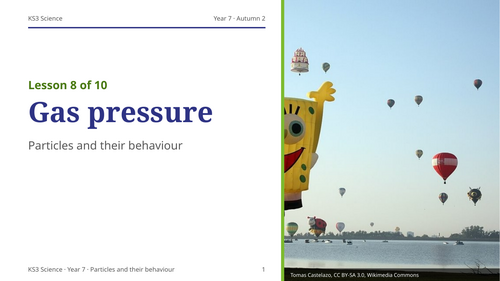
- Gas pressure: Explain gas pressure as particles hitting the walls of a container.
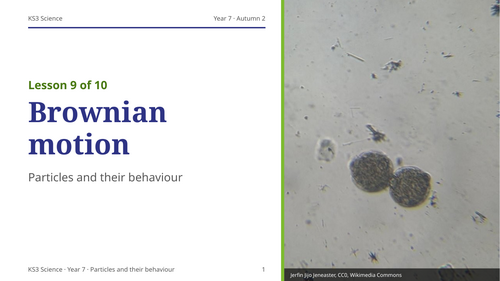
- Brownian motion: Describe and explain the random movement of tiny particles.
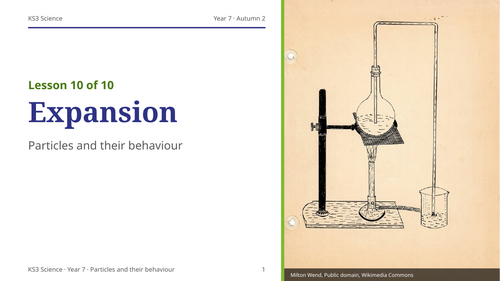
- Expansion: Explain why solids, liquids and gases expand when heated.
Practicals and demonstrations: Demo: Squashing sealed syringes of air, water and sand; Mass and volume of blocks; displacement can for an irregular object; Cooling curve of stearic acid in a boiling tube; Drying of wet paper towels with different surface areas; Demo: Ammonia and hydrogen chloride meeting in a long glass tube (teacher only); Demo: Collapsing can: a can with a little boiling water turned into cold water; Demo: Smoke cell under a microscope, or video; Demo: Heated metal ball and ring.
Key words: solid, liquid, gas, particle, particle model, density, melting point, boiling point, evaporation, condensation, sublimation, diffusion, gas pressure, Brownian motion, expansion.
Assessment: End-of-unit test (40 minutes), including a six-mark explanation: why a balloon shrinks in the freezer.
What is included
- 10 editable PowerPoint decks (12 to 13 slides each) with teacher notes on every slide
- A Do Now retrieval starter, with a photograph or diagram (credited on the slide)
- Practical slides with the method, equipment and safety notes, or a teacher demonstration
- Worked examples for the maths, with units
- Tasks with answer slides for self-marking
- A self-check and an exit ticket to close every lesson
- Picture credits slide in every deck
Everything is in real text boxes, so you can change wording, add your own slides and print handouts. Planned against the National Curriculum for science in England (Key Stage 3). Practicals are suggestions: check each against your school’s risk assessments and CLEAPSS guidance. British English throughout. Part of a complete KS3 Science course for Years 7 to 9.
Something went wrong, please try again later.
This resource hasn't been reviewed yet
To ensure quality for our reviews, only customers who have purchased this resource can review it
Report this resourceto let us know if it violates our terms and conditions.
Our customer service team will review your report and will be in touch.
£22.50